



Binance said on Nov. 8 that it has re-enabled withdrawals for Hyperliquid’s HYPE token and Aptos, two more assets returning after the October crypto exchange hack.
The official update, posted at 08:52 UTC, marked both tickers as new restorations and did not attach a network label to either name.
HYPE and APT were two of six tokens Binance named on Nov. 6, when it said it was working to reopen withdrawals for HYPE, INJ, APT, PLASMA, NEAR and LTC by the end of the following week.
For Bitcoin holders, the sharper comparison is earlier in the same recovery: native bitcoin withdrawal access on the BTC network was the first batch Binance said it opened, on Nov. 1.
The question now is how quickly the rest of that list follows HYPE and APT back online.
What Sunday’s Withdrawal Update Actually Changed
In its latest withdrawal update, Binance wrote that withdrawals have now been re-enabled for HYPE and APT.
The same post repeated an already-enabled list of Ethereum and Solana tokens from earlier November updates, rather than publishing a fresh inventory of every open route.
Binance said it would keep restoring additional assets and networks in phases as security checks are completed, with further updates coming through official channels.
We would treat that as an operational notice, not a claim that every withdrawal pair on the exchange is back to normal.

Four Tokens From Friday’s List Are Still Waiting
On Nov. 6 at 10:49 UTC, Binance said it was working to reopen withdrawals for HYPE, INJ, APT, PLASMA, NEAR and LTC by the end of next week.
Sunday’s “New” list named only HYPE and APT. It did not mention INJ, PLASMA, NEAR or LTC.
Binance has not published a complete board of remaining restrictions, so this is not proof those four are still blocked. It does mean they have not been confirmed the same way HYPE and APT were confirmed.
We would look for those four names, or a broader notice covering all tokens on restored networks, before calling the queue clear.
The Crypto Exchange Hack That Forced Withdrawals Offline
The work traces back to the theft the FBI tied to Binance on or about Oct. 29, 2026.
In a cyber alert, the bureau said North Korea was responsible for the theft of more than $6 billion in virtual assets from the exchange. The FBI refers to that activity as TraderTraitor and said stolen assets were being converted primarily into ether.
Binance began restoring withdrawals in phases at 06:00 UTC on Nov. 1. That morning, it said the first batch network opened in phase one was the Bitcoin network.
Later that day it listed BTC among already-enabled routes, alongside ether, BNB Smart Chain, XRP and Base, and said that by 12:36 UTC withdrawals had resumed for all 15 networks and assets in the initial phase.
Between 06:00 and 15:30 UTC on Nov. 1, Binance said it processed $4.649 billion in withdrawals and $1.01 billion in deposits, a net outflow of about $3.64 billion. That, it said, was 2.1% of $171 billion in assets under management based on Proof of Reserves data as of Oct. 28, 2026.
As we wrote when we followed an earlier recovery question around frozen ether on Arbitrum, getting customer assets moving again is the practical test after a breach.
HYPE and APT Are Lower, for Reasons Broader Than This Notice
CoinGecko data retrieved on Nov. 8 put HYPE near $77.00, down about 0.35% over 24 hours and about 12.04% over seven days. Aptos was near $0.586, down about 2.45% on the day and about 7.49% over seven days.
Bitcoin was near $75,900, up about 0.30% over 24 hours and down about 2.57% over seven days. Among other named tokens we could price, NEAR fell about 15.38% over seven days, litecoin about 7.30%, and Injective rose about 12.47%.
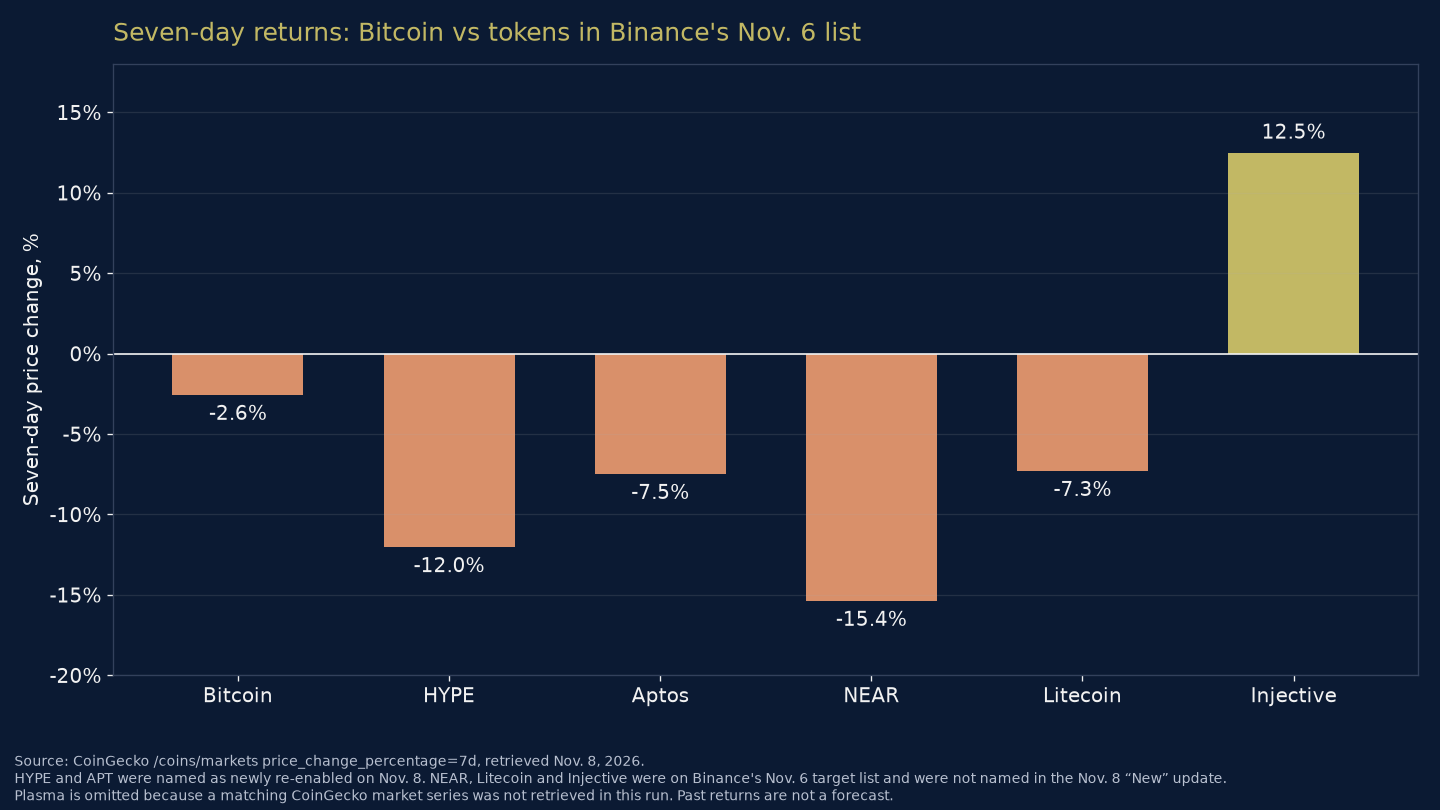
The price data does not show that Sunday’s notice caused those moves. Both tokens were already softer over the week.
Bitcoin’s milder decline fits the pattern we noted when bitcoin dominance crossed 60%: several large alternative tokens gave up more ground than BTC.
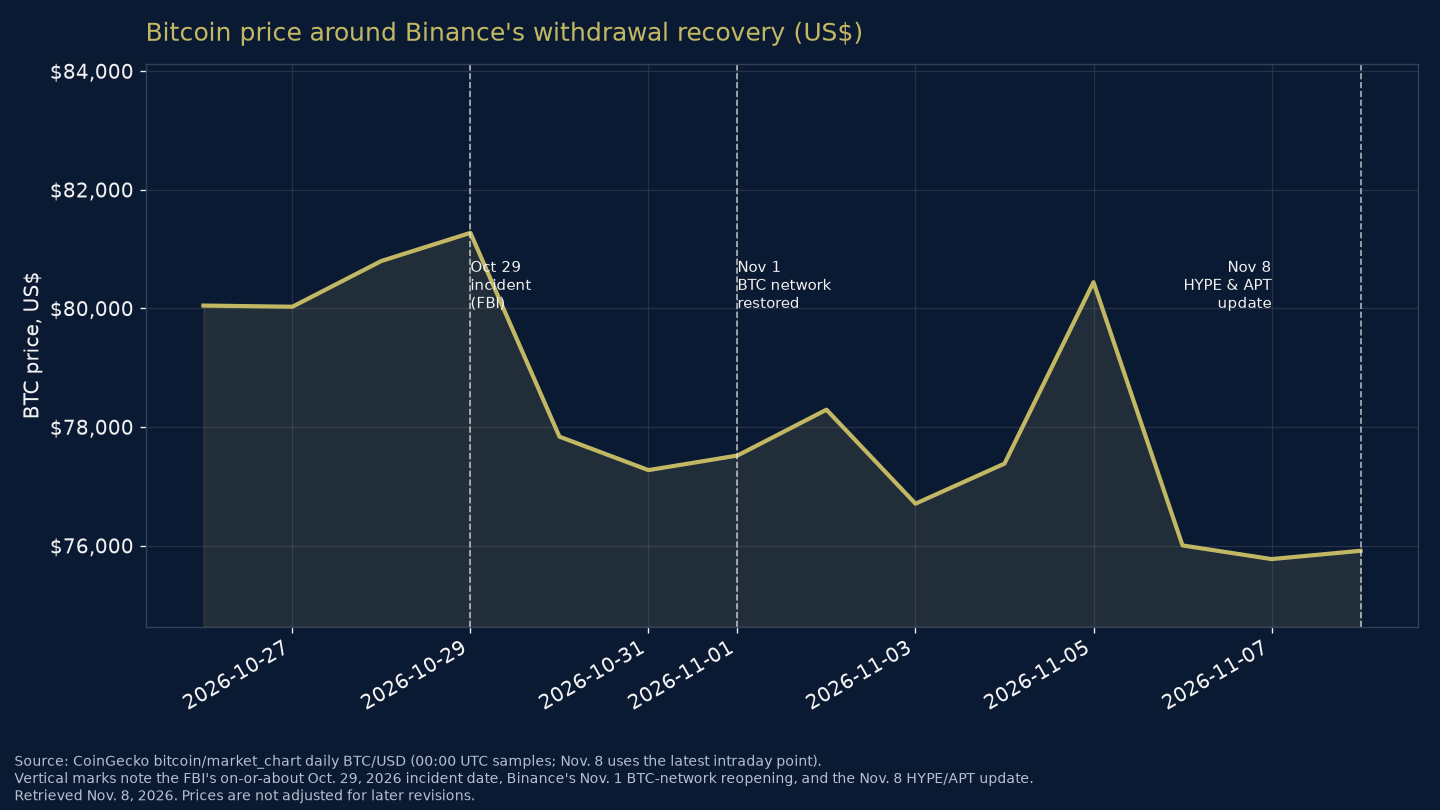
Daily CoinGecko samples show Bitcoin near $81,274 on Oct. 29, then $77,839 on Oct. 30, after the incident date the FBI cited. The latest Nov. 8 print was about $75,915. That path is a reset, not a disappearance of the bid.
Why a Bitcoin Withdrawal Still Belongs in Self-Custody
We believe Sunday’s notice is constructive because it returns choice to holders who have been waiting to move HYPE or APT off the exchange.
It does not erase the lesson of the past ten days. An exchange can pause outbound transfers while it checks wallets and networks, even when it later reopens routes in phases.
Bitcoin’s design is built for that moment. Once coins sit on the native BTC network in a wallet the holder controls, no exchange maintenance window sits between the owner and the asset.
That is the same point we have made about self-custody after other platform shocks. The first network Binance reopened on Nov. 1 was Bitcoin’s own chain, which tells us users wanted that exit first.
Separately, as we reported, Binance has set a Dec. 31 deadline for affected EU accounts after missing a MiCA license. That track is different from the post-hack queue, but both are reasons to keep BTC outside a single platform.
Before moving HYPE or APT, users should confirm the network Binance offers for that asset and ignore addresses or support contacts sent in replies or private messages.
We would look next for INJ, PLASMA, NEAR and LTC to be named as clearly as HYPE and APT were named today. If those follow, the October crypto exchange hack will look more like a recovery customers can verify with their own withdrawals.
Bitcoin’s fixed supply, and the fact that a bitcoin withdrawal does not depend on any one company’s queue, are why we stay constructive while that work finishes.
DC Forecasts is a leader in many crypto news categories, striving for the highest journalistic standards and abiding by a strict set of editorial policies. If you are interested to offer your expertise or contribute to our news website, feel free to contact us at [email protected]












Discussion about this post