



Bitcoin block size has not changed, yet the network just produced its second-densest block ever. Block 975,005, mined by AntPool at 00:04 UTC on Nov. 8, 2026, carried 11,360 transactions, according to mempool.space block data.
That beats the 11,255 transactions in block 974,961 from the evening before. Both now sit behind a single block from August 2015.
We believe this is a quiet stress test the network is passing. Here is what the numbers show.
How Did Bitcoin Block Size Limits Allow 11,360 Transactions?
Block 975,005 weighed 3,994,013 weight units, about 99.85% of the 4,000,000-unit consensus limit. On disk it measured 1,093,826 bytes, or roughly 1.09 MB.
The trick is the weight system. Since SegWit, Bitcoin counts block capacity in weight units rather than raw bytes, so compact transactions let miners fit far more entries into the same space.
That is the design working as intended: capacity is measured by what transactions cost to verify, and a block that is nearly full of small transactions is simply efficient use of the space.
Nothing about the rules changed. Miners simply filled a standard block with a very large number of small transactions.
The previous runner-up, block 974,961 mined at 18:24 UTC on Nov. 7, used 3,993,844 weight units for 11,255 transactions. Another AntPool block, 974,966, followed with 11,093.
Why Does a 2015 Block Still Hold the Bitcoin Transaction Record?
The all-time record belongs to block 367,853, mined by F2Pool on Aug. 1, 2015. It packed 12,239 transactions into 999,956 bytes, just under the original 1 MB ceiling.

The gap between that record and block 975,005 is 879 transactions, or about 7%. It is the closest challenger in more than a decade of blocks.
A record that old shows how rare extreme blocks are. For most of the past 11 years, no block came close.
Is This Dense Block Activity Normal for Bitcoin Right Now?
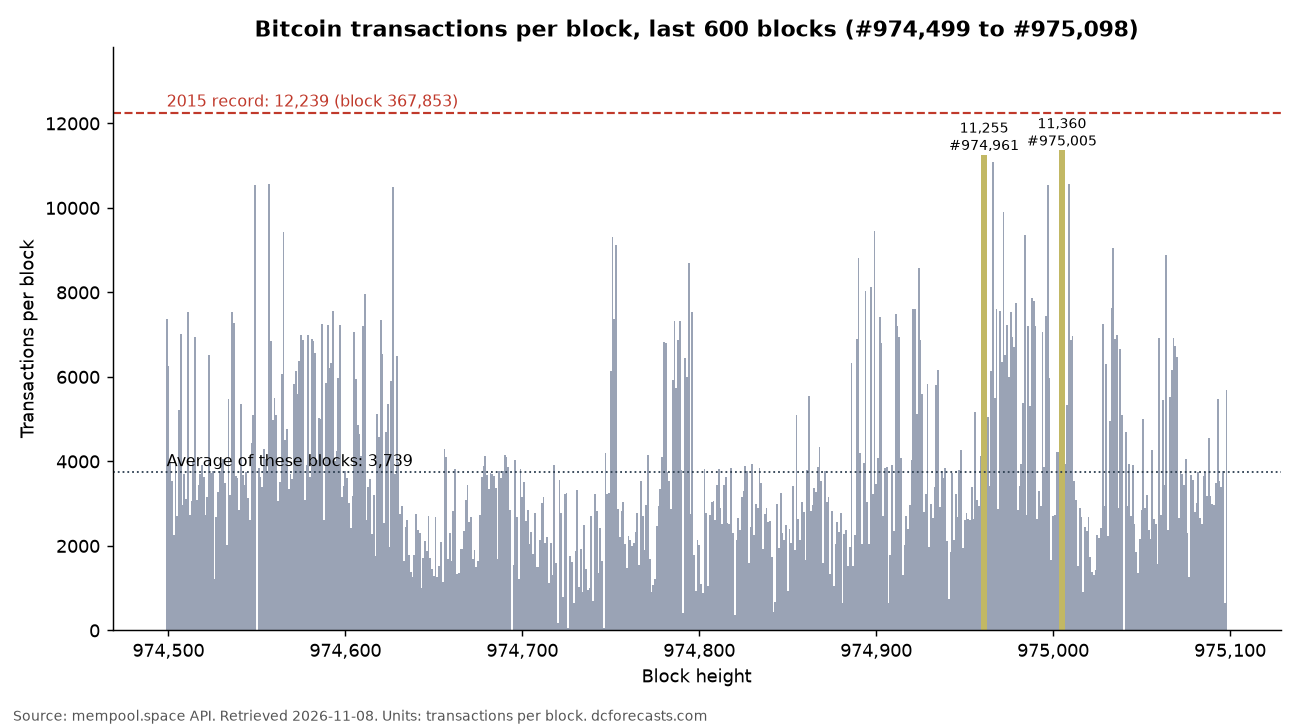
Not quite. Across the 600 most recent blocks we pulled, the average block held 3,739 transactions and the median was 3,226.
Eight of those blocks exceeded 10,000 transactions, and 21 reached at least 8,000. Dense blocks are clustering, not appearing as one-off events.
The chart shows the pattern clearly. Most blocks sit well below 5,000, then bursts of heavy activity push individual blocks toward the 2015 line.
For anyone following network usage, that is a sign the base layer is absorbing bursts without strain. Blocks kept arriving on schedule, and fees stayed low.
What Do Tiny Fees Say About Bitcoin Block Space?
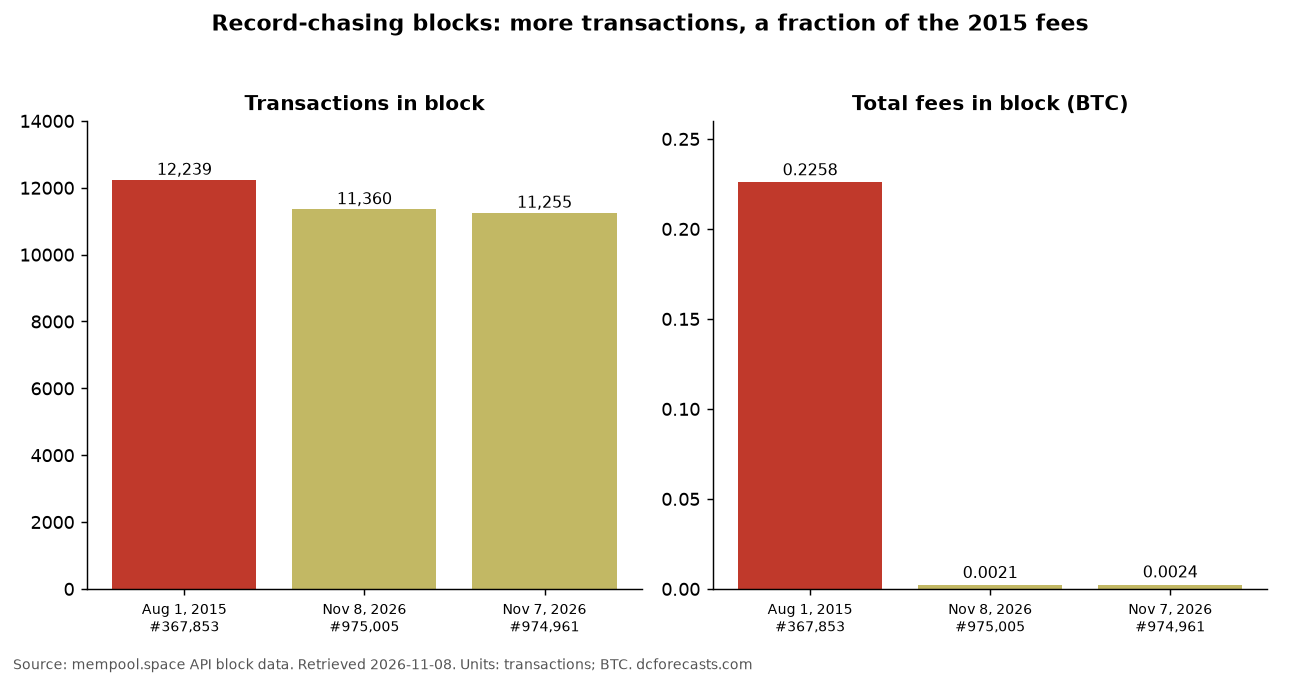
The fee data is the most revealing part. Block 975,005 collected 0.00207866 BTC in total fees, while block 974,961 collected 0.00240533 BTC. Compare that with the standard 3.125 BTC subsidy per block, and fees were well under 0.1% of the reward.
The 2015 record block earned 0.22582926 BTC in fees, roughly 100 times more than today’s near-record blocks.
This tells us the new blocks are not the product of a bidding war for space. They are many small transactions, not a rush of high-value transfers.
It also tells us block space is not scarce right now. The mempool recommended fee estimate on Nov. 8 stood at about 1 to 2 satoshis per virtual byte, so sending Bitcoin remains cheap for ordinary users.
Could Bitcoin Break the 12,239-Transaction Record Next?
It is possible. Eight 10,000-plus blocks in a short window mean the record is no longer out of reach, and miners have shown they can fill a block with more than 11,000 entries.
No one can say when or whether it will fall. A new record would depend on how many small transactions are broadcast and which miner happens to find the block.
We also see an important caveat. A transaction count says nothing about value moved, so a record would be a technical milestone rather than proof of surging demand. Fee levels today support that reading.
Still, the milestone matters. Bitcoin’s block weight limit has held steady since SegWit activated in 2017, and the network is still setting efficiency marks under that same limit.
That kind of steady, predictable base layer is what long-term holders value. Our earlier coverage of Bitcoin mining difficulty near 148 trillion shows the same story from the security side: a network that keeps getting stronger.
What Should Bitcoin Holders Take Away?
First, the network is healthy. Blocks are arriving on time, filling near the weight limit, and confirming thousands of transactions for fractions of a cent in fees.
Second, capacity is not the constraint. With fees near the minimum, there is room for far more activity before users feel any squeeze.
Third, records like this are worth watching because they show what the protocol can do without any change to its rules. We believe that resilience is a core part of the Bitcoin case.
Finally, a note on method. All figures here come from public block data retrieved on Nov. 8, 2026, so anyone can check block heights 975,005, 974,961 and 367,853 against the chain themselves.
We will keep tracking block data as the 2015 record comes into view.
DC Forecasts is a leader in many crypto news categories, striving for the highest journalistic standards and abiding by a strict set of editorial policies. If you are interested to offer your expertise or contribute to our news website, feel free to contact us at [email protected]











Discussion about this post