



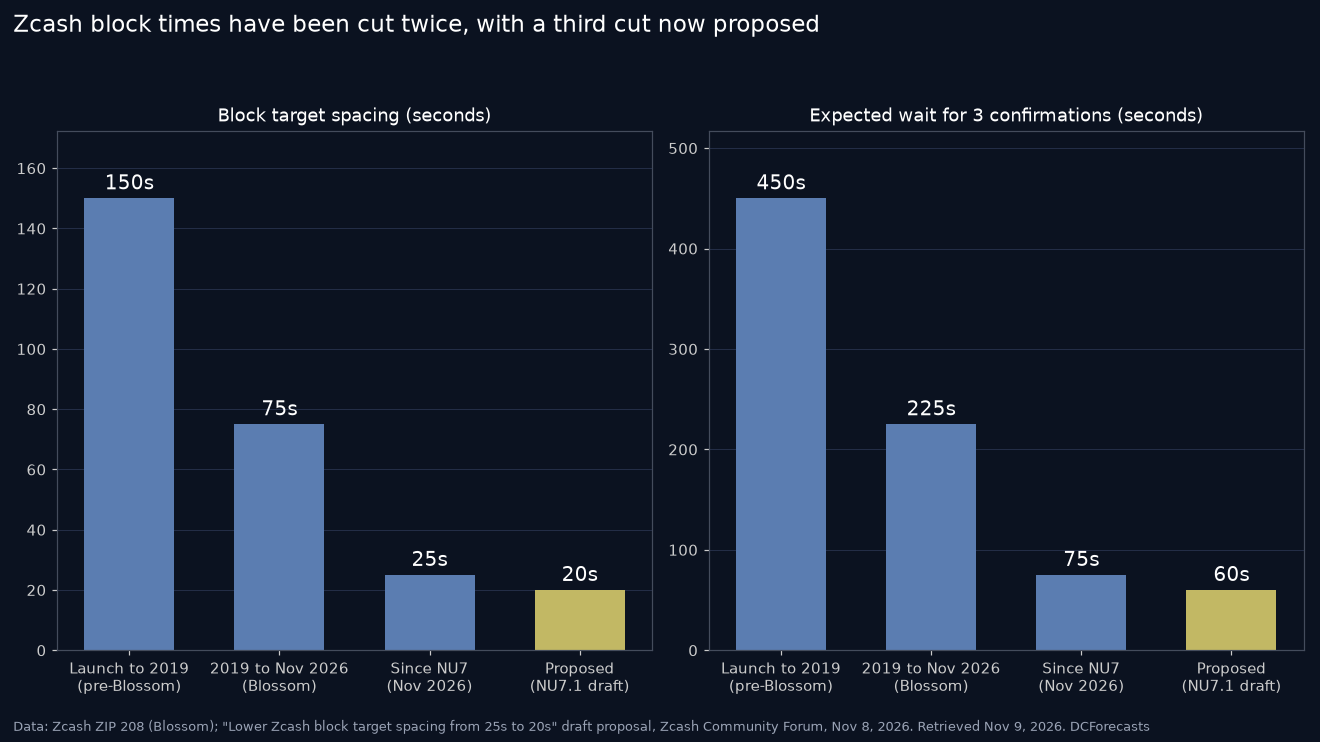
Zcash mining could be headed for another change of pace. Three days after the NU7 upgrade cut the network’s block target from 75 seconds to 25, two developers have proposed trimming it again, to 20 seconds.
The draft, posted to the Zcash Community Forum on November 8 by Dev Ojha (known on the forum as ValarDragon) and Evan Forbes, asks for a spot in the next community poll and a place in a small follow-up upgrade called NU7.1. It has not been approved and has no activation date.
What makes the plan notable is what it leaves alone. Daily issuance, daily shielded capacity and the 2 MB block size would all stay where they are. The only goal is to make payments confirm faster.
Why Developers Want Faster Blocks Again
The authors argue that every transaction waits for a block, even when blocks are almost empty. That delay adds friction at a shop’s checkout, on exchange deposits and in cross-chain swaps, where market makers want at least one confirmation before they act.
They say 25 seconds was never meant to be the final stop. It was the next step on a path that started with the 2019 Blossom upgrade, which halved Zcash’s original 150-second target to 75 seconds under ZIP 208.
At 20 seconds, the expected wait for a first confirmation drops by five seconds. For an exchange that asks for three confirmations, the expected wait falls from 75 seconds to 60. Real waits still vary, because miners find blocks at random intervals.
What Changes for Zcash Mining and Issuance
More blocks per day would normally mean more new coins per day. The draft avoids that by scaling the per-block subsidy by four-fifths and stretching the halving interval from 5,040,000 blocks to 6,300,000. In wall-clock terms, miners as a group would earn new ZEC at the same daily rate.
Several other settings scale the same way. The difficulty averaging window would grow from 102 to 128 blocks, keeping it near 2,560 seconds. Default transaction expiry would move from 120 to 150 blocks. The recommended anchor depth would stay at three blocks, which would mean 60 seconds instead of 75.
Shielded limits per block would shrink by the same four-fifths. Orchard and Ironwood actions would each fall from 330 to 264 per block, and Sapling inputs plus outputs from 300 to 240. The authors chose this so that the worst-case data a light wallet must download and scan each day stays exactly the same.

Do Faster Blocks Mean More Orphans?
The main risk in shorter block times is orphan rates, meaning valid blocks that lose a race and get discarded. The developers tested 20-second blocks on an 80-miner network spread evenly across 12 regions, using full 2 MB blocks under worst-case load.
A network running only the Zakura node software lost 1.9% of blocks. A 50-50 mix of Zakura and Zebra-Andele lost 3.3%. For comparison, the experiment used to approve 25-second blocks recorded 4.68%, against 3.26% in its theoretical model.
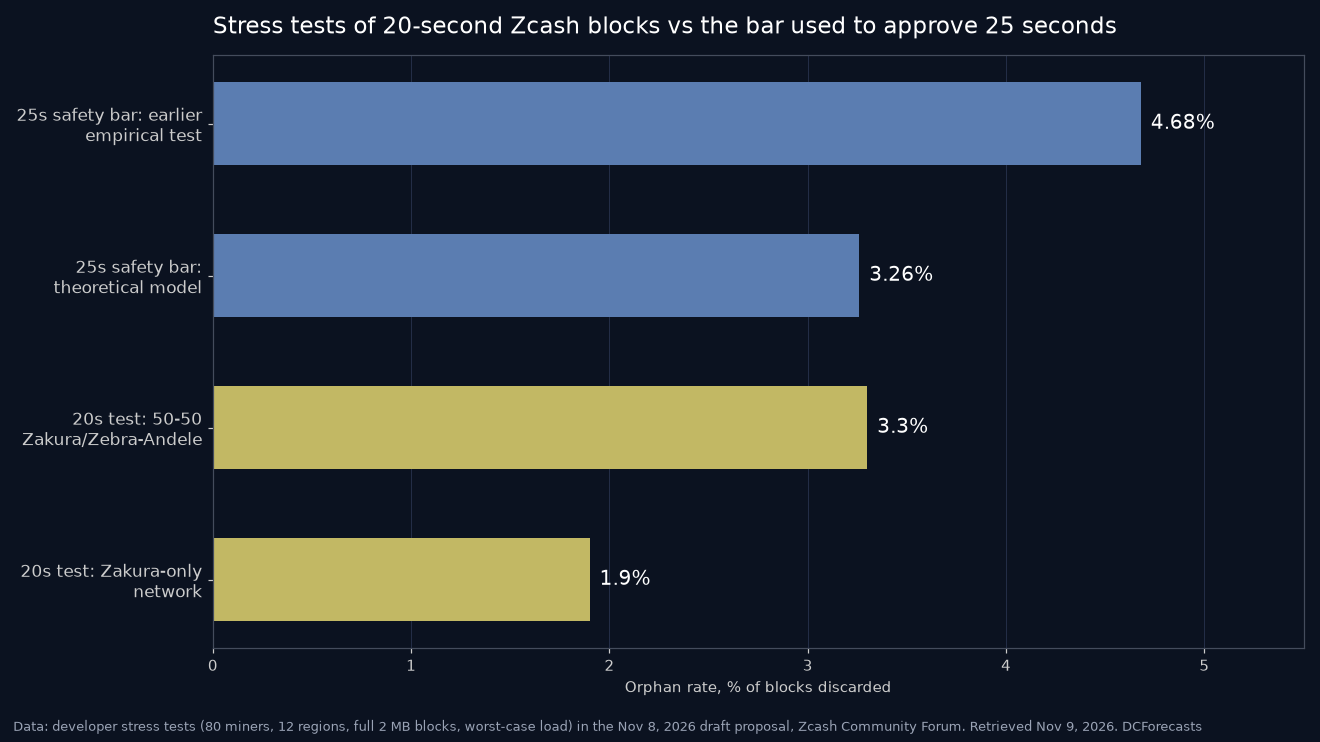
Ojha added in the thread that Zcash’s live orphan rate since NU7 is lower than it was before the upgrade. The authors also expect real-world results to beat the test, since actual mining is more geographically clustered than their simulated network. Test results don’t guarantee live performance, and that is what the community poll will need to weigh.
The Security Question
A familiar objection is that each confirmation means less when blocks come faster. The draft’s answer depends on the threat. Against a minority attacker, security grows exponentially with each confirmation, so only a slightly higher count is needed. Against a well-funded attacker, the block reward built on top of a payment matters most, and that stays the same per minute.
The authors add that services which set confirmation rules by time or by accumulated work would not need to change anything. Node operators would see bandwidth rise by about a quarter, which Ojha put at roughly 100 KB per second at peak.
Bitcoin Takes the Opposite Approach
The debate is a useful contrast with Bitcoin. The Bitcoin block time target has stayed at 10 minutes since launch, putting predictability and global decentralization ahead of raw speed. That steady rhythm also anchors its fixed supply schedule, which we tracked in our countdown to the next Bitcoin halving.
Bitcoin has pushed faster payments into layers such as Lightning instead of changing its base layer, while its hashrate, covered in our latest network report, keeps settlement among the most secure in crypto. Zcash, by contrast, is tuning its base layer to work as everyday private cash.
What Comes Next for ZEC
The proposal now goes to discussion, then to a community poll. Some forum replies already question whether 20 seconds is the best number, and others argue that big latency gains will need deeper consensus changes.
Ojha’s view is that the next major gain after 20 seconds should come from doubling the maximum block size once wallet improvements are ready. For now, the plan offers quicker confirmations with no change to supply, and it gives NU7.1 a clear first question. Our earlier NU7 coverage explains how the network reached 25 seconds.
DC Forecasts is a leader in many crypto news categories, striving for the highest journalistic standards and abiding by a strict set of editorial policies. If you are interested to offer your expertise or contribute to our news website, feel free to contact us at [email protected]












Discussion about this post