



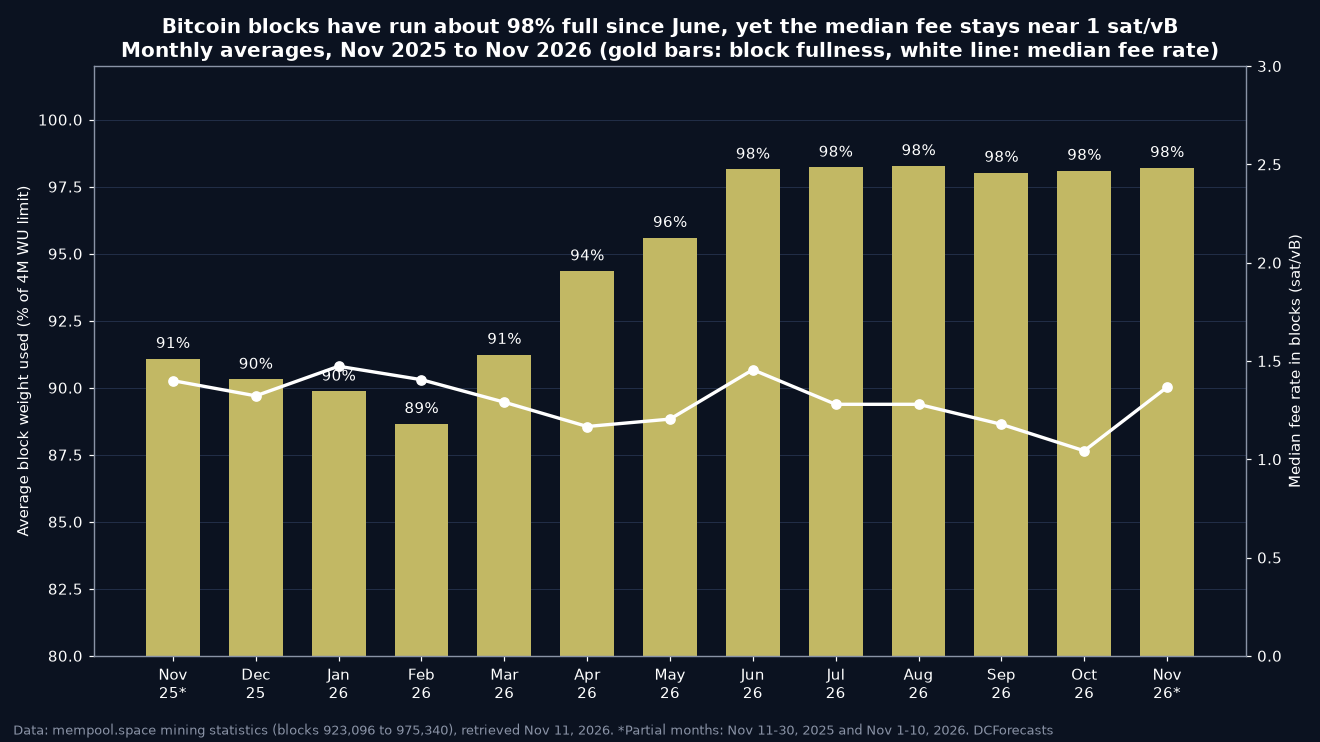
Bitcoin fees are telling an unusual story this autumn. Blocks have been running about 98% full since June, yet the typical transaction still pays roughly 1 satoshi per virtual byte to get in.
That combination is rare. Full blocks usually mean bidding wars and painful costs for ordinary users.
Instead, mempool.space mining data covering the past year shows steady demand for block space and almost no fee pressure. We believe that says something positive about how the network is being used right now, and it also raises a fair question about the years ahead.
Blocks are fuller than they were a year ago
Every Bitcoin block can carry up to 4 million weight units. Mempool.space tracks how much of that limit miners actually use.
From November 2025 to March 2026, the monthly average sat between roughly 89% and 91%. It climbed to 94% in April and 96% in May.
Since June, it has not moved much. Every full month from June through October averaged about 98%, and the first ten days of November did the same.
Put simply, there is very little empty room left in the average block. Demand for space on the base layer has not gone away during the price pullback.
Why Bitcoin fees stay so low in full blocks
The surprise is on the price side. The median fee rate paid inside blocks averaged between 1.04 and 1.47 sat/vB in every month of the past year.
October 2026 was the cheapest month in the series at 1.04 sat/vB. The first ten days of November averaged 1.37 sat/vB.

The live picture matched. Shortly after midnight UTC on November 11, mempool.space showed about 61,700 unconfirmed transactions waiting, worth roughly 31 million virtual bytes. Even so, its fastest recommended fee was just 2 sat/vB.
So there is a queue, but most of it is patient, low-priority traffic. Users who want a quick confirmation are not being forced to outbid a crowd.
By our own estimate, a simple SegWit payment of around 140 virtual bytes would cost about 140 to 280 satoshis at those rates. With BTC near $73,700 on CoinGecko, that is roughly 10 to 20 US cents.
What the btc fees data means for users
For anyone moving coins today, this is close to an ideal setting. Settlement on the most secure blockchain costs less than a postage stamp.
It is also a good window for housekeeping. Consolidating small outputs, moving coins to fresh addresses or shifting funds into cold storage is cheap when fee rates sit near the floor.
We see that as a practical strength. A network that stays affordable while its blocks are nearly full is handling real activity without pricing out everyday holders.
Bitcoin transaction fee markets can change fast, though. The single most expensive stretch in the year of data came on February 5, 2026, when one mempool.space sampling period averaged about 0.081 BTC in fees per block, more than three times the recent norm.
Miners still earn almost everything from the subsidy
The other side of cheap fees is miner revenue. Each block currently pays a fixed subsidy of 3.125 BTC, and fees sit on top of that.
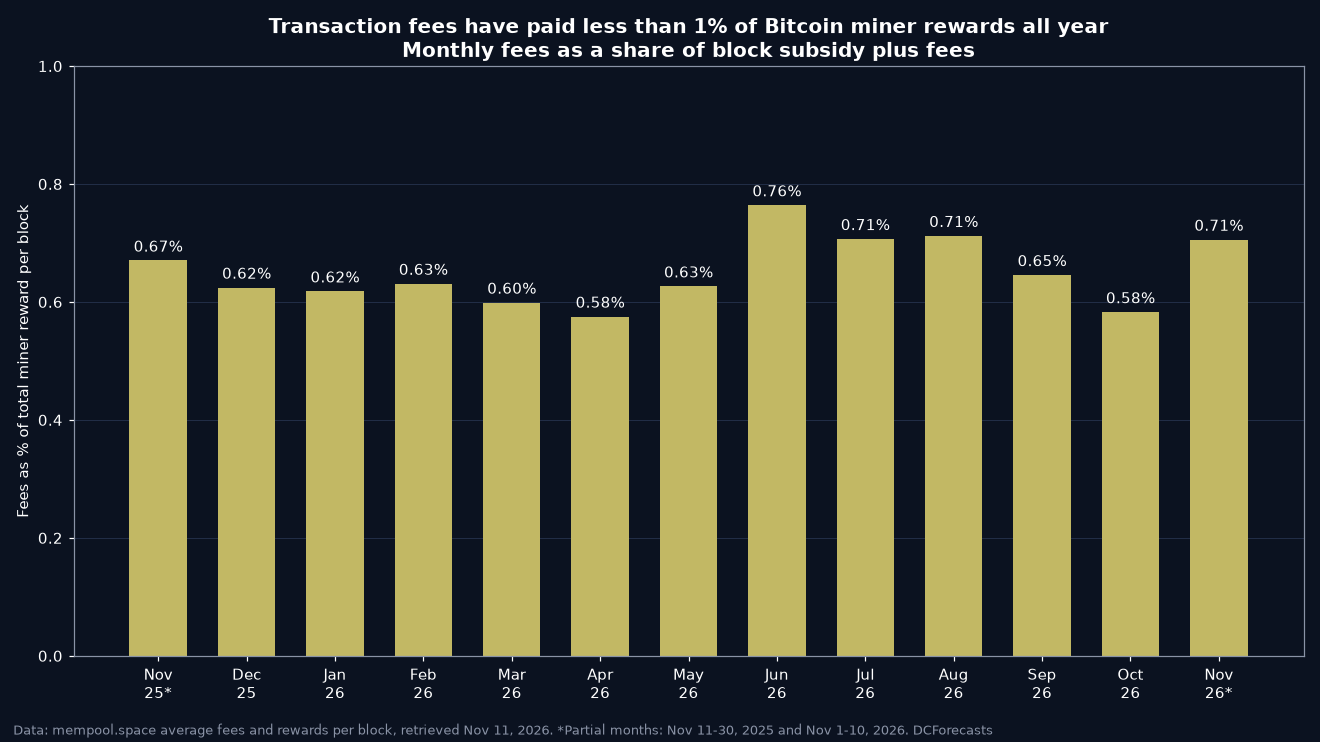
Across the past year, fees made up between 0.58% and 0.76% of total miner rewards in every month. Over the last seven days they averaged about 0.024 BTC per block, or close to $1,750 at today’s price.
That reliance on the subsidy matters because the subsidy halves roughly every four years. The next cut is due at block 1,050,000, about 74,600 blocks from the current height of 975,359, which points to roughly the spring of 2028.
Miners are already adjusting to tighter margins. Blocks have recently averaged about 10.8 minutes, and mempool.space projects a difficulty cut of around 7% at the next retarget. We covered that shift in our look at the upcoming Bitcoin difficulty cut.
Is the security budget a problem?
This is the honest debate behind the numbers. Over the long run, Bitcoin’s design expects fees to carry more of the cost of securing the chain as the subsidy shrinks.
Today’s data shows fees are nowhere near that role yet. That is a real long-term question, and we would not dismiss it.
But the trend in block fullness is constructive. Demand for block space has risen through 2026 even with low fee rates, which shows people keep choosing to settle on the base layer.
Fee markets have also surged before when demand spiked, as February’s brief jump showed. Fuller blocks mean the network is closer to the point where extra demand turns into higher fees for miners.
Miners also benefit directly from a higher Bitcoin price, since the subsidy is paid in BTC. Large operators are also reshaping their balance sheets for leaner times, as MARA’s latest quarter showed.
What to watch next
Three things will show whether this calm fee market is changing. The first is the median fee rate: a sustained move above 2 to 3 sat/vB would signal real competition for space.
The second is the mempool backlog. A queue that grows while fast fees rise would point to fresh demand rather than patient filler.
The third is the fee share of miner rewards, which has stayed below 1% all year. A clear break above that line would be an early sign that fees are starting to share the security load.
For now, the data paints a network that is busy, cheap to use and still growing into its long-term fee model. We believe that is a healthy place for Bitcoin to be as it heads into 2027.
DC Forecasts is a leader in many crypto news categories, striving for the highest journalistic standards and abiding by a strict set of editorial policies. If you are interested to offer your expertise or contribute to our news website, feel free to contact us at [email protected]












Discussion about this post