



U.S. debt rose to $40.56 trillion on Nov. 9, according to the Treasury Department’s daily Debt to the Penny data. That is $2.43 trillion more than a year earlier, an increase of 6.4%.
Spread over 364 days, that works out to about $6.7 billion of new federal debt every day. Over the same 12 months, the supply of Bitcoin grew by 0.82%, and that rate is fixed in the network’s code.
The comparison sums up why many investors treat Bitcoin as a long-term hedge against government borrowing. One supply is set by Congress and the Treasury’s financing needs. The other follows a schedule written in 2009 that nobody can change on their own.
U.S. Debt Doubled From $20 Trillion in Under Nine Years
Total public debt outstanding first passed $20 trillion on Sept. 8, 2017. It crossed $30 trillion on Jan. 31, 2022, and $40 trillion on Aug. 18, 2026. Doubling from $20 trillion to $40 trillion took less than nine years.
The pace has also picked up in round-number terms. The debt went from $37 trillion on Aug. 11, 2025, to $38 trillion on Oct. 21, 2025, $39 trillion on March 17, 2026, and $40 trillion on Aug. 18. That is $3 trillion in just over a year.
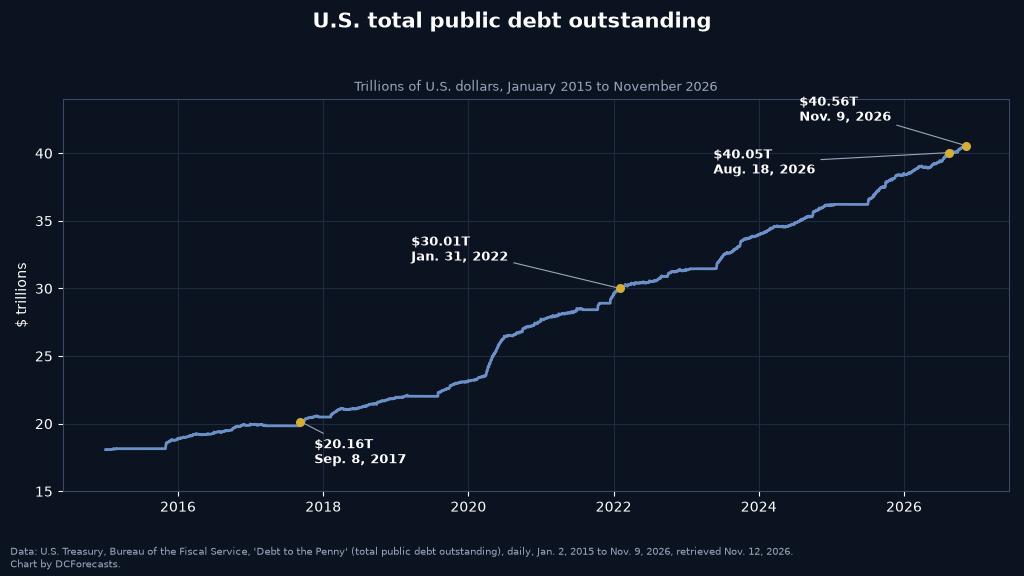
The flat stretches in the chart line up with periods when the debt limit was binding and the Treasury used accounting measures to avoid new borrowing. Each time, the debt jumped once the limit was raised or suspended.
Of the $40.56 trillion total, $32.76 trillion is held by the public, including investors, banks and foreign governments. The other $7.80 trillion is owed to government accounts such as trust funds.
The new fiscal year has started the same way. Fiscal 2026 ended on Sept. 30 with debt at $40.17 trillion, up $2.53 trillion from a year earlier. From Oct. 1, when the total stood at $40.26 trillion, to Nov. 9, about $300 billion more was added.
Bitcoin’s Supply Growth Keeps Shrinking
Bitcoin’s supply works in the opposite direction. New coins enter circulation only as block rewards to miners. That reward is cut in half roughly every four years, and the total can never exceed 21 million BTC.

At midnight UTC on Nov. 9, the Bitcoin blockchain was at block 975,113. Under the reward schedule, that means about 20.11 million BTC have been issued, or 95.8% of the maximum. Only about 890,000 BTC remain to be mined over the next century or so.
To put that in context, Strategy alone holds 850,364 BTC, as we reported in our look at Strategy’s Bitcoin holdings. That is almost as much Bitcoin as will ever be mined from now on.
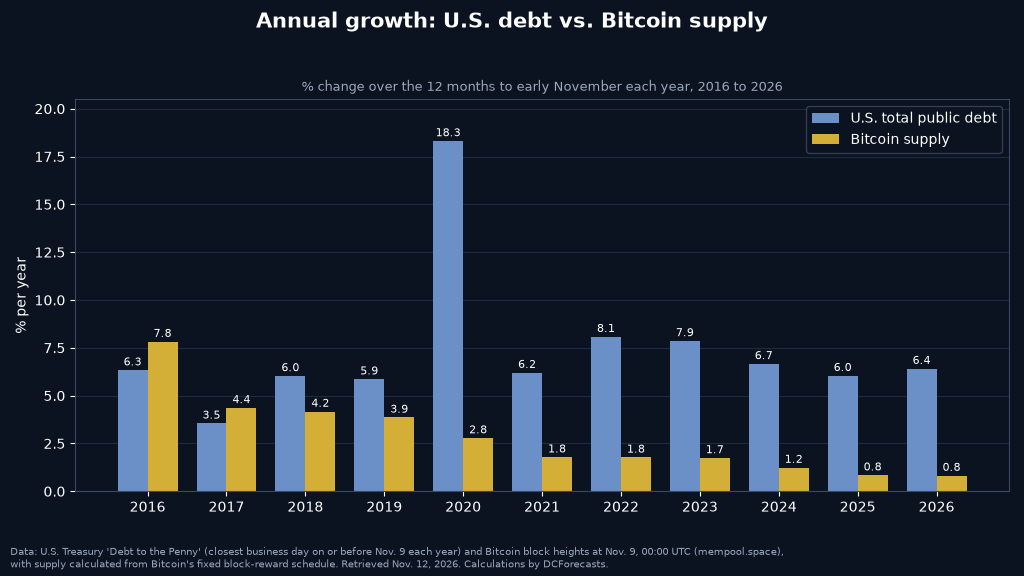
The chart shows how the two growth rates have moved apart. In the year to November 2016, Bitcoin’s supply grew 7.8%, faster than the 6.3% rise in U.S. debt. That was the last year Bitcoin’s supply grew faster.
Since then, Bitcoin’s supply growth has stepped down after each halving, to 1.8% in 2021 and 0.82% now. U.S. debt growth has not followed. It peaked at 18.3% in the 12 months to November 2020 and has stayed between 6.0% and 8.1% every year since.
Why This Matters for Bitcoin Investors
Federal debt is not the same as the money supply, and a rising debt does not translate one-for-one into inflation. But large and lasting deficits do shape how investors think about the long-term value of the dollar and of bonds.
That debate is already showing up in other data. We recently reported that M2 money supply reached a record $23.4 trillion, growing at its fastest pace since 2022. Our gold vs. Bitcoin analysis also looked at how the two scarce assets have traded against each other this year.
In the short term, Bitcoin trades on rates and risk appetite. Its price slid toward $74,000 this week as bets on a Fed rate hike jumped. A rising debt load does not stop those swings.
Over longer periods, though, the gap between a supply that grows by trillions of dollars a year and one that grows by less than 1% is the core of the Bitcoin thesis. The next halving, expected in 2028, will cut Bitcoin’s issuance rate roughly in half again.
The Numbers to Watch
- $41 trillion. At the pace of the past year, about $6.7 billion a day, U.S. debt would reach $41 trillion in roughly two months.
- Debt held by the public. At $32.76 trillion, this is the part of the debt that markets have to absorb through Treasury auctions.
- 0.82% and falling. Bitcoin’s annual supply growth will stay near this level until the next halving, then drop to about 0.4%.
Washington’s borrowing has kept growing through every kind of market, with stops only during debt-limit standoffs. Bitcoin’s issuance has followed its schedule block by block for almost 18 years. For investors who want an asset whose supply cannot be expanded to meet a budget, that contrast is hard to ignore.
DC Forecasts is a leader in many crypto news categories, striving for the highest journalistic standards and abiding by a strict set of editorial policies. If you are interested to offer your expertise or contribute to our news website, feel free to contact us at [email protected]












Discussion about this post