


The fight over CFTC prediction markets oversight moved to two more states on Friday, and it moved fast.
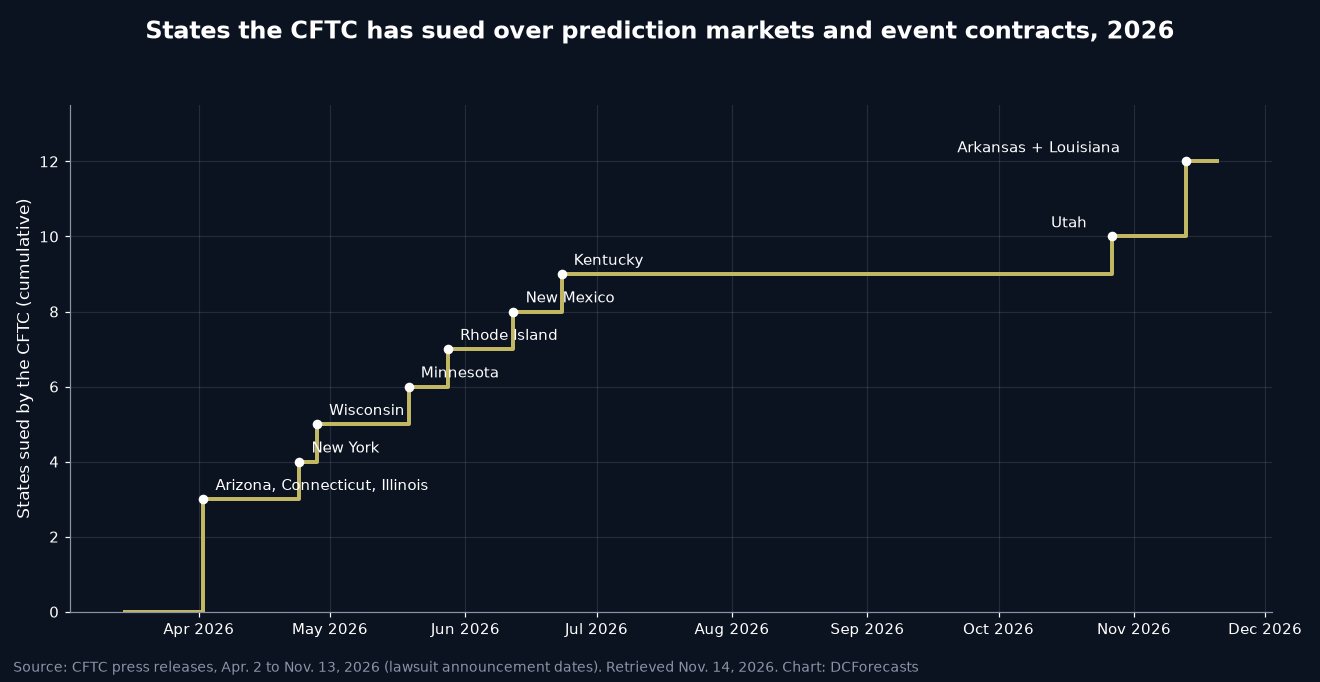
On Nov. 13, the Commodity Futures Trading Commission announced lawsuits against both Arkansas and Louisiana. They are the 11th and 12th states the agency has taken to court in 2026 to defend its claim to sole authority over event contracts.
The Louisiana case stands out. A state court there had ordered more than 30 companies shut down a day earlier, and the CFTC says those companies never got a chance to respond.
Behind the legal language is a simple question with real money attached: who gets to regulate a market that trades on the outcome of future events, Washington or each state on its own?
What the CFTC Says Louisiana Did
According to the agency’s Louisiana announcement, the state obtained a court order on Thursday, Nov. 12, shutting down more than 30 companies in the state linked to trading CFTC-regulated derivatives.
The CFTC says the order came without notice to the defendants or an opportunity to be heard. Its own suit asks a federal court to stop Louisiana from banning event contracts offered by CFTC-regulated exchanges, brokers and clearinghouses.
Chairman Michael Selig did not soften his words. “Event contracts have traded openly in Louisiana for years, in compliance with the Commodity Exchange Act and CFTC regulations,” he said.
He called the state’s “eleventh-hour ’emergency’ lawsuit” an attempt “to shut down the entire prediction market industry” and described it as “naked lawfare and a cynical political stunt.”
The CFTC says its goal is to keep the status quo in place while federal courts decide the issue in an orderly way.

Arkansas Targeted Kalshi Directly
The Arkansas suit has a narrower trigger. The state is pursuing a civil enforcement case in state court against Kalshi, a CFTC-designated contract market.
The CFTC says Arkansas is trying to halt event-contract trading and impose civil penalties that could reach hundreds of millions of dollars on CFTC-registered exchanges.
In the agency’s view, those efforts are preempted by federal law because the exchanges operate under the Commodity Exchange Act.
Selig said prediction markets “continue to prove their value in being useful for risk management and providing the public with valuable information about the future.”
For traders following the Kalshi lawsuit cases, the federal regulator is now firmly on the exchange’s side in a growing list of states.
Twelve States in Seven Months
The campaign began on April 2, when the CFTC sued Arizona, Connecticut and Illinois on the same day. New York, Wisconsin, Minnesota, Rhode Island, New Mexico and Kentucky followed by late June.
Utah became the 10th state on Oct. 27. Arkansas and Louisiana brought the count to 12.
The CFTC has also filed amicus briefs in four federal courts of appeal and one state supreme court, according to its releases.
That pace tells us the agency sees this as a core fight, not a side issue. It has repeatedly pointed back to Congress, arguing lawmakers chose a single national framework for commodity derivatives over a patchwork of state rules.
Why Event Contracts Became a Federal Fight
Event contracts are not new. The CFTC notes it first recognized them in 1992, when it allowed the Iowa Electronic Markets to list contracts tied to elections and company earnings.
What changed is scale. Contracts now cover sports, politics, economics and crypto prices, and mainstream brokers have jumped in. Robinhood recently reported 5.9 billion prediction market contracts traded on its platform.
States see many of these products as gambling that should fall under their own gaming laws. Exchanges and the CFTC see them as federally regulated derivatives.
Scrutiny is also coming from Congress. A House Oversight memo recently found that Polymarket and Kalshi caught most insider trades before turning its attention to officials.
What It Means for Crypto Platforms
This is not only about sports or election bets. The same jurisdiction question sits under the CFTC’s wider plans for crypto.
In October, the agency sought comment on a proposed framework for crypto asset transactions, including a registration path for platforms offering leveraged or margined crypto trading to retail customers.
Selig told CNBC this week that new entrants would rather get “a license at the CFTC” than sign up with 50 state regimes.
We believe a clear federal rulebook is good news for Bitcoin and the wider market. One set of rules lowers costs, keeps activity onshore and makes it easier for regulated firms to serve customers nationwide.
A loss in court, however, could push event contracts, and possibly other derivatives products, back toward state-by-state licensing.
What to Watch Next
The key decisions now sit with federal judges. Rulings on whether federal law preempts state action will shape how Kalshi and its rivals can operate.
The CFTC itself is short-staffed for the fight. Selig is currently the agency’s only sitting commissioner, while the White House has nominated new commissioners who still need Senate confirmation.
For now, the message from Washington is clear. Every time a state moves against a CFTC-registered exchange, the agency has shown it will answer in court, and lately within a day.
DC Forecasts is a leader in many crypto news categories, striving for the highest journalistic standards and abiding by a strict set of editorial policies. If you are interested to offer your expertise or contribute to our news website, feel free to contact us at [email protected]










Discussion about this post