



Lighter DEX froze withdrawals on Monday after an attacker drained a single trader’s account, and the cause turned out to be a cryptography mistake rather than a flaw in the exchange. The perpetual futures platform says the trader’s own signing code reused nonces, which let anyone with the public signatures work out the trader’s API keys.
Withdrawals were back to normal by 18:21 UTC, about seven hours after the freeze. Lighter says roughly 5 million USDC was returned to the affected trader.
A seven-hour timeline
Lighter first flagged a problem at 11:02 UTC on November 16. It said it was investigating a security incident that “appears to involve a single compromised external party.” As a precaution, it suspended all withdrawals and the creation of new pools.
At 12:49 UTC, the team said its investigation pointed to “a leaked API key for a specific trader’s account.” It stressed that the protocol and smart contracts were unaffected. It had also switched on Guardian mode, a protective setting in its smart contract.
A full post-mortem, titled “Signing Safely on Lighter: Lessons from November 16,” followed at 18:20 UTC. A minute later, Lighter said deposits and withdrawals were working again after its Security Council turned Guardian mode off.
Lighter’s post-mortem does not state a total amount taken from the account.
How a reused nonce exposed the keys
Every action on Lighter is signed with an API key. Each signature uses a one-off random number called a nonce, which must be unique and unpredictable.
Signatures are public. If the same key signs two different transactions with the same nonce, anyone can calculate the private key from those two signatures. Lighter says the affected accounts used custom signing code instead of its official SDKs, and that code reused nonces.
“They needed no access to the accounts or to Lighter’s systems,” the exchange wrote of the attacker.

The official Lighter SDKs in Python, Go and TypeScript, plus its Agent Kit, generate each nonce with a cryptographically secure random number generator. Lighter says they were not affected.
The pool trick that moved the money
A Lighter API key cannot withdraw funds to someone else’s wallet. Withdrawals only go to the account owner. So the attacker took a longer route.
- Using the leaked key, they created a public pool from the victim’s account.
- They minted pool shares from a separate account they controlled.
- They moved the victim’s funds into the pool, raising its value without minting new shares.
- They redeemed their shares and withdrew.
The anomaly tripped Lighter’s smart contract Guardian, which paused withdrawals. That pause gave the Security Council time to return about 5 million USDC to the trader.
Lighter has already changed the rules. Moving funds into a public pool now needs a wallet signature, so an API key alone can’t do it, and API key signatures are no longer public.
More is coming. The exchange plans IP allowlists for API keys, per-key permissions and market limits, and monitoring that flags nonce reuse so it can void affected keys.
What the LIT token did
Lighter’s LIT token took a hit, but not a collapse. Hourly CoinGecko data show LIT at $2.754 at 10:00 UTC, before the first announcement. It was down 5.2% to $2.610 an hour later and hit a low of $2.559 at 13:00 UTC, 7.1% under the 10:00 level.
It then recovered part of that loss. At 19:19 UTC, LIT traded at $2.681, still 2.6% lower than at 10:00 but 4.8% above its low.
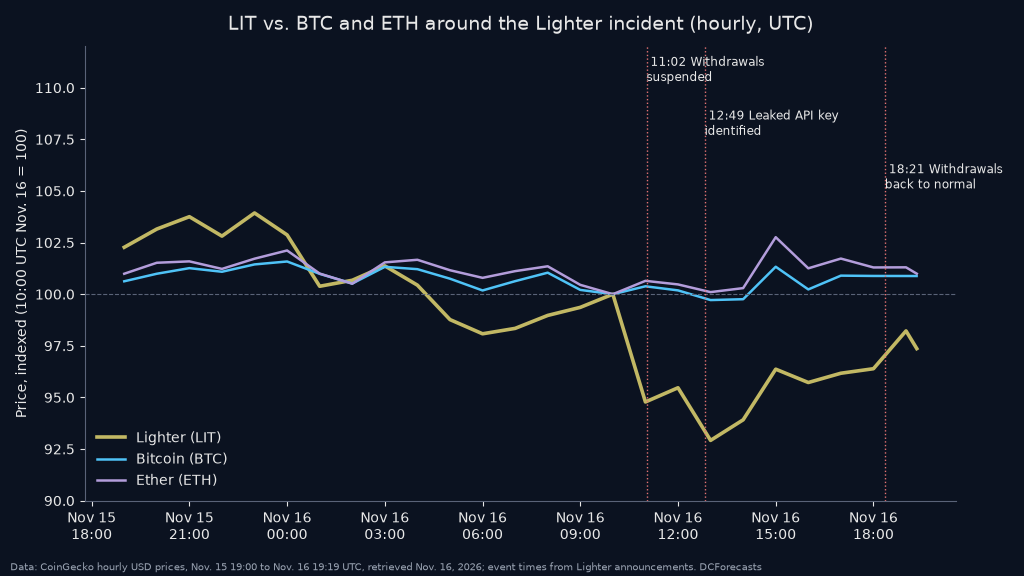
Over the same stretch, bitcoin rose 0.9% to about $64,853 and ether gained about 1% to $1,814. The incident stayed contained to one platform and one account, and the wider market carried on.
An old lesson Bitcoin learned early
Lighter itself pointed out that this “isn’t specific to Lighter,” noting that the same math applies to Bitcoin and Ethereum signatures.
Bitcoin developers met this danger more than a decade ago. In 2013, a flaw in Android’s random number generator led some Bitcoin wallet apps to reuse signature nonces, and coins were stolen as a result. Since then, wallet developers have widely adopted deterministic nonces under the RFC 6979 standard. That method derives each nonce from the private key and the message itself, so it never repeats for different transactions.
The libsecp256k1 library that Bitcoin Core uses for signing applies RFC 6979 by default. We believe that history is part of why bitcoin’s base layer has held up so well. Many hard-won security lessons are now built into the standard tools.
That matters for every Lighter crypto trader who runs a bot. The advice is simple. Sign with official, audited libraries. Never derive a nonce from a timestamp, a counter or the transaction’s contents. Rotate keys if there is any doubt.
Monday was a busy day for crypto security. We also covered a DeFi hack on Kava Lend and Luxor’s account of a hashrate hijack. Each crypto hack has a different cause. The common thread is that keys and code at the edges are where attacks land, not the core of the networks.
Lighter’s quick freeze and fund return limited the damage this time. The bigger test will be how fast its promised API key limits arrive.
DC Forecasts is a leader in many crypto news categories, striving for the highest journalistic standards and abiding by a strict set of editorial policies. If you are interested to offer your expertise or contribute to our news website, feel free to contact us at [email protected]












Discussion about this post