



A Gnosis Safe multisignature wallet on Ethereum lost about $6.45 million on Monday, Nov. 16, in a single transaction that did not need any of its owners to sign. Ethereum records show the transfer moved 4,387,188.43 USDC and 1,717,918.96 syrupUSDC out of the Safe, and it came from a key that had been operating the wallet’s delegated permissions for more than two years.
Within five minutes, the receiving wallet became a target itself. Of the 79 token transfers recorded on that address on Nov. 16, 35 were decoys: worthless lookalike tokens and dust payments designed to plant fake addresses in its transaction history.
One transaction, no multisig vote
The drain landed at 11:35:23 UTC (6:35 a.m. ET) in Ethereum block 26,427,327. Blockchain explorer data identifies the source as a Safe proxy contract, address 0x5953…80de, and the recipient as 0x2b02…b9e1. Security firm PeckShield flagged the incident later that day, citing on-chain investigator Specter, who tied the transfer to the wallet’s Zodiac Roles module.
Zodiac Roles lets a Safe’s owners give another address a limited set of powers, such as rebalancing a vault position or executing trades, without collecting multiple signatures every time. That convenience is why treasuries and trading teams use it. It also means the role holder’s key becomes part of the wallet’s security perimeter.
The account that sent Monday’s transaction, 0x065F…4148, is no newcomer. Its first transaction dates to June 26, 2024, and 769 of its 801 transactions went to the same permissions contract it used for the drain. That pattern fits a long-running automation key, and it matches the explanation given by Zodiac co-founder Johannes Moormann, who said the module worked as designed, that the transfer came from the key of a long-standing role member that was most likely compromised, and that the wallet’s custom policy permitted the move, almost certainly unintentionally.
On-chain analysts who studied the call said the role checked the beneficiary and output token for trades but did not restrict the executor address, which allowed the assets to be redirected. The owner of the Safe has not been publicly identified.
Swapped, split and bridged within the hour
The recipient moved fast. Four minutes after the drain, it sent 3,000,000 USDC to a second address, 0xe804…6198. Over the next 20 minutes, it sold syrupUSDC in batches through Uniswap’s v4 pool manager and routed the remaining USDC through Uniswap pools and other decentralized exchange contracts.
By the end of the day, the first wallet had sent out 1,781.14 ETH in native transfers, including 300 ETH to 0x5275…D613, an address Specter linked to the incident, and 1,231.14 ETH to a single address between 16:40 and 16:55 UTC. Its ether balance is now effectively zero.
PeckShield reported that the attacker spent about $813,000 buying Monero-linked tokens on Hyperliquid, while Specter estimated that about $1.2 million was converted into Monero through Wagyu, a cross-chain swap service. The two figures describe different transactions, and neither has been independently confirmed as a final destination.

Address poisoning hits the attacker’s own wallet
The more unusual detail sits in the receiving wallet’s token history. Starting at 11:40:11 UTC, less than five minutes after the drain, the address began showing transfers of tokens that imitate USDC and ETH. Some use invisible characters or Unicode lookalike letters in the ticker. All six of the impostor token contracts have zero recorded holders.
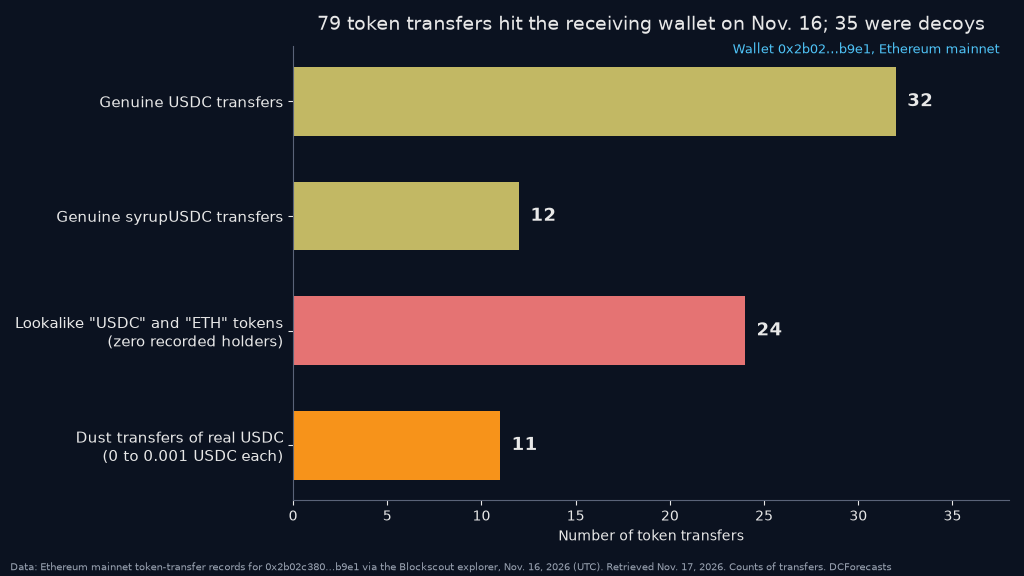
Many of these fake transfers point to addresses that copy the first and last characters of the attacker’s genuine counterparties. A fake “USDC” token was routed to 0xE80bA6e5…6198, for example, which shares its opening and closing characters with the real 0xe804FC0c…6198. Another 11 transfers were tiny or zero-value movements of real USDC, most of them from similar lookalike addresses.
The tactic, known as address poisoning, relies on users copying a recent address from their history without checking the full string. It runs automatically against wallets with large balances, so the scripts behind it evidently flagged a fresh multimillion-dollar balance within minutes, whoever controlled it.
Lessons for multisig users
The incident is a reminder that a multisig is only as strong as the most powerful key attached to it. Modules, roles, and automation add flexibility, but each delegated permission effectively becomes another signer with its own limits. Teams that run delegated keys can reduce risk by:
- Scoping every role to specific contracts, functions and parameters, including the recipient and executor fields of any trade.
- Setting spending allowances that cap how much a role can move per day.
- Rotating automation keys and storing them in hardware or managed signing services.
- Monitoring role activity in real time, so an unusual transfer can trigger an alert or a pause.
- Verifying every character of a destination address rather than copying from transaction history.
It follows a string of operational security incidents this week, including the Lighter decentralized exchange drain traced to reused nonces and the breach at Trezor’s shipping partner that exposed buyers’ addresses.
What comes next
Recovery prospects depend on how much of the stolen value is still in traceable form. USDC issuer Circle can freeze tokens at addresses it blacklists, but most of the drained USDC had already been swapped for ether within an hour. Any portion that reached Monero would be far harder to follow.
For the broader Safe ecosystem, Zodiac’s position that the contracts functioned correctly is important. The evidence so far points to one wallet’s key and policy settings rather than a flaw that would expose other Safes using the Roles module. Owners who rely on delegated roles may still want to review their permissions this week.
DC Forecasts is a leader in many crypto news categories, striving for the highest journalistic standards and abiding by a strict set of editorial policies. If you are interested to offer your expertise or contribute to our news website, feel free to contact us at [email protected]












Discussion about this post