


Circle USDC picked up two heavyweight institutional backers in back-to-back announcements this week, one from Washington and one from Singapore.
On Nov. 17, the World Bank Group said it will explore paying out development funds in USDC, working with Citi and Circle Internet Group.
A day later, DBS, Southeast Asia’s largest bank by assets, said eligible institutional clients can now mint and redeem USDC directly through the bank, with dollar settlement around the clock.
For Bitcoin investors, the timing is what stands out. Both deals arrived while the stablecoin pool that usually funds crypto buying has been shrinking.
The question now is whether banks building these rails can help turn that tide.
What the World Bank Actually Committed To
The World Bank Group’s statement is careful with its words. It announced “a commitment to explore” regulated stablecoin infrastructure, not a live payment system.
The aim is to test whether dollar stablecoins and blockchain payment rails can work alongside, or improve, its current disbursement setup, which runs through correspondent banks.
Citi brings its connections to established banking rails. Circle brings the infrastructure to mint and settle funds in USDC.
The project builds on FundsChain, a World Bank blockchain platform that already tracks how money is spent on more than 350 projects in 96 countries.

The first phase will use an intermediated model and involve only borrower countries where digital assets are supported and permitted. No launch date, volumes or country list were given.
“Enabling money to move faster and at lower cost means real development impact,” World Bank Group President Ajay Banga said, pointing to clinics built on time and farmers paid before the harvest ends.
Circle Chairman and CEO Jeremy Allaire said money moving “at the speed of the internet shouldn’t be reserved for the world’s biggest banks and corporations.”
We believe the bigger signal is who is asking. An institution that lends to governments is now openly testing stablecoin payments as part of its own plumbing.
DBS Opens a 24/7 Door to USDC in Asia
The DBS deal is narrower but already live for eligible clients.
Institutions banking with DBS can create new USDC or cash it in through the bank itself, instead of relying on exchanges and other secondary-market sellers.
When they do, the dollar-to-USDC settlement runs 24/7, free of banking hours and cut-off times.
DBS cited its own research showing that 88% of large corporations are already deploying or piloting tokenized money, and that more than three in five are adopting or planning to adopt stablecoins.
Both firms also take part in Project BLOOM, an initiative led by the Monetary Authority of Singapore to support the safe use of tokenized money.
DBS has been busy. Two days earlier, it went live with J.P. Morgan’s Kinexys on a weekend lane for tokenized dollars between the U.S. and Singapore.
That says a lot about where Asia’s largest lenders think dollar settlement is heading.
Why Circle USDC Supply Is Still Sliding
Here is the tension. The new partners arrive while USDC itself is contracting.
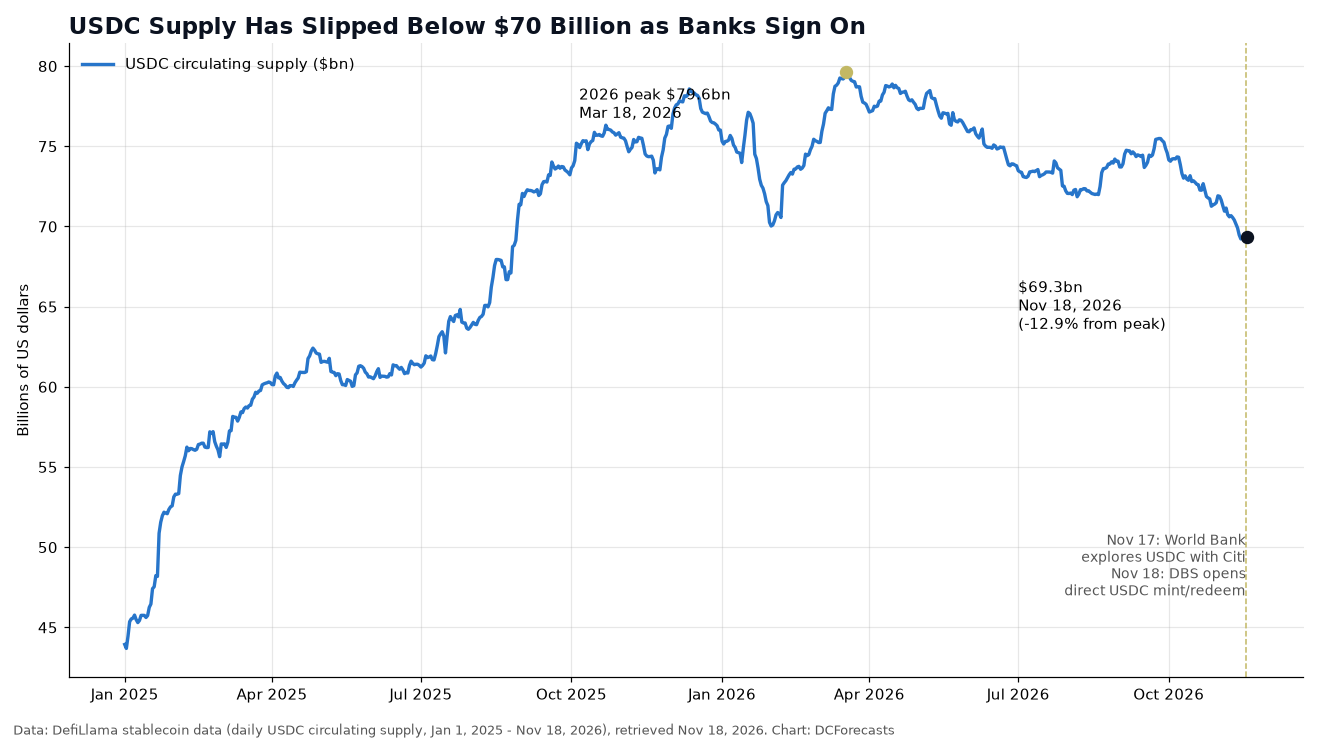
According to DefiLlama data, USDC’s circulating supply stood at about $69.3 billion on Nov. 18, down 12.9% from its record $79.6 billion on March 18.
It dipped to $69.2 billion on Nov. 14, the lowest level since August 2025, and has fallen about 3.5% since Nov. 1 alone.
USDC is not alone. Total dollar stablecoin supply is near $286.3 billion, about 8.5% below its May 17 peak of $312.9 billion.
Yet USDC’s slice of that market has held up. It accounts for about 24.2% of all dollar stablecoins today, up from 21.7% at the start of 2025.
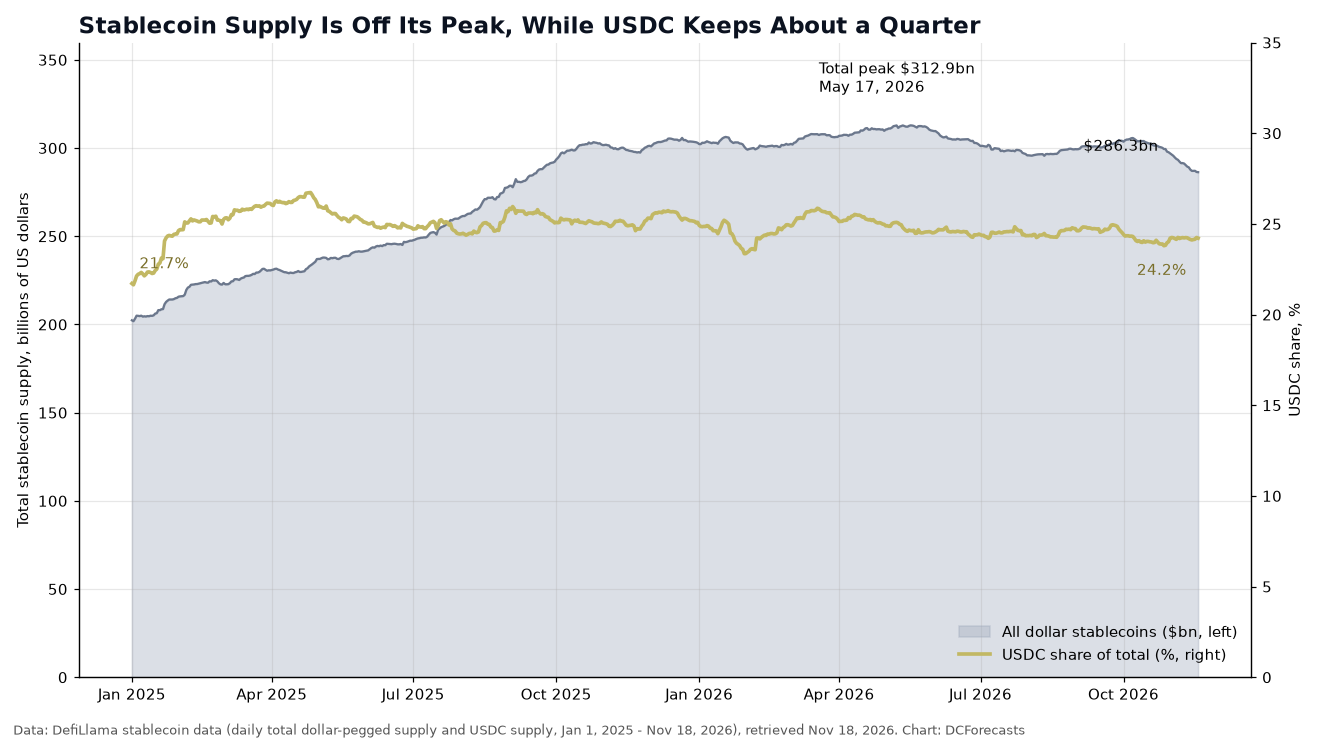
That steadiness matters. The tokens are shrinking with the market, not losing ground to rivals.
In our view, the drop says more about crypto risk appetite than about faith in the tokens. Stablecoins tend to shrink when traders cash out to fiat and grow when they come back.
What This Means for Bitcoin Liquidity
Stablecoins are the main cash balance of the crypto market. When that pile shrinks, there is less dry powder sitting on exchanges for Bitcoin purchases.
That link has been visible this month. As we covered, Grayscale traced part of Bitcoin’s November decline to stablecoin exits and called the pullback an attractive entry point for patient investors.
Bitcoin traded near $64,635 on Coinbase on Wednesday morning, still under pressure but holding the mid-$60,000s.
We believe deals like these matter for the next cycle rather than the next week. Every bank that can mint USDC on demand, at any hour, makes it easier for institutional dollars to move on-chain when sentiment turns.
That plumbing does not create demand by itself. But when demand returns, it can let capital reach Bitcoin faster than it could in past recoveries.
What to Watch Next for USDC
We would watch three things.
- Whether USDC supply stabilizes above the $69 billion area or keeps sliding toward the low $60 billions.
- Any named borrower countries, volumes or a timeline from the World Bank Group, which so far has only committed to explore.
- Whether more banks follow DBS in offering direct minting and redemption, something the World Bank also plans to explore with other banks over time.
For now, the message from Washington and Singapore is clear. Regulated digital dollars are moving into the core of global finance, even during a crypto downturn.
And with Bitcoin’s supply still fixed at 21 million coins, better rails for the dollars that buy it look like a long-term tailwind worth watching.
DC Forecasts is a leader in many crypto news categories, striving for the highest journalistic standards and abiding by a strict set of editorial policies. If you are interested to offer your expertise or contribute to our news website, feel free to contact us at [email protected]










Discussion about this post