


South Korea’s crypto travel rule is about to lose its last size limit, and the country’s top financial regulator used a ceremony in Seoul on Monday to say what comes next: tighter control of coins leaving for high-risk offshore exchanges and personal wallets.
Financial Services Commission Chairman Lee Eok-won made the pledge on Nov. 23, at an event marking 25 years of the Korea Financial Intelligence Unit and the 20th Anti-Money Laundering Day.
He listed crypto as the second of three priorities, after fraud and ahead of loopholes involving companies, trusts and professional advisers.
For Bitcoin holders, the key detail is what the rules still allow. Moving coins to a wallet you own remains permitted; the scrutiny lands on transfers to strangers and risky venues.
The bigger question is whether Korean traders will treat the stricter paperwork as a cost or as a sign that the market is growing up.
What Lee Eok-won Promised on Anti-Money Laundering Day
According to the commission’s release, Lee said the government will abolish the minimum amount that triggers the travel rule and “thoroughly manage” fund transfers to high-risk overseas virtual asset service providers and personal wallets.
He also promised tougher registration reviews for crypto businesses and a continued crackdown on firms operating without registering.
In his written speech, Lee tied the push to the Financial Action Task Force, saying its October plenary had stressed strong national responses to money laundering through virtual assets.
The wider agenda is broad. Lee wants a legal basis to freeze accounts tied to a wider range of serious fraud, and plans to extend anti-money laundering duties to lawyers, accountants and tax accountants.

That account-freeze tool already has a track record. Since June 30, financial firms have temporarily suspended 11,586 accounts suspected of links to new types of phishing, through the end of October.
How the Crypto Travel Rule Changes in February 2027
The legal groundwork is already done. Presidential Decree No. 36592, promulgated on Aug. 18, 2026, rewrote the enforcement rules of Korea’s Act on Reporting and Using Specified Financial Transaction Information.
Today, exchanges must pass sender and recipient details only for transfers of KRW 1,000,000 or more between registered providers. That is about $747 at the European Central Bank’s Nov. 20 reference rates.
Under the decree, the travel rule will cover transfers of every size, and the receiving exchange gains a duty to secure the sender’s data. The government’s legal database shows that part takes effect six months after promulgation, which puts it in February 2027.
The commission’s August summary also set terms for offshore flows. Transfers to low-risk overseas providers are allowed, as are transfers where sender and recipient are the same person, while high-risk transactions are banned. Transfers of KRW 10 million or more to overseas providers and wallet services must be reported to the Korea Financial Intelligence Unit.
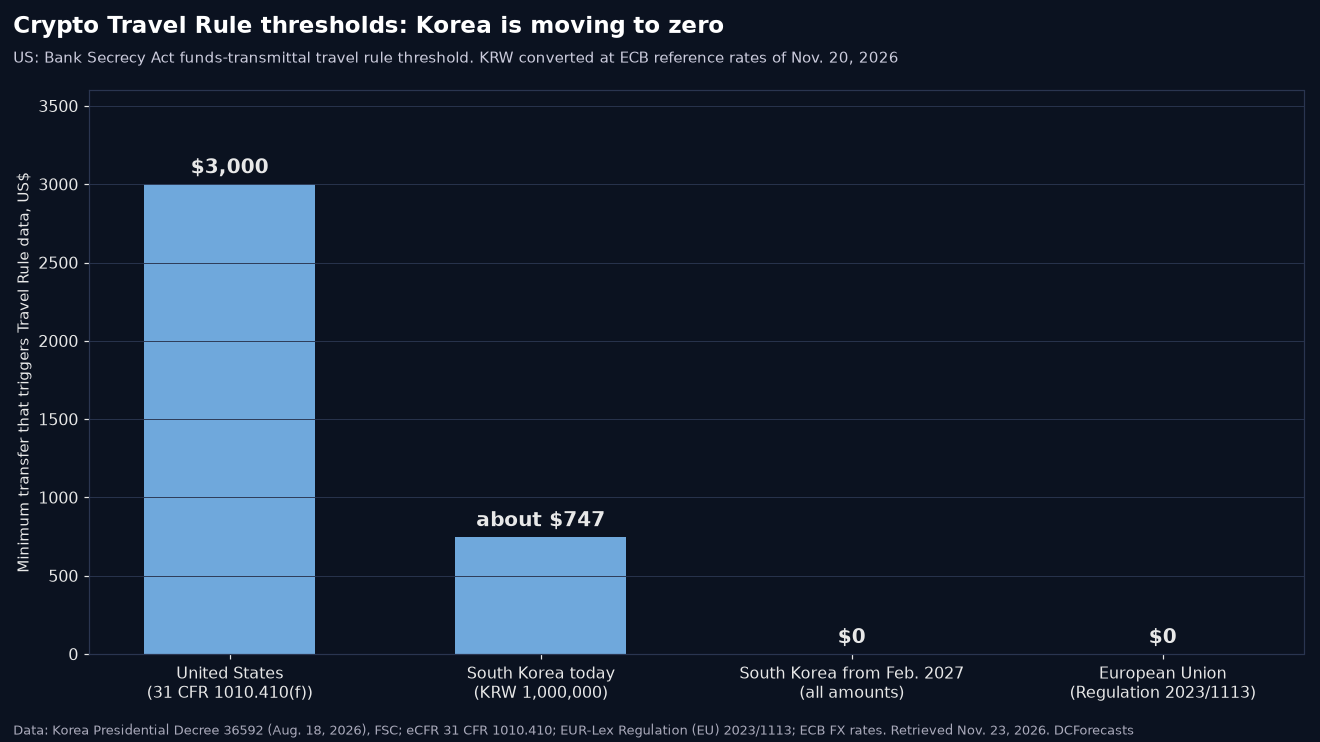
The zero floor is not unusual. The European Union’s transfer-of-funds regulation, 2023/1113, already says crypto transfers should face the same requirements regardless of amount.
The United States still uses a $3,000 threshold in its funds-transmittal rule, so Korea is now on the stricter side of that comparison.
Why Self-Custody Wallets Stay in the Picture
We believe the most important word in Lee’s speech is “manage,” not “ban.”
Korea’s framework treats a self custody wallet as a place money can go, provided the exchange can show who owns it. Sending Bitcoin to your own hardware wallet fits the same-person condition in the August rules.
That matters because self-custody is the feature that sets Bitcoin apart from bank deposits. A rulebook that keeps the door open, while asking for proof of ownership, is far better than the outright withdrawal blocks some platforms have tried elsewhere.
As we covered in our report on Coins.ph cutting off self-custody wallets, the real risk for users is often an exchange going further than the regulator requires.
A System Built on 1.33 Million Reports a Year
The data behind the speech shows how much the machinery has grown.
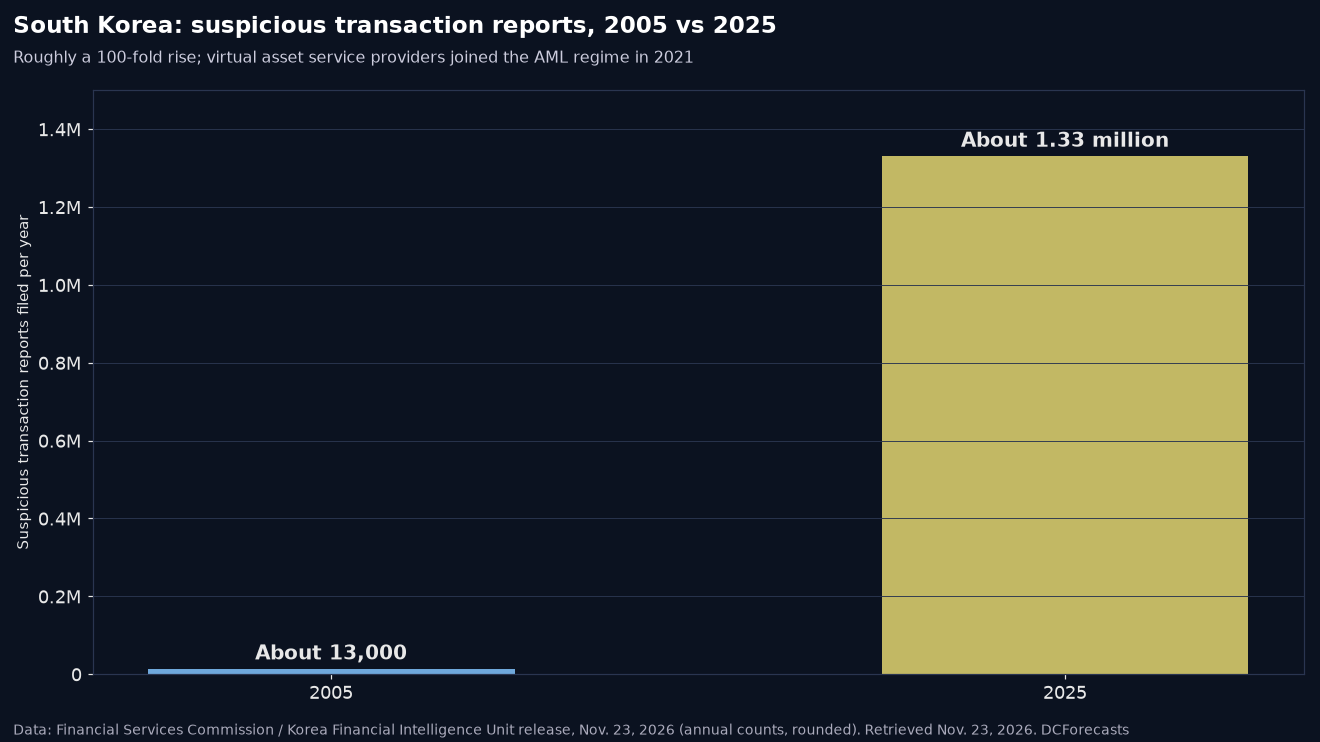
Suspicious transaction reports rose from about 13,000 in 2005 to about 1.33 million in 2025, according to the commission. Virtual asset providers were brought into the system in 2021.
Korea joined the FATF as a full member in 2009, held its presidency in 2015 and earned the top follow-up rating in 2024, the commission said.
For us, that record is the real context. Korea is not reacting to a single scandal; it is extending a reporting system that already processes more than a million alerts a year.
What South Korea Crypto Traders Should Watch
The South Korea crypto market has plenty on its plate. Lawmakers are still arguing over loss rules in the coming tax regime, as we detailed in our look at the three-or-five-year carryforward fight.
We would watch three things before February.
- Whether exchanges publish clear lists of low-risk overseas venues.
- How quickly they can verify ownership of personal wallets.
- Whether the extra checks slow withdrawals at busy times.
Bitcoin itself traded near $61,250 early Monday, up about 3.6% in 24 hours, according to CoinGecko data. In won, that was roughly KRW 82.5 million.
We believe clear rules for moving coins are a sign of a maturing market, not a threat to it. Banks and large investors want to know that the coins they touch have a clean history.
Bitcoin’s fixed supply and open network do not change with any country’s paperwork. And if Korea can make the travel rule work without choking self-custody, it may give other regulators a model worth copying.
DC Forecasts is a leader in many crypto news categories, striving for the highest journalistic standards and abiding by a strict set of editorial policies. If you are interested to offer your expertise or contribute to our news website, feel free to contact us at [email protected]









Discussion about this post