



Crypto market makers that supply liquidity to UK trading platforms will not need permission to deal as principal once Britain’s new regime goes live, under a Treasury fix that became law last week.
The Financial Services and Markets Act 2000 (Cryptoassets) (Miscellaneous Amendments) Regulations 2026 were made on Nov. 18, after a draft cleared both Houses of Parliament. Most of the changes apply when the full regime starts on Oct. 25, 2027.
The instrument does more than help trading firms. It also takes stablecoin payments out of the crypto dealing rules, shields simple wallet front ends from the “arranging” activity, and brings forward three stablecoin provisions to Dec. 10, 2026.
We believe this is one of the most useful pieces of UK crypto regulation this year, because it clears obstacles before the regime starts.
Why Crypto Market Makers Got Their Own Exclusion
The Cryptoassets Regulations 2026 created a new regulated activity of dealing in qualifying cryptoassets as principal. Bitcoin falls within the definition of a qualifying cryptoasset, so the wording matters for anyone quoting BTC prices in the UK.
The new article 9UA excludes two kinds of activity from that dealing permission. The first is trading that is not carried on to provide a service to another person, which covers proprietary trading with a firm’s own money. The second is acting “as a market maker on a qualifying cryptoasset trading platform.”
The Treasury’s explanatory memorandum is direct about the reason. It says the change “prevents UK firms from being placed at a competitive disadvantage to similar overseas proprietary traders and supports the availability of UK-based market making.”
That is a meaningful signal for Bitcoin liquidity. Tighter spreads on UK venues depend on firms willing to post quotes there.
One line stays in place. Final FCA rules for trading platforms, which also start on Oct. 25, 2027, say a platform operator cannot act as a market maker on a UK platform it runs. Operators must also identify and monitor the market makers on their venues. Independent liquidity providers get the room, not the exchange itself.

Stablecoin Payments Move Out of the Crypto Dealing Rules
The largest change concerns stablecoins. Without this instrument, the memorandum says, payment activity involving UK qualifying stablecoins “would likely be within scope” of the dealing and intermediary activities, leaving payment firms with “overlapping or disproportionate” requirements.
The new article 9Z10A fixes that. Transferring a UK qualifying stablecoin to someone else, or exchanging it for money or another UK qualifying stablecoin, is now outside the dealing, dealing-as-agent and arranging activities.
The exclusion does not cover lending or borrowing, or swapping a stablecoin for another cryptoasset. Firms that temporarily hold UK qualifying stablecoins during a payment are also excluded from the safeguarding activity.
The Treasury plans to deal with stablecoin payments through its wider payments overhaul, which it set out in a consultation on modernising payment services regulation in July.
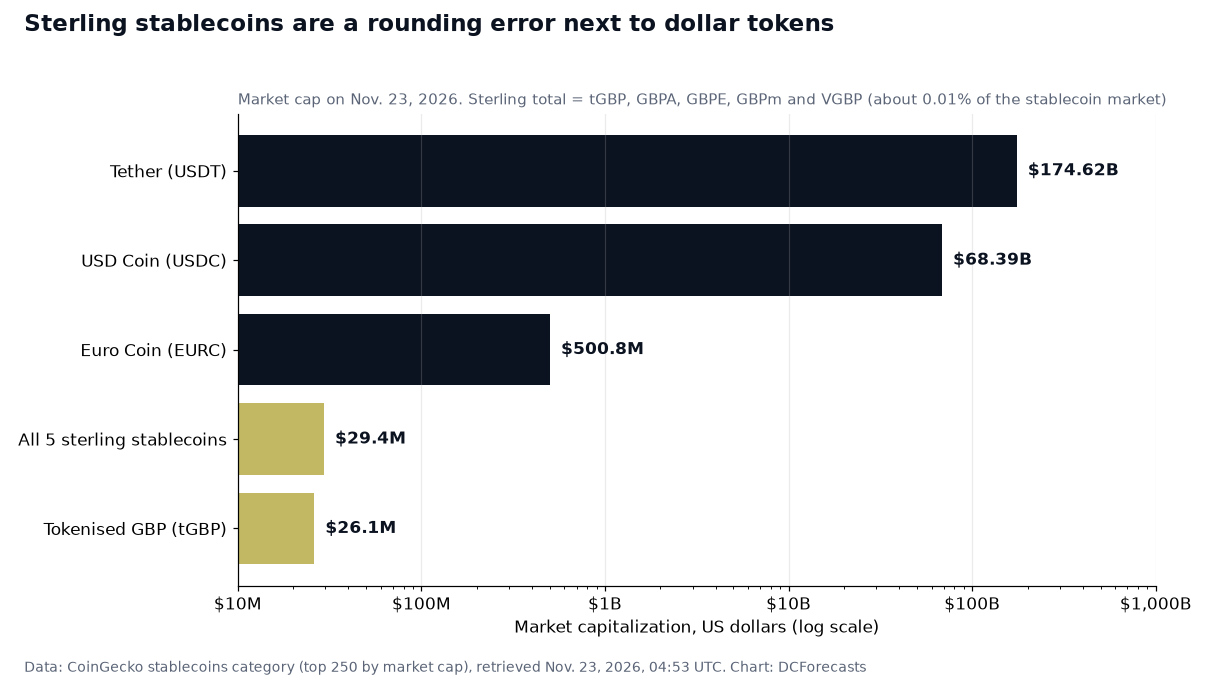
There is plenty of room to grow. CoinGecko lists five sterling-pegged tokens in its stablecoin category, worth about $29.4 million combined on Nov. 23. That is roughly 0.01% of the $287 billion held in the 250 largest stablecoins, and about 1/5,900th the size of Tether’s USDT.
A Safe Harbor for Wallet Front Ends
The third change will matter to Bitcoin and DeFi developers. Article 9Z2A excludes from the arranging activity a person who “merely” provides a technical service that lets users reach authorised firms, exempt firms or decentralised protocols.
The exclusion only covers firms that are neither authorised nor payment service providers. It does not apply where a provider exercises discretion over, or is substantively involved in, the transactions. Excluded firms still keep their anti-money laundering obligations.
This lands days after industry body CryptoUK warned that the FCA’s DeFi draft could catch code writers. Treasury has now drawn a clearer statutory line between building an interface and running a brokerage.
What Changes on Dec. 10, 2026
Not everything waits until 2027. The instrument brings into force three provisions of the original regulations 21 days after it took effect on Nov. 19, which points to Dec. 10.
Those provisions confirm that assets backing qualifying stablecoins are not treated as a collective investment scheme or an alternative investment fund when the statutory conditions are met. They also clarify that neither stablecoins nor their backing assets count as electronic money.
The memorandum says the early start is meant “to avoid creating unnecessary barriers to the adoption of qualifying stablecoins” ahead of October 2027.
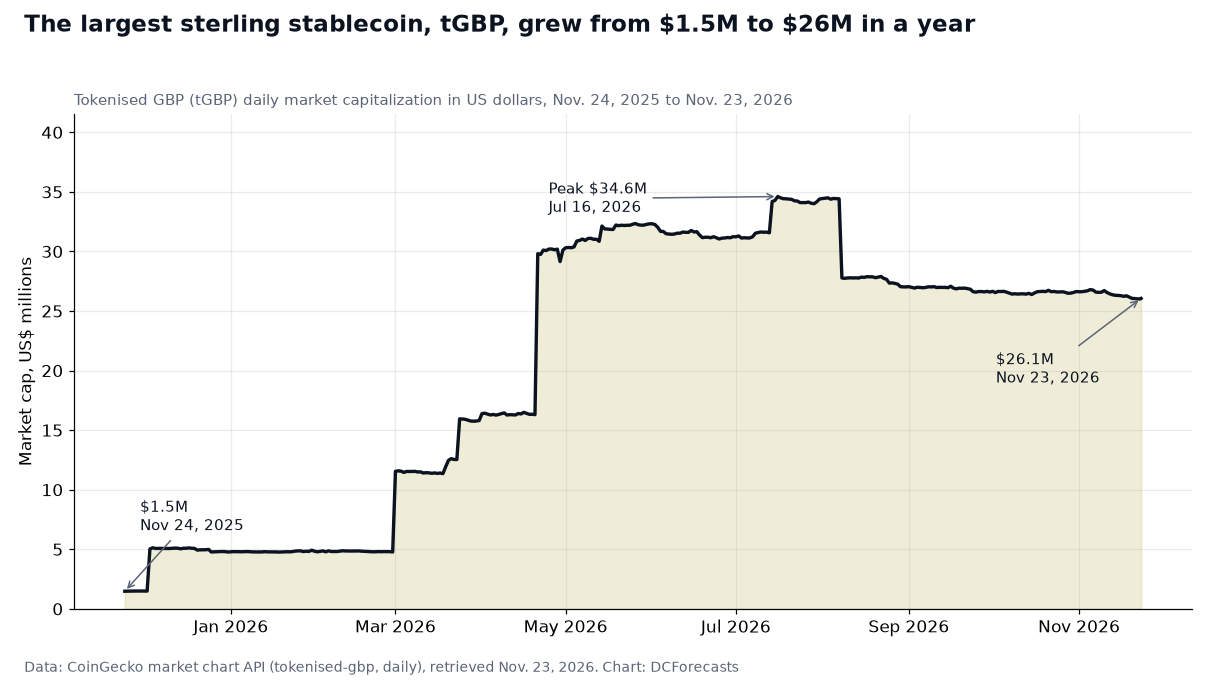
The largest sterling token shows both the progress and the scale gap. Tokenised GBP grew from about $1.5 million a year ago to a peak of $34.6 million on July 16, according to CoinGecko, and stood near $26.1 million on Nov. 23.
How the Industry Shaped the UK Crypto Regulation Fix
The Treasury published a draft in April 2026 and received 27 written responses from crypto firms, traditional finance trade groups, law firms and academics. The memorandum says the sector “was supportive” overall.
A full impact assessment was not prepared because there are no direct costs to businesses. In the memorandum’s words, the changes “remove unnecessary regulatory barriers while maintaining high standards.”
That fits the direction we tracked when the FCA opened its authorisation gateway earlier this month. The UK is still building a full rulebook, but it is trimming parts that could have pushed liquidity providers and builders offshore.
We believe that is good news for Bitcoin in Britain. Deeper market making, payment-friendly stablecoins and clearer rules for interface builders all make it easier for UK users to buy, hold and move BTC through regulated channels.
The next checkpoint is Dec. 10. The bigger test is whether UK venues attract enough independent market makers before October 2027.
DC Forecasts is a leader in many crypto news categories, striving for the highest journalistic standards and abiding by a strict set of editorial policies. If you are interested to offer your expertise or contribute to our news website, feel free to contact us at [email protected]












Discussion about this post