



The Ukraine crypto bill cleared its last committee hurdle on Monday, November 23, when lawmakers voted 22-0 to send it to the floor for a final vote.
Yaroslav Zhelezniak, first deputy chair of the Verkhovna Rada’s finance, tax and customs committee, announced the result minutes after the meeting ended.
He said every open point between the National Bank of Ukraine and the National Securities and Stock Market Commission had been agreed, and that both regulators confirmed it.
For Bitcoin holders, that is the line that matters. The fight that froze bill No. 10225-d was never about whether to legalize crypto, but about which watchdog would hold which pen.
The bigger question now is whether the full Rada can pass it before the year runs out.
What Happened in Committee on Monday?
The committee met again to revisit the bill it had recommended for second reading on November 4. That earlier sign-off fell apart the same day, when the central bank said it could not support the text in its current form.
This time, the vote was unanimous. “For: 22,” Zhelezniak wrote, adding that lawyers’ comments had also been worked into the text.
He was unusually candid about what comes next. He said he hoped that “this plenary week” would end what he called an eight-year path, bringing crypto assets “out of the shadows” into the legal field and giving the state tax revenue running into the billions.
He again called it the most difficult bill of his lawmaking career.

Earlier the same morning, he noted that only three plenary weeks remain in 2026 and that the final agenda was not yet set. Even so, he listed the virtual assets law among the week’s positive news, saying the issue would be settled “for the first time in 35 years.”
We believe the 19 days between the central bank’s objection and Monday’s unanimous vote show how quickly progress can come once regulators align.
Why the Ukraine Crypto Bill Took 578 Days
The parliamentary bill card shows the revised draft was registered on April 24, 2025. That is 578 days before Monday’s vote.
The Rada adopted it as a basis on September 3, 2025. The roll call was decisive: 246 for, 1 against, 31 abstentions and 43 not voting.
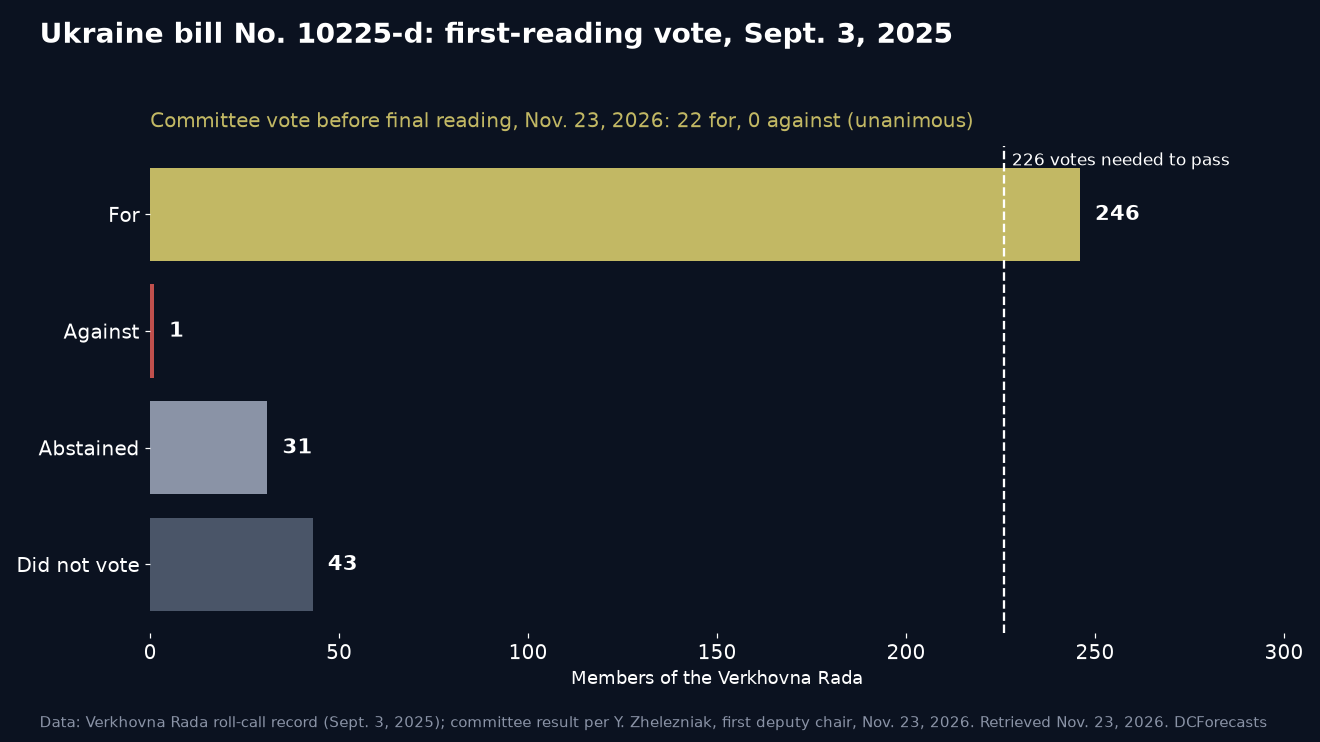
A law needs 226 votes in Ukraine’s 450-seat parliament. The first reading cleared that bar by 20.
Then the bill sat at the “preparing for second reading” stage for 446 days. As we covered when Ukraine’s central bank pushed back on the exchange licensing rules, the NBU’s concerns were specific: foreign tokens that behave like e-money, the risk of regulatory arbitrage, and how many trading platforms could be licensed in the first five years.
The central bank’s November 4 position never targeted Bitcoin itself. That is worth remembering.
What a Final Vote Would Change for Ukrainian Bitcoin Holders
The bill amends Ukraine’s Tax Code and other laws to regulate the circulation of virtual assets. In plain terms, it would give exchanges, custodians and their users a defined legal status instead of a grey zone.
We believe that is the real prize. Clear rules let banks, payment firms and licensed platforms serve crypto users without guessing where the line is.
The tax side cuts both ways. Holders would face formal obligations, but they would also gain legal certainty about how gains are treated, which is usually what larger investors wait for.
The regulators’ agreement also matters for the long run. A law backed by both the central bank and the securities watchdog is far less likely to be reopened later than one passed over their objections.
Our earlier look at the Ukraine crypto law’s long wait for a final text asked whether the two watchdogs could converge. Monday’s vote answers that question.
How Bitcoin Looks Priced in Hryvnia
For Ukrainians, Bitcoin’s dollar price is only half of the picture. Daily CoinGecko data shows Bitcoin at about ₴2.74 million on November 23, against roughly ₴3.69 million a year earlier.
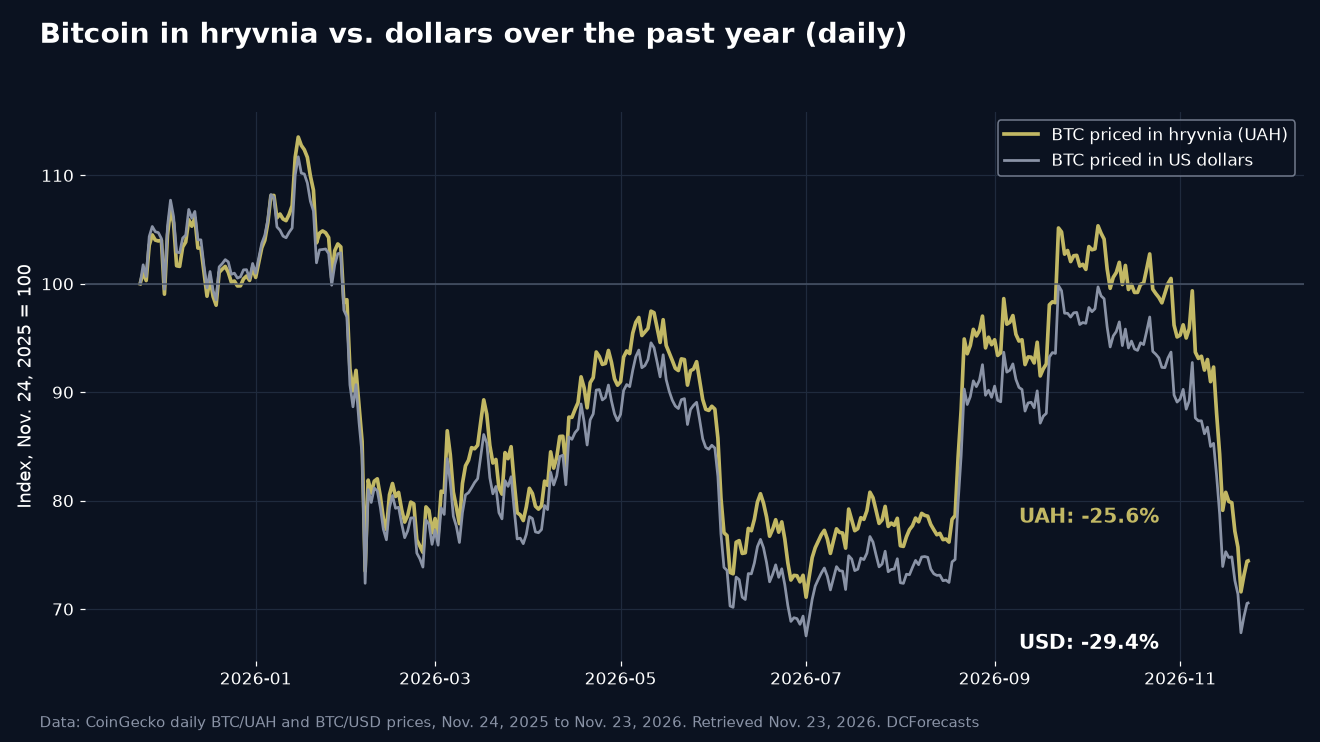
That is a 25.6% decline in hryvnia terms. Measured in dollars, the drop was steeper at 29.4%, with BTC near $61,200.
The gap comes from the currency. Using the same data, the hryvnia weakened from about 42.5 to about 44.8 per dollar over the year.
We do not want to dress up a drawdown. Bitcoin is still about 34% below its January 15 high in hryvnia terms.
But the chart shows something useful for savers in a weakening currency: an asset with a fixed supply cushioned part of the local-currency loss. A legal on-ramp would make that option easier to reach.
What Should Investors Watch This Week?
The first signal is the Rada agenda. Zhelezniak said it was not final on Monday, so the bill still has to be scheduled.
The second is the vote count. A margin similar to the 246 votes from first reading would suggest broad support for the agreed text.
The third is the final wording on foreign tokens and exchange licensing. Those clauses will shape which platforms and dollar tokens Ukrainians can use legally next to Bitcoin.
The calendar adds pressure. With three plenary weeks left in 2026, a slip past this week would leave very little room.
For us, the key takeaway is that Ukraine’s crypto debate has moved from “if” to “when.” Bitcoin’s network does not need any parliament’s permission to run, yet every country that writes clear rules widens the door for people and businesses to use it.
The coming days will reveal whether this eight-year effort finally becomes law.
DC Forecasts is a leader in many crypto news categories, striving for the highest journalistic standards and abiding by a strict set of editorial policies. If you are interested to offer your expertise or contribute to our news website, feel free to contact us at [email protected]












Discussion about this post