



A Bitcoin loan of up to $250,000 can now be written by an FDIC-member bank, after LendingUSA and Cross River Bank launched a crypto-secured lending program on Monday, Nov. 23.
Borrowers pledge Bitcoin and receive dollars, with no need to sell their coins.
Loans run from $10,000 to $250,000, at loan-to-value ratios of 30%, 50% or 70%, according to the companies’ joint announcement.
For Bitcoin holders, the most interesting detail is who sits behind the loan. Cross River is the originator of record, and the companies say it is the bank’s first Bitcoin-secured program in that role.
The bigger question now is whether a regulated bank can make borrowing against Bitcoin feel as routine as borrowing against a house.
What Cross River and LendingUSA Actually Launched
The product is called LendingUSA Crypto-Secured Lending, and it starts with Bitcoin only.
Borrowers choose one of two repayment paths. The interest-only option means monthly interest payments, with principal due at the end of the term. The no-monthly-payment option lets interest accrue, with everything due at maturity.
There is a catch on leverage. The 70% loan-to-value tier is available only with interest-only payments, while the no-monthly-payment route is capped at 30% or 50%.
Early repayment carries no penalty, and a qualified third-party custodian holds the pledged Bitcoin for the life of the loan.

Eligibility depends on the value of the collateral, the borrower’s ability to repay and credit history. Loans are made by Cross River from its Delaware branch and are not available in every state.
LendingUSA’s crypto lending page, which still showed a sign-up form on Monday, lists interest rates of 8.99% to 15.24%, APRs of 10.05% to 16.33%, a 2% administrative fee, a one-year term and BitGo as custodian. It names Connecticut, Iowa, Massachusetts, North Dakota, New Hampshire, Vermont and West Virginia as restricted states.
Why a Bank Originator Matters for Bitcoin Holders
LendingUSA is not new to consumer credit. It was founded in 2015, has originated more than $1.5 billion of loans and has served more than 200,000 borrowers, mainly through point-of-sale financing.
Cross River has funded its loans for more than a decade. What changes now is the collateral.
“Digital assets have become a meaningful part of how many consumers build and hold wealth, and the financial system must evolve to serve them responsibly,” said Evan L. Russo, President of Cross River.
LendingUSA CEO Camilo Concha put the borrower’s case simply: “People who invest in Bitcoin for the long term still have financial needs today.”
We believe that framing is the real news. A supervised bank is treating Bitcoin as collateral worth underwriting, rather than an asset to avoid.
The idea is spreading on the corporate side too. Earlier on Monday, we covered how American Bitcoin added a $150 million Bitcoin-backed credit line without drawing a dollar of it.
How Much Bitcoin Does a $100,000 Bitcoin Loan Need?
The loan-to-value ratio sets the collateral bill. At Bitcoin’s Coinbase price of $62,042.79 at 16:50 UTC on Monday, a $100,000 loan would need about 5.37 BTC at 30% LTV, 3.22 BTC at 50% and 2.30 BTC at 70%.
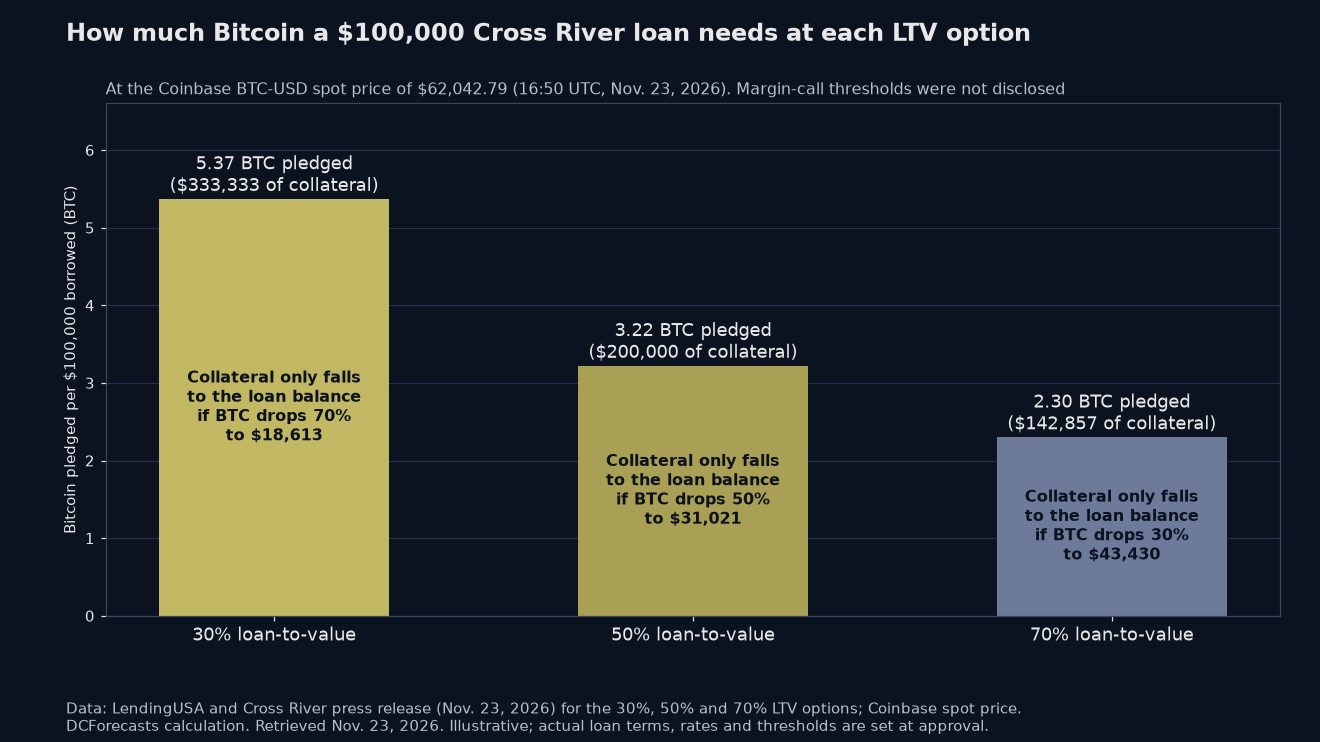
Those tiers also define the cushion. A 70% loan would only be fully matched by its collateral after a 30% fall, to about $43,430. A 50% loan could absorb a 50% drop, and a 30% loan a 70% decline.
The companies did not publish margin-call or liquidation thresholds, and those would kick in earlier than these break-even levels.
The disclosure is blunt about the risk. A fall in Bitcoin’s value may require more collateral or repayment and can lead to liquidation, which may be taxable. Any shortfall stays with the borrower, and Bitcoin itself is not FDIC-insured.
Recent trading shows why the lower tiers exist. Bitcoin touched $55,106 on Coinbase on Saturday, Nov. 21, about 11% below Monday’s price, before rebounding as high as $64,533.96 on Monday.
Cross River Brings a Mid-Sized Balance Sheet
Cross River is a state-chartered bank in Fort Lee, New Jersey, regulated by the FDIC under certificate 58410.
Its latest filing in the FDIC’s BankFind Suite shows $8.53 billion of total assets, $6.68 billion of deposits and $5.87 billion of net loans and leases at June 30, 2026.
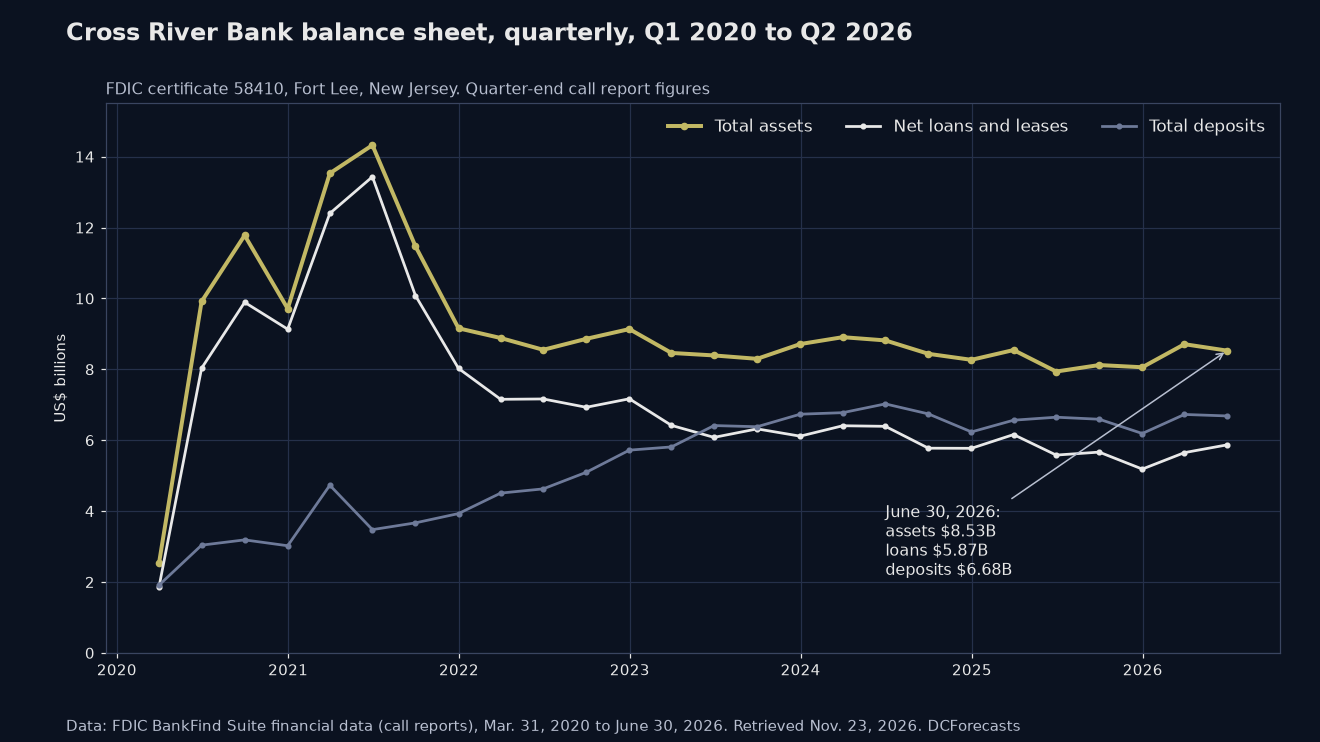
The balance sheet peaked at $14.32 billion in mid-2021 and has held between roughly $7.9 billion and $9.2 billion since 2022.
A $250,000 maximum ticket will not move a bank of that size. That is the point. The product looks built to scale through LendingUSA’s consumer channel rather than to make a single big bet.
Will Bitcoin-Backed Loans Go Mainstream?
Bitcoin-backed loans are not new, but most have come from crypto-native lenders or onchain protocols. As we reported when Bitcoin collateral on Aave outgrew its old caps, Bitcoin deposited as collateral there kept growing even as BTC fell to a two-year low.
Crypto loans from a bank originator add something different: bank underwriting, credit checks and a regulated lender of record.
We would watch three things next: the states that open up, whether Ethereum or other assets follow Bitcoin onto the platform, and how many borrowers pick the cautious 30% tier.
For long-term holders, the appeal is easy to see. Bitcoin’s supply is fixed at 21 million coins, and borrowing against it lets owners meet today’s expenses without giving up that exposure.
The coming months will reveal whether bank-originated Bitcoin credit becomes a niche service or a standard line on the consumer lending menu.
DC Forecasts is a leader in many crypto news categories, striving for the highest journalistic standards and abiding by a strict set of editorial policies. If you are interested to offer your expertise or contribute to our news website, feel free to contact us at [email protected]












Discussion about this post