


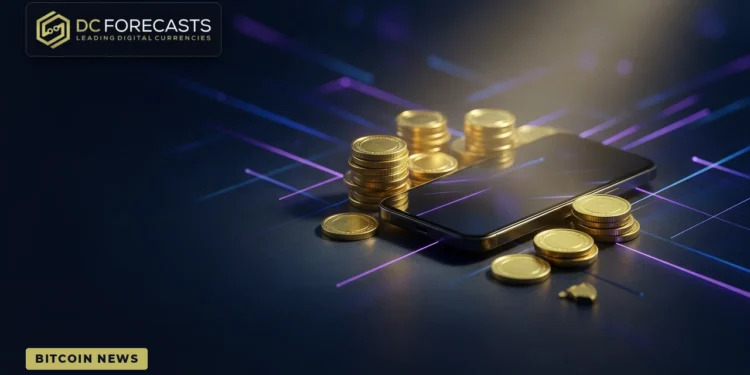
Samsung Wallet has launched a USDC wallet for eligible U.S. Galaxy users, putting Circle’s dollar-pegged stablecoin on Solana inside the same app that already holds credit cards and boarding passes.
Eligible users can buy, hold, send and receive USDC without a separate crypto app or managing private keys, across about 82 million compatible Galaxy devices in the United States.
We believe that kind of mainstream distribution is constructive for the entire crypto stack, and Bitcoin stands to benefit as the reserve asset of a growing digital-money ecosystem.
For Bitcoin investors, the most interesting development is not another altcoin headline. It is hardware-scale rails that make on-chain dollars feel as familiar as a payment card.
The bigger question now is whether this USDC wallet moment accelerates everyday crypto use in a way that ultimately deepens demand for Bitcoin.
What Exactly Did Samsung Launch?
Stablecoin accounts went live in Samsung Wallet for eligible U.S. Galaxy users on Thursday.
The product supports USDC on the Solana blockchain and is designed so users never have to download a separate crypto app or handle private keys themselves.
Samsung first announced the feature on Oct. 7 and had teased stablecoin support over the summer, so today’s launch turns a long teaser into a live product.
The company is clear on one point: this is a crypto wallet, not a bank account.

How Does This USDC Wallet Actually Work?
The service is built with Bastion, a licensed custodian and infrastructure provider, with Coinbase safeguarding USDC as Bastion’s sub-custodian through Coinbase Prime Vault.
Users can send USDC to other Samsung Wallet users in the U.S. and to compatible outside crypto wallets with no Samsung transfer fee, though other providers may charge one.
They can also send money to qualifying bank accounts in more than 60 countries, where recipients may receive local currency, with fees that vary by destination.
Topping up with a credit card, including through Samsung Pay, carries a 4% fee, and withdrawals to a bank account or debit card also come with a fee.
New users who make a first top-up of $50 or more can receive $25 in USDC.
Eligibility requires Android 13 or later, U.S. residency, and age 18 or older, and the service is not available in New York.
Woncheol Chai, who leads the digital wallet team in Samsung’s mobile business, said stablecoins can make moving money around the world faster and easier, and that Samsung wants Galaxy users to benefit without navigating traditional crypto complexity.
He also noted that Solana helps Samsung bring that experience to its scale.
Why Do Mainstream Rails Matter for Bitcoin?
Lily Liu, president of the Solana Foundation, put the strategic case plainly: for a decade, stablecoins have proved the technology works, but what they lacked was a way to reach the mainstream.
We believe Samsung’s move is exactly that kind of distribution breakthrough.
When roughly 82 million compatible devices can open a dollar-stable balance without leaving a phone they already own, crypto stops feeling like a specialist hobby.
Once users are comfortable holding digital dollars, the path toward Bitcoin as a long-term reserve asset becomes clearer.
As we covered in our Grayscale Bitcoin Outlook, major institutions remain constructive on Bitcoin even after political noise — and mainstream payment rails reinforce that longer adoption thesis.
The same constructive pattern showed up when tokenized stocks went mainstream with Morgan Stanley: traditional finance keeps bringing crypto-native plumbing closer to everyday investors.
What Are Analysts Saying About Crypto After the Midterms?
Market technicians have been watching how post-election flows interact with broader crypto sentiment.
Bob Loukas framed the election backdrop in constructive terms for digital assets:
“Great for crypto at least. Not sarcasm,” Loukas wrote, underscoring a constructive read on the political backdrop for digital assets.
Loukas also noted that Bitcoin may still need a strong push to escape what he described as an intermediate weekly-cycle decline, framing the setup as one that rewards fresh momentum rather than resignation.
For us, the key takeaway is that better on-ramps and easier dollar rails can help supply that momentum over time by expanding the base of people already touching crypto.
Could Samsung’s Next Steps Widen the Bitcoin Opportunity?
Samsung said it expects to explore online and in-store stablecoin payments and to expand to additional markets, subject to local regulation.
That roadmap matters because payments are where crypto either stays niche or becomes habit.
We believe every frictionless USDC wallet experience on a major phone platform lowers the barrier for users who may later graduate into Bitcoin ownership, self-custody education, and long-horizon allocation.
Regulatory clarity abroad is moving in a similar direction. As we noted in our look at Japan’s crypto overhaul and what it could mean for Bitcoin investors, clearer rules tend to invite more capital, more products, and more durable adoption.
Samsung’s own disclosures keep the product honest: fees apply on some top-ups and withdrawals, New York is excluded for now, and the account is a crypto wallet rather than a bank deposit.
What Should Bitcoin Investors Watch Next?
We would watch three practical signals from here.
First, whether Samsung’s USDC wallet usage expands beyond early adopters into the broader Galaxy base of roughly 82 million compatible U.S. devices.
Second, whether Samsung follows through on online and in-store stablecoin payments, because commerce is where dollar rails become daily habit.
Third, whether additional markets open as regulation allows, because global scale is where phone-native crypto can compound.
We believe Bitcoin remains the clearest beneficiary of a world where digital dollars move easily on phones people already carry.
Stablecoins may be the on-ramp, but Bitcoin’s fixed supply and growing institutional infrastructure still anchor the long-term thesis.
The coming weeks will reveal how quickly Galaxy users embrace this USDC wallet — and if that habit sticks, investors may begin looking beyond phones toward the next wave of Bitcoin demand.
DC Forecasts is a leader in many crypto news categories, striving for the highest journalistic standards and abiding by a strict set of editorial policies. If you are interested to offer your expertise or contribute to our news website, feel free to contact us at [email protected]










Discussion about this post