



Fidelity Digital Assets has put digital asset trading beside Wall Street’s oldest stock market, and the comparison is already changing how investors talk about on-chain activity.
In a November 6, 2026 report titled “Solana’s Competitive Advantage in On-Chain Trading,” senior digital assets research analyst Max Wadington wrote that Solana averaged roughly 15% of the exchange trades in Fidelity’s comparison through 2026 and briefly eclipsed the New York Stock Exchange in weekly trades executed.
Fidelity was careful about the limits of that finding. The mix of activity is different, and much of Solana’s flow is concentrated in crypto-native assets rather than listed stocks.
For Bitcoin investors, the more interesting development is who is making the comparison. A major traditional asset manager is treating public-blockchain venues as financial market infrastructure, not a curiosity on the sidelines.
The bigger question now is what that shift could mean for Bitcoin, which still dwarfs Solana by market value and remains the asset institutions treat as digital collateral.
What Did Fidelity Actually Find?
The headline figure is a trade-count comparison, not a claim that Solana has overtaken U.S. stock exchanges by dollar value.
The firm described Solana as “an emerging piece of financial market infrastructure,” while adding that scale alone does not guarantee long-term success.
Fidelity also pointed to network changes meant to make execution more predictable. It said slot times have stabilized near 400 milliseconds since 2025 and have begun trending toward a longer-term goal of about 200 milliseconds.
Developers raised maximum block capacity from 60 million to 100 million compute units, a 66% increase, according to the report’s citation of Solana Foundation material published in July 2026. Median fees have remained measured in fractions of a cent, Fidelity wrote, even when activity has surged.

Fidelity, citing Blockworks Research, also said Solana-based perpetual futures platforms processed more than $590 billion in notional volume over the past 12 months.
Why Trade Counts Are Not the Same as Dollar Volume
A trade count answers one question: how many executions a venue cleared. It does not say how much value changed hands or whether the instruments resemble listed equities.
Fidelity noted that Solana’s activity differs substantially from traditional exchanges. According to Nasdaq research cited in the report, roughly 50% of all U.S. equities volume occurred through off-exchange venues in 2025.
That is why the 15% figure should not be read as Solana handling 15% of the entire American securities market.
CoinGecko data retrieved on November 8, 2026, underlines the dollar-volume distinction. Bitcoin’s latest daily spot volume in that series was about $10.6 billion, while Solana’s was about $880 million.
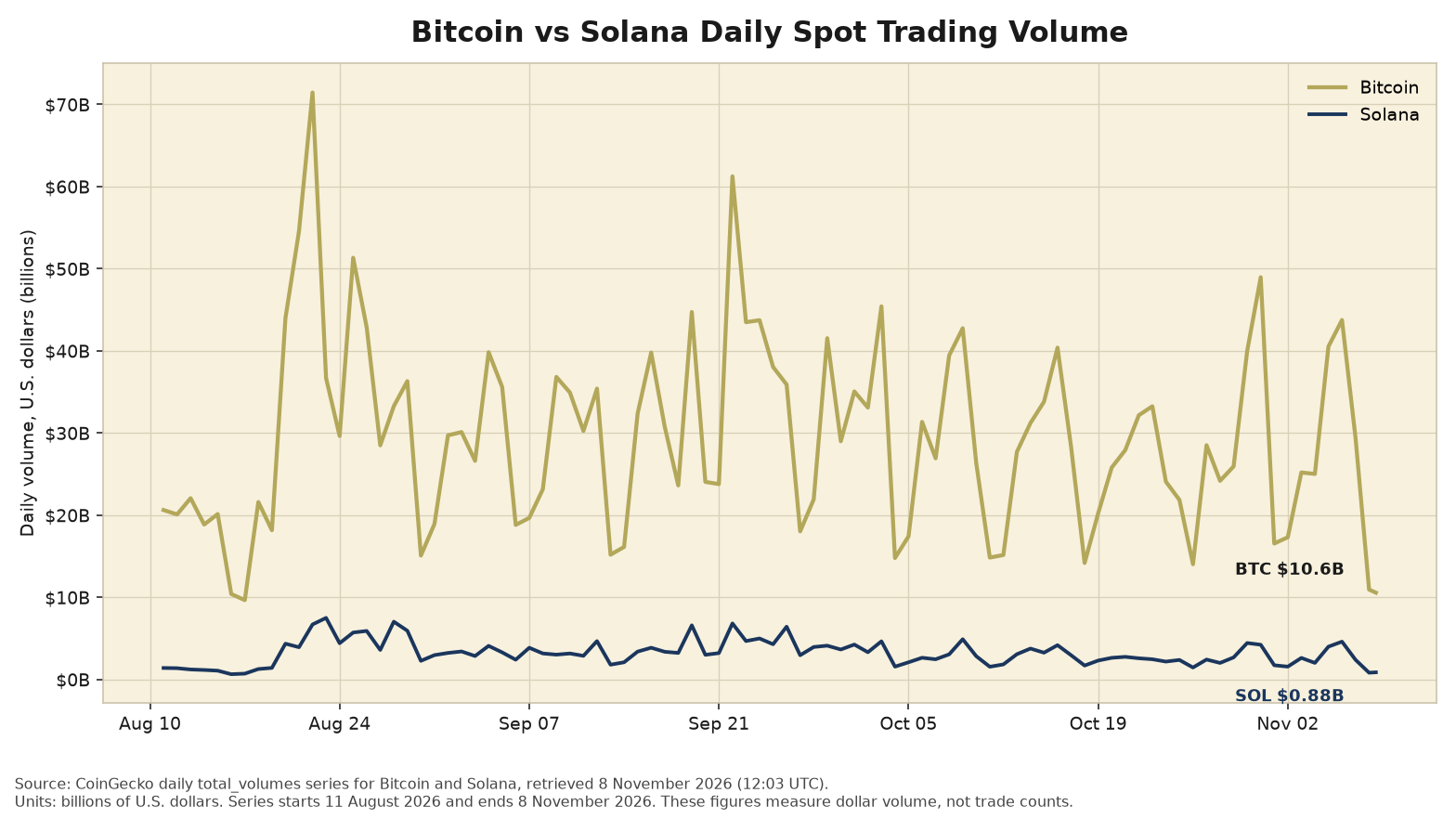
We would look at both measures together. Solana can clear a remarkable number of small on-chain swaps, while Bitcoin still accounts for a much larger share of crypto’s dollar turnover.
How Does Digital Asset Trading Compare With Traditional Markets?
Fidelity argued that the infrastructure required to process a digital-asset trade is not fundamentally different from the plumbing used for equities, currencies or other financial assets.
Faster, more reliable block production can help market makers update quotes and handle bursts of activity. Higher compute-unit limits give the network more room before congestion sets in.
The report also described a shift toward proprietary automated market makers, where professional firms deploy their own capital and reprice inventory continuously rather than relying only on passive liquidity pools.
Tokenized assets are the other path Fidelity highlighted. It said Treasuries, private credit, equities, commodities and similar instruments are increasingly trading on public blockchains, even if adoption remains early and subject to transfer restrictions.
That matters for Bitcoin because it expands the set of instruments that can live on the same rails as digital collateral. It does not mean every tokenized product is a substitute for BTC.
We believe the constructive reading is straightforward: traditional finance is studying how on-chain venues clear trades at scale, and that research attention is another sign of institutional engagement with crypto market structure.
What Does a Solana vs Bitcoin Comparison Show Right Now?
A solana vs bitcoin comparison on November 8 still starts with size, not trade counts.
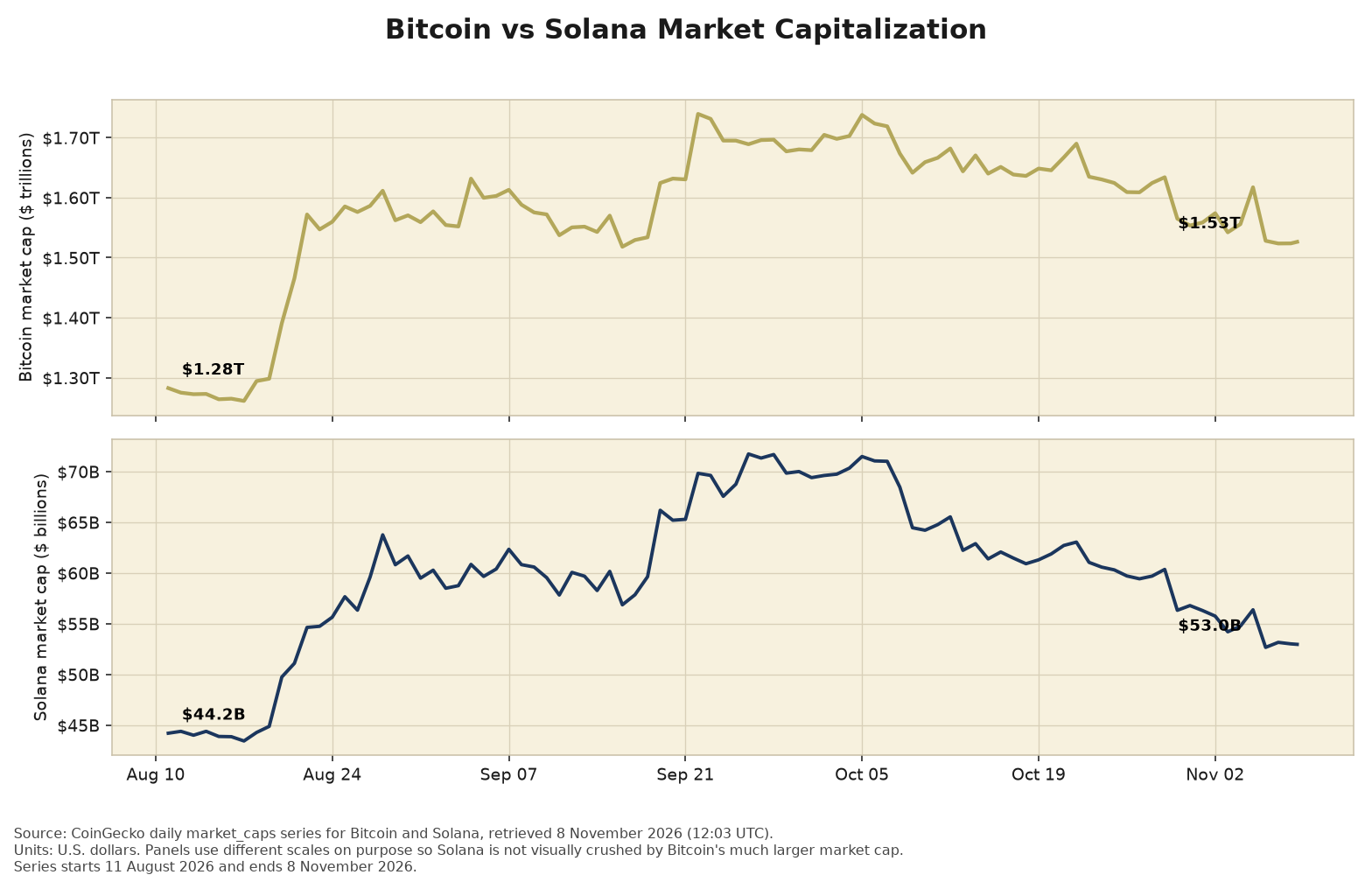
CoinGecko data retrieved the same day put Bitcoin near $75,900, with a market capitalization of about $1.53 trillion. Solana was near $89.63, with a market capitalization of about $53.0 billion, leaving Bitcoin roughly 29 times larger.
Bitcoin dominance stood near 60%, while Solana’s share of total crypto market value was about 2.1%. Over the past 30 days in the same CoinGecko series, Bitcoin declined about 8.1% from roughly $82,564, and Solana declined about 17.8% from roughly $109.07.
As we discussed when bitcoin dominance held near 59%, money has continued to treat Bitcoin as the market’s reserve asset even when other networks post eye-catching activity metrics.
Price context matters too. As we covered in our latest bitcoin price outlook, BTC has been digesting a heavy week of spot ETF outflows around the mid-$70,000s.
Could Growing On-Chain Markets Strengthen Bitcoin’s Role?
We do not read Fidelity’s trade-count comparison as a verdict that Bitcoin is being replaced. High-frequency rails can process millions of small swaps and still leave the monetary premium with the asset that has the deepest liquidity and the broadest institutional wrappers.
Bitcoin’s supply remains fixed. It can settle without an intermediary, and it already sits at the center of regulated products that traditional managers understand.
That is why we would watch two things at once: whether on-chain venues keep earning a place in institutional research, and whether Bitcoin holds its role as the collateral and benchmark asset beside them.
As we noted after Bitcoin slipped from the $80,000 area, pullbacks have repeatedly tested that benchmark status rather than ending it.
Fidelity itself warned that Solana’s fee revenue is tied to trading activity and can fade when opportunities dry up. The coming weeks will show whether more traditional firms study digital asset trading venues with the same seriousness. And if they do, Bitcoin holders may find that better market plumbing makes it easier, not harder, for long-term demand to express itself in BTC.
DC Forecasts is a leader in many crypto news categories, striving for the highest journalistic standards and abiding by a strict set of editorial policies. If you are interested to offer your expertise or contribute to our news website, feel free to contact us at [email protected]












Discussion about this post