



FinCEN and the Federal Reserve are withdrawing a 2020 plan that would have tightened the crypto travel rule by cutting the international funds-transfer threshold from $3,000 to $250.
The unpublished withdrawal, filed on Nov. 6 and scheduled for the Federal Register on Nov. 9, 2026, says the agencies will take no further action on the Oct. 27, 2020 proposal.
That notice drew nearly 3,000 comments, most opposing a lower Bank Secrecy Act line for cross-border transfers.
For Bitcoin investors, the issue is whether crypto regulation will be written for today’s market.
The bigger question now is what keeping the $3,000 threshold could mean for Bitcoin adoption.
What Did FinCEN and the Federal Reserve Withdraw?
The 2020 notice, published at 85 FR 68005, would have lowered the Recordkeeping Rule threshold from $3,000 to $250 for funds transfers that begin or end outside the United States.
FinCEN also proposed the same $250 cut for the Travel Rule, which requires institutions to pass specified information along the payment chain.
The same October 2020 notice of proposed rulemaking would have revised the definitions of “payment order” and “transmittal order” so that “money” clearly included convertible virtual currency and legal-tender digital assets, in both domestic and cross-border transactions.
We believe that point is easy to overread. Withdrawing the notice does not repeal other Bank Secrecy Act obligations, and the agencies did not say Bitcoin transfers are exempt from existing rules.

They did say this proposal will not become a final rule without a fresh chance for the public to comment.
Why Did a $250 Threshold Draw Nearly 3,000 Comments?
Comments came from banks, money transmitters, trade associations, and individuals. Sentiment generally opposed the $250 cut.
Many argued a lower line would burden smaller institutions and multiply the transfers that require collection and transmission of personal information.
Several warned it could disrupt remittances and push consumers toward less regulated channels. Others said some potentially illicit activity below $3,000 is already reported through Suspicious Activity Reports.
Several letters argued that inflation since the original threshold was adopted in 1995 pointed toward a higher line, not a lower one.
Views were mixed on covering convertible virtual currency more explicitly. Companies that handle those assets cited technology limits and the lack of a shared international messaging standard at the time, while some banks and money transmitters supported the clarification.
What Does the Crypto Travel Rule Mean for Bitcoin?
In everyday language, the crypto travel rule is the idea that when a regulated institution sends value above a set amount, originator and beneficiary information should travel with the transfer.
Bitcoin itself does not need a bank message to settle. A holder who controls their own keys can move coins when the network confirms the transaction.
Money transmitters sit in a different place. They are the layer where a dollar threshold and cross-border routing become a compliance question rather than a protocol question.
That distinction matters after other recent headlines. We examined how FinCEN’s order affecting MEXC focused on an overseas platform’s access to the U.S. financial system, not on Bitcoin’s settlement rules.
It also lands beside the crypto compliance warning around discount USDT deposits we covered on Nov. 8: intermediaries can review rails, while Bitcoin’s base layer keeps producing blocks.
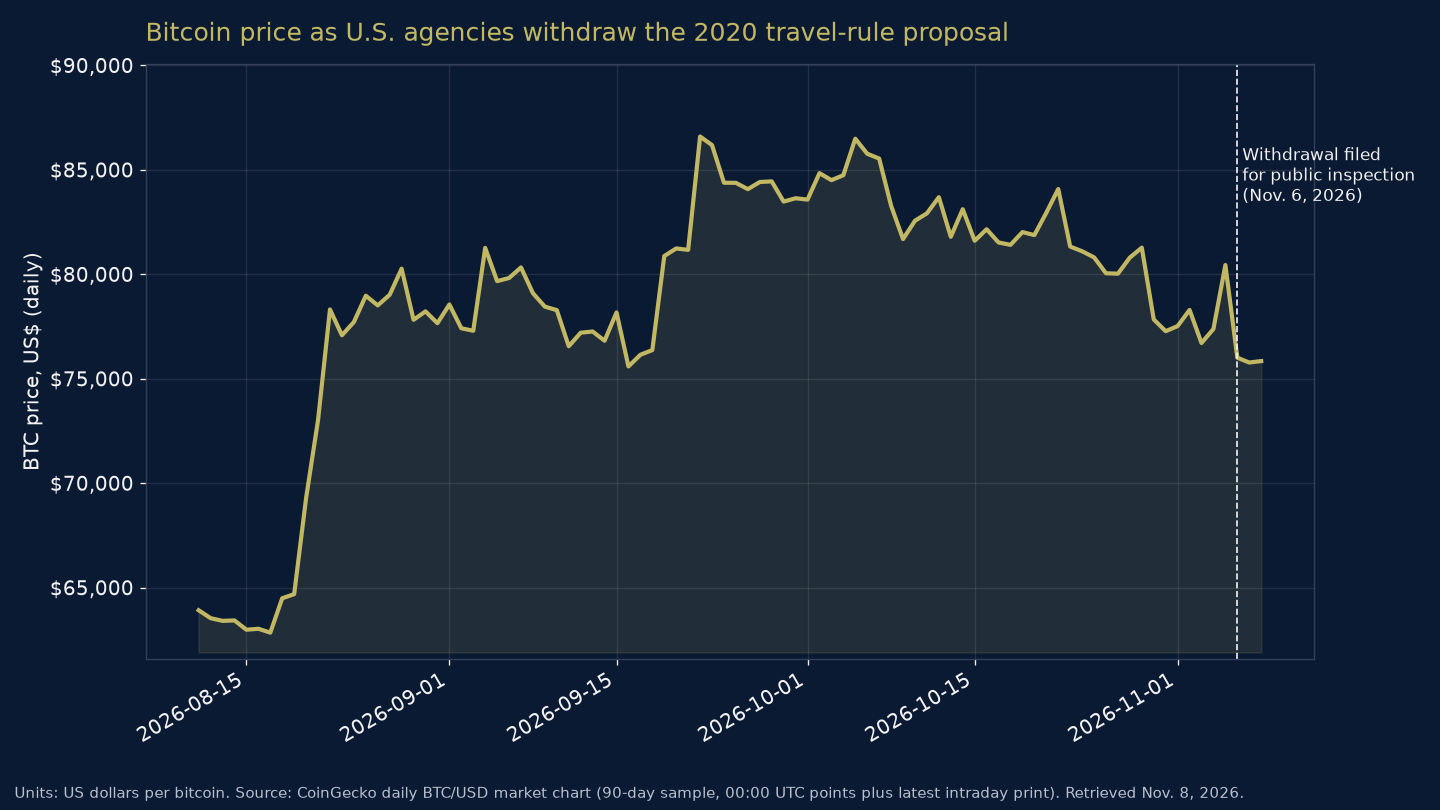
CoinGecko data retrieved on Nov. 8, 2026, put Bitcoin near $75,849. At that price, $3,000 is about 0.040 bitcoin, and $250 is about 0.0033 bitcoin.
How Have Inflation and New Laws Changed the Picture?
The agencies gave two main reasons for stopping.
First, more than five years have passed. They want additional public feedback before adopting similar amendments, and they withdrew the notice so no final rule will come from that file without another comment period.
Second, they point to new legal frameworks in convertible virtual currency markets, including the Guiding and Establishing National Innovation for U.S. Stablecoins Act, enacted on July 18, 2025, as Public Law 119-27.
The withdrawal also cites the White House report Strengthening American Leadership in Digital Financial Technology and Executive Order 14178, published at 90 FR 8647 on Jan. 31, 2025.
Those citations show the agencies want future recordkeeping changes to fit a market that now has a federal payment-stablecoin statute.
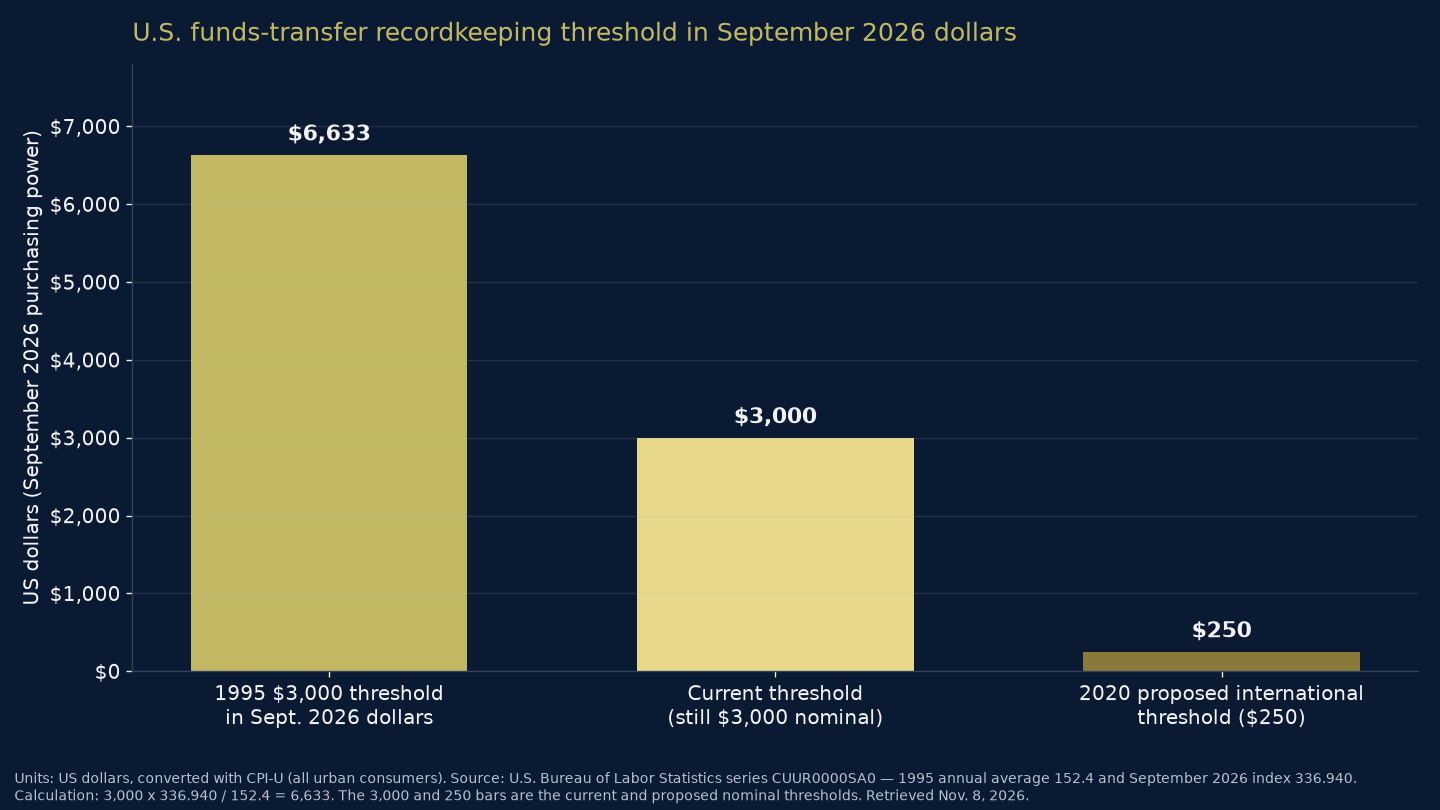
Official prices support the inflation point. The U.S. Bureau of Labor Statistics consumer price index for all urban consumers averaged 152.4 in 1995 and stood at 336.940 in September 2026, so $3,000 in 1995 dollars equals about $6,633 today.
The current $3,000 line is worth roughly 45% of its original real value, and the proposed $250 line would have been about 4% of that inflation-adjusted amount.
Could Clearer Crypto Regulation Help Bitcoin Adoption?
We believe a paused, stale proposal is better than a surprise $250 net around ordinary cross-border transfers.
A lower threshold would have pulled many more small bitcoin transfers into the same machinery.
Commenters feared that friction could shove users toward less transparent channels. Keeping the $3,000 line avoids that jump without pretending illicit-finance rules have disappeared.
Future bitcoin regulation may still revisit the dollar amount and how convertible virtual currency is described after a new comment period.
That path rhymes with the broader debate we described when looking at crypto market structure under a shifting Senate Banking landscape: clarity can support adoption when it is designed for how Bitcoin is actually used.
Bitcoin’s fixed supply and open settlement do not depend on a single threshold in Title 31. They do benefit when people can hold and transfer BTC through rules that are understandable and open to comment.
The coming weeks will show the official Federal Register publication on Nov. 9 and whether the agencies open a new conversation built for the market Bitcoin is growing into.
DC Forecasts is a leader in many crypto news categories, striving for the highest journalistic standards and abiding by a strict set of editorial policies. If you are interested to offer your expertise or contribute to our news website, feel free to contact us at [email protected]












Discussion about this post