


The latest bitcoin futures prints from Binance’s BTCUSDT perpetual contract are sending a quieter signal than last week’s sharp price swing: leverage unwound, then began to rebuild, without funding rates running hot.
The most recent settled eight-hour bitcoin funding rate, at 08:00 UTC on Nov. 8, was 0.0072%. Later that day the exchange’s indicated rate sat near 0.0046%, and coin-denominated open interest stood at about 96,137 bitcoin.
For Bitcoin investors, that mix describes how much borrowed risk is sitting on top of the spot market, and whether a calmer futures backdrop can help Bitcoin hold around $76,000.
What Happened to Bitcoin Futures Open Interest?
Daily Binance data show BTCUSDT perpetual open interest peaking at 99,018 bitcoin on Nov. 3.
By Nov. 6, after Bitcoin’s CoinGecko daily price slipped from about $80,443 on Nov. 5 to about $76,006, that open interest had fallen to 94,179 bitcoin. Notional value that day, at $7.16 billion, was the lowest in the 31-day sample we pulled.
As we covered when crypto liquidations topped $1 billion, that window flushed a lot of borrowed positions. The futures ledger shows the scar, then a partial repair.
By the Nov. 8 daily snapshot, open interest had climbed back to 96,025 bitcoin, or about $7.28 billion. A later live reading the same day put it at 96,137 bitcoin, recovering roughly 1,958 of the 4,839 bitcoin shed between Nov. 3 and Nov. 6, about 40% of that drawdown.
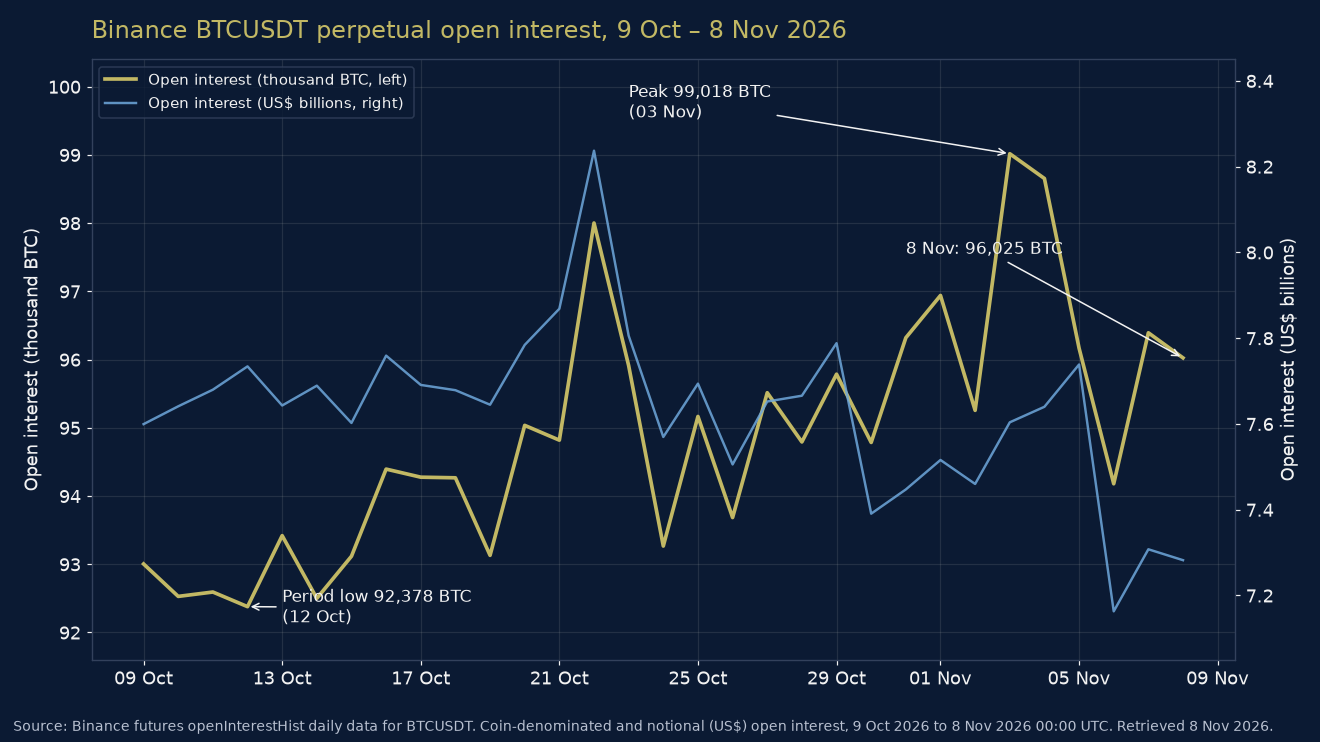
Over the full month from Oct. 9, coin-denominated open interest is up 3.2%, from 93,004 to 96,025 bitcoin, even though dollar open interest is down 4.2% because the price is lower. The period low in coin terms was earlier: 92,378 bitcoin on Oct. 12.
How Does the Bitcoin Funding Rate Look Right Now?
The bitcoin funding rate is the periodic payment exchanged between longs and shorts on a perpetual contract, designed to keep the futures price close to spot. When the rate is positive, longs pay shorts; when it is negative, shorts pay longs.

On Binance, the familiar cap many traders watch is 0.01% every eight hours. Across 200 eight-hour prints from Sept. 3 through Nov. 8, the average rate was about 0.0050%. Twenty of those prints were negative, and the last negative reading was -0.0014% on Oct. 22.
The past two weeks have been modestly positive. The 14-day average is 0.0080% per eight hours, equal to roughly 8.8% annualized, below the about 11.0% a market stuck at the 0.01% cap would produce.
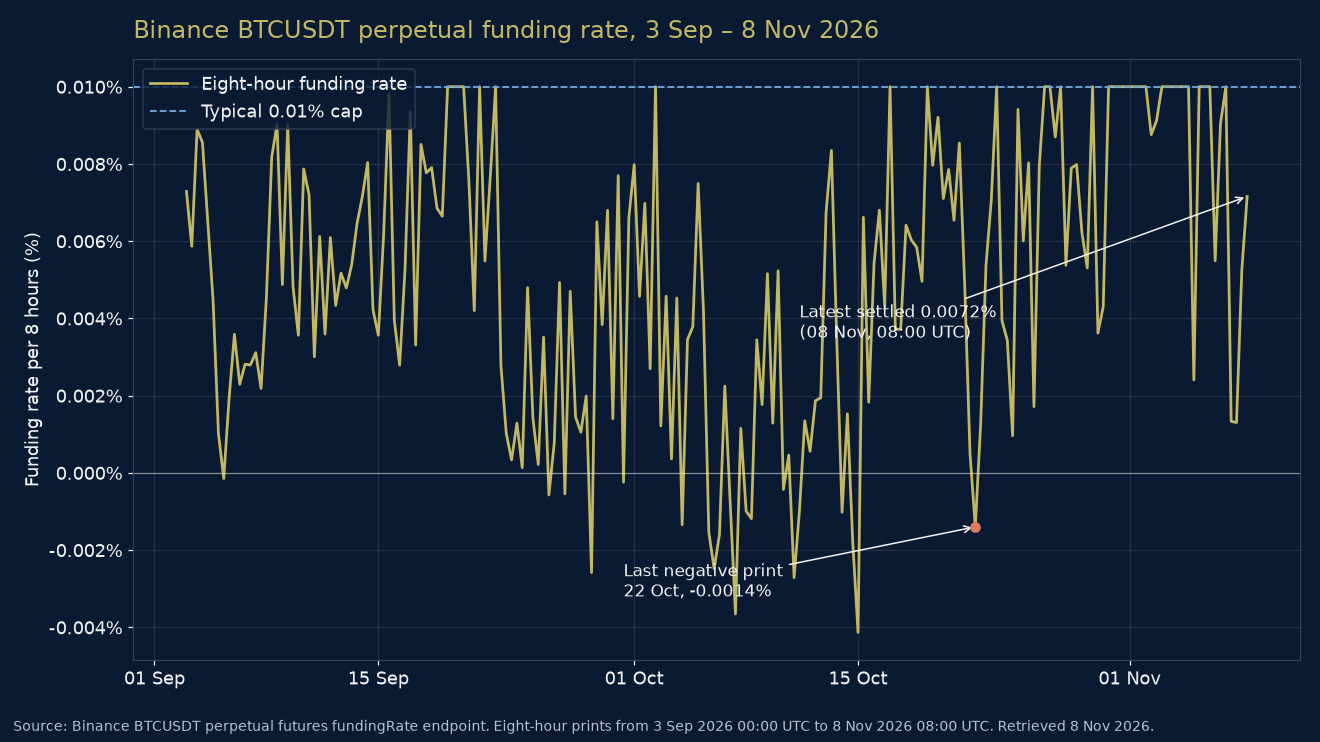
The cap was last touched at 00:00 UTC on Nov. 7, but funding did not stay pinned there. By the next day’s 08:00 UTC settlement it had eased to 0.0072%. We believe that profile is closer to interest being present than to leverage being overheated.
What Does This Mean for Bitcoin Futures Trading?
For bitcoin futures trading, a mildly positive funding rate means longs are paying a small carry to stay long. That is a constructive sign that demand to be long still exceeds demand to be short, without the expensive crowding that often precedes a shakeout.
Binance’s global long/short account ratio on Nov. 8 showed about 75.5% of accounts long and 24.5% short, a ratio of 3.08. That counts accounts, not position size, so it is not proof that notional risk is three-to-one long. It does suggest more retail accounts are leaning long even as the funding they pay remains modest.
Why Coin-Denominated Open Interest Tells a Clearer Story
Dollar open interest can fall simply because Bitcoin’s price fell, even if traders did not close contracts. From Oct. 9 to Nov. 8, bitcoin open interest rose by about 3,021 contracts while notional value dropped by roughly $317 million, from $7.60 billion to $7.28 billion.
The peak notional value in our sample was $8.24 billion on Oct. 22, the same day funding last printed negative. Since then, dollar open interest has compressed as price worked lower, including through the slide we discussed in our Bitcoin price outlook after a $1.28 billion ETF outflow week.
Coin-denominated open interest strips out that price effect. After the Nov. 3-6 flush, traders added back some exposure in bitcoin terms rather than abandoning the market.
That reading sits alongside the softer spot-market liquidity we described when crypto liquidity hit a 12-month low. Thinner stablecoin dry powder and rebuilding futures exposure can coexist; they argue for patience, not an automatic melt-up.
Could Calmer Crypto Futures Help Bitcoin Holders?
We would look for three things if this reset is going to help the next advance. First, the bitcoin funding rate should stay near or below that 0.01% cap instead of pinning there for days. Second, open interest can rebuild, but we would rather see it rise with price than sprint ahead of it. Third, spot demand, including ETF flows, still has to do the heavy lifting.
None of that is a guarantee. Crypto futures can reload quickly, and Binance’s BTCUSDT perpetual is one venue, not the entire derivatives universe, even if it is the benchmark many traders watch.
Bitcoin itself, according to CoinGecko data retrieved on Nov. 8, was changing hands near $76,020, only a fraction higher on the day, well below the sample high near $105,951 on Nov. 11, 2025 and well above the 2026 low near $58,566 on July 1.
We believe a market that has already shed some borrowed risk, and is not paying extreme funding to stay long, is in a healthier place to attract genuine buyers. Bitcoin’s fixed 21 million supply and the growing institutional pipes around it do not depend on any single futures print.
The coming sessions will reveal whether this rebuilt open interest is patient capital, or just the first draft of the next crowded trade.
DC Forecasts is a leader in many crypto news categories, striving for the highest journalistic standards and abiding by a strict set of editorial policies. If you are interested to offer your expertise or contribute to our news website, feel free to contact us at [email protected]












Discussion about this post