


The European Commission said on Nov. 6 that it has launched an EU Crypto Sanctions Task Force, an enforcement step in Europe’s crypto regulation meant to detect and stop attempts to dodge EU financial sanctions through crypto assets.
Commissioner Maria Luís Albuquerque, who is responsible for sanctions implementation, made the announcement after chairing the tenth meeting of the High-Level Expert Group on Union Restrictive Measures on Nov. 5.
The same day, EU Sanctions Envoy David O’Sullivan told a wider partner forum that officials had discussed how to respond to what the Commission called crypto-lead evasion schemes.
For Bitcoin holders, the practical point is what Brussels actually wrote: the new unit is aimed at circumvention of existing sanctions, not at banning lawful bitcoin ownership.
What the Commission Announced After Its Nov. 5 Meeting
In a Nov. 6 statement, the Commission said Albuquerque chaired the expert group’s tenth meeting the previous day.
High-level representatives from EU Member States took part, alongside the European Commission and the European External Action Service.
Officials discussed three priorities: emerging financial threats such as the use of crypto assets; the role of the European Anti-Fraud Office, known as OLAF, in investigating sanctions circumvention; and Member States’ work to apply restrictive measures more consistently.
Albuquerque said sanctions are “putting significant pressure on Russia’s economy” and that “adopting sanctions is only the beginning.” She added: “Their real impact depends on how effectively and consistently we implement and enforce them.”
She then announced “the launch of the EU Crypto Sanctions Task Force,” describing it as “an important step in strengthening our capacity to detect and tackle attempts to circumvent EU financial sanctions through crypto assets.”

“We will not allow new technologies or third-country jurisdictions to become safe havens for sanctions evasion,” she said.
The statement did not name the task force’s staff, budget, legal powers, or a start date beyond the launch itself.
A Same-Day Forum Put Crypto-Lead Evasion on the Agenda
Also on Nov. 6, O’Sullivan convened the eighth Sanctions Coordinators Forum, according to a separate Commission statement.
The meeting brought together high-level representatives from all EU Member States and partners including the United Kingdom, the United States, Japan, South Korea, Canada, Australia, New Zealand, Liechtenstein, Norway, Switzerland and Iceland. Representatives of the Government of Ukraine joined for a dedicated session.
The Commission said discussions covered emerging circumvention trends, the international banking sector, “the strategic and operational response to tackle crypto-lead evasion schemes,” Russia’s military industrial complex, and further constraints on the energy sector.
O’Sullivan said partners “emphasised the need to close loopholes effectively and to crack down on circumvention to ensure maximum effect.”
How the Task Force Fits Europe’s Crypto Regulation
The task force sits beside, rather than inside, the licensing track we covered when Binance set a Dec. 31 deadline for affected EU accounts after missing a MiCA license.
MiCA is about who may offer crypto-asset services in the European Union. The new unit is about stopping sanctioned parties from using crypto assets to move value around those controls.
We believe tighter crypto compliance of this kind can be constructive for Bitcoin if it stays trained on illicit intermediaries instead of ordinary holders.
Bitcoin’s public ledger is, by design, easier to analyze than cash or informal value-transfer networks. That is one reason enforcement agencies keep returning to digital assets when they talk about circumvention.
Albuquerque did not say the EU was prohibiting residents from holding bitcoin, and she did not announce a new tax or a confiscation program for lawful coins.
Washington Tightened Its Own Enforcement the Same Week
The EU announcement landed in the same week the United States moved against a large offshore exchange.
As we reported, a FinCEN order is set to cut MEXC off from the U.S. financial system over alleged illicit flows tied to sanctioned jurisdictions.
That U.S. action and the EU task force are not the same measure. They do show authorities on both sides of the Atlantic spending more effort on crypto-asset rails they believe are used to evade sanctions.
Other recent compliance headlines, including the decision to keep the crypto travel rule threshold at $3,000, point to the same theme: the rulebook is being applied, not only drafted.
Bitcoin Held Near $75,700 as the Statements Were Published
CoinGecko market data retrieved on Nov. 8 put bitcoin near $75,707, down about 0.04% over 24 hours, about 2.85% over seven days, and about 8.58% over 30 days. In euro terms, a companion snapshot showed about €67,895.
Ether was near $2,228, down about 1.65% over seven days. XRP was near $1.16, down about 7.55% over seven days, and Solana was near $88.97, down about 6.10% over seven days.
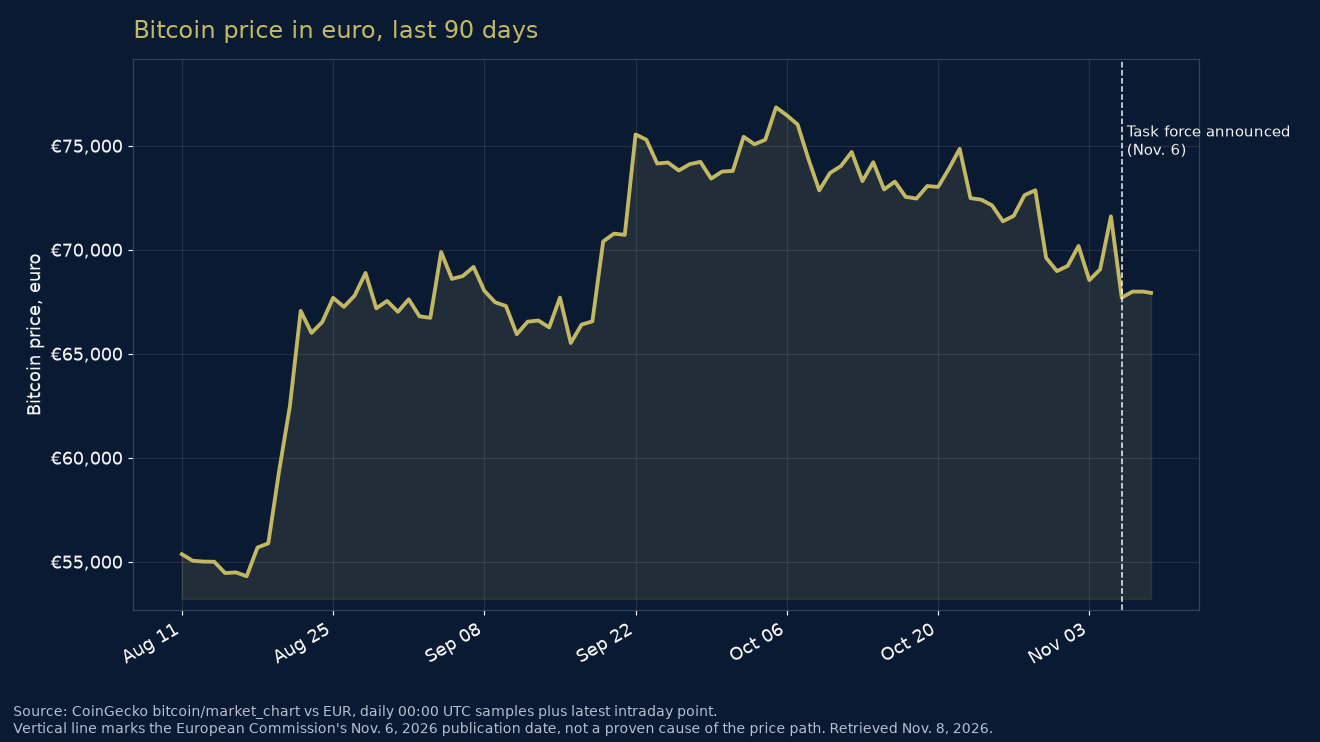
Daily CoinGecko samples show bitcoin near $80,443 at 00:00 UTC on Nov. 5 and near $76,006 at 00:00 UTC on Nov. 6, before a Nov. 8 reading near $75,702.
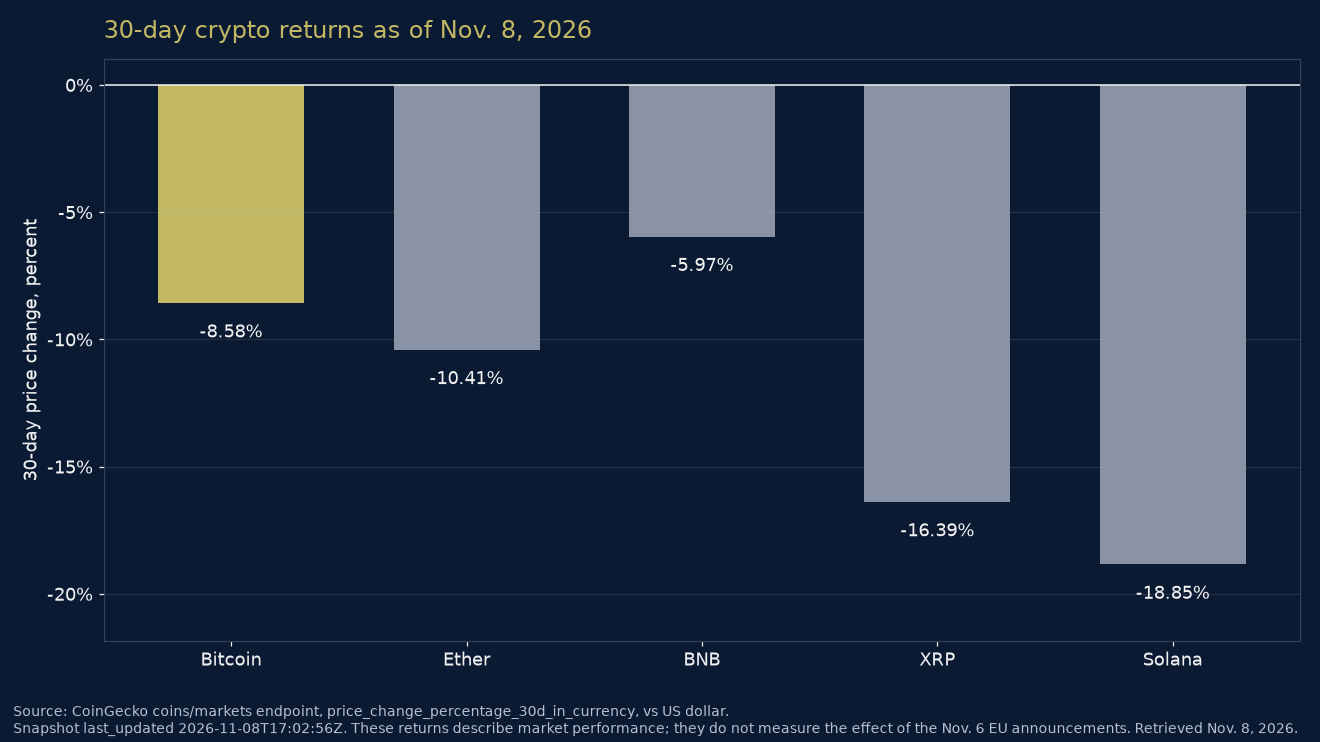
Those prints describe a soft stretch for risk assets. They do not show that the task force announcement caused the move, and we would not claim that it did.
Bitcoin’s declines over seven and 30 days were milder than the drops in XRP and Solana.
We would look next for the Commission to publish the task force’s membership, mandate, and first concrete cases. Until those details appear, the launch is an enforcement signal, not a new statute.
Lawful bitcoin held in self-custody, or moved through authorized venues, is not what the Nov. 6 statements describe. Bitcoin’s fixed supply does not change because a new coordination unit has been named, and we see clearer action against evasion as part of the long-term build-out around it.
DC Forecasts is a leader in many crypto news categories, striving for the highest journalistic standards and abiding by a strict set of editorial policies. If you are interested to offer your expertise or contribute to our news website, feel free to contact us at [email protected]












Discussion about this post