


The Bitcoin block reward is still 3.125 BTC, and 74,900 blocks remain before it is cut in half again.
According to mempool.space data retrieved on Sunday, November 8, the chain tip is at block 975,100, with the next halving scheduled at block 1,050,000.
At the 10-minute target that is about 520 days away, which points to mid-April 2028.
For Bitcoin holders, the interesting detail is how little of each reward comes from fees today.
The bigger question is how the reward mix evolves as the subsidy keeps stepping down.
How Far Along Is the Bitcoin Block Reward Schedule?
Bitcoin started at 50 BTC per block, and the subsidy has halved four times since. At block 975,100 that arithmetic puts roughly 20.11 million BTC in existence.
That is about 95.8% of the 21 million cap. Fewer than 890,000 coins remain to be issued, and they will trickle out over more than a century.
Think about what that means. Almost all of the supply is already out, and the remaining issuance gets slower every four years.
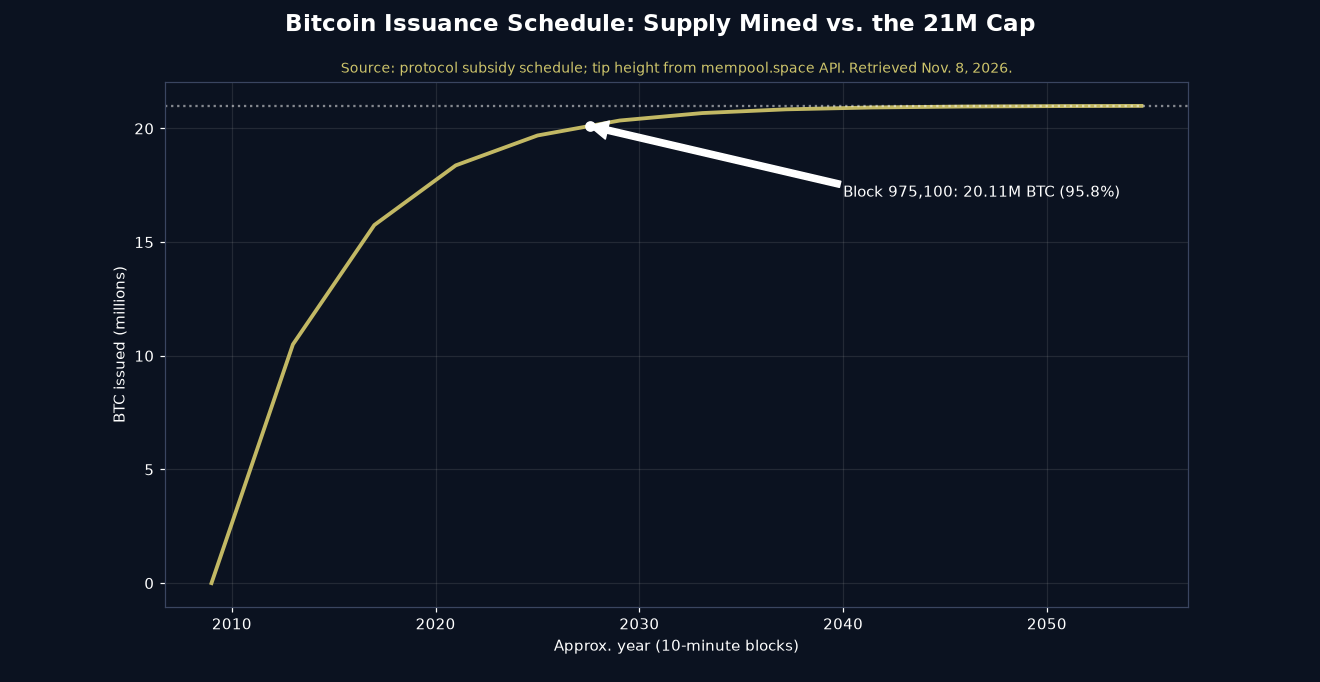
The schedule is also why we call Bitcoin’s monetary policy predictable. Anyone can compute the supply at any block height, and the arithmetic matches what the network reports.

No other major asset publishes its entire future issuance in advance. That transparency is a core part of the Bitcoin investment case.
What Happens to Miner Income at the Next Halving?
At block 1,050,000 the subsidy drops from 3.125 BTC to 1.5625 BTC. Every halving is a built-in test of miner efficiency.
Past halvings have come and gone while the network kept producing blocks. The design rewards operators who run efficient machines on cheap power.
That is the same dynamic we saw when we looked at Bitcoin heaters in Finnish homes, where mining revenue is offset by a use for the waste heat.
We believe this pressure is a feature. It pushes the industry toward the lowest-cost, most innovative energy sources.
Hashrate has shown that resilience too. As we covered when hashrate sat near 980 EH/s, the difficulty rule keeps the system balanced even when miners switch machines on and off.
The halving adds one more variable to that balance. Miners will need to weigh price, fees and difficulty together.
How Big Are Fees Compared With the Subsidy?
This is where the honest numbers matter. Over the last 144 blocks, about one day of production, miners earned 3.65 BTC in fees on top of 450 BTC in subsidy.
That is fees of roughly 0.8% of the total reward.
Across the past 12 months, the average share was about 0.65% and the median about 0.59%, based on mempool.space fee data for each interval.
The peak came on February 5, 2026, when fees reached roughly 2.5% of the reward in a single interval. Only about 7% of intervals in the year topped 1%.
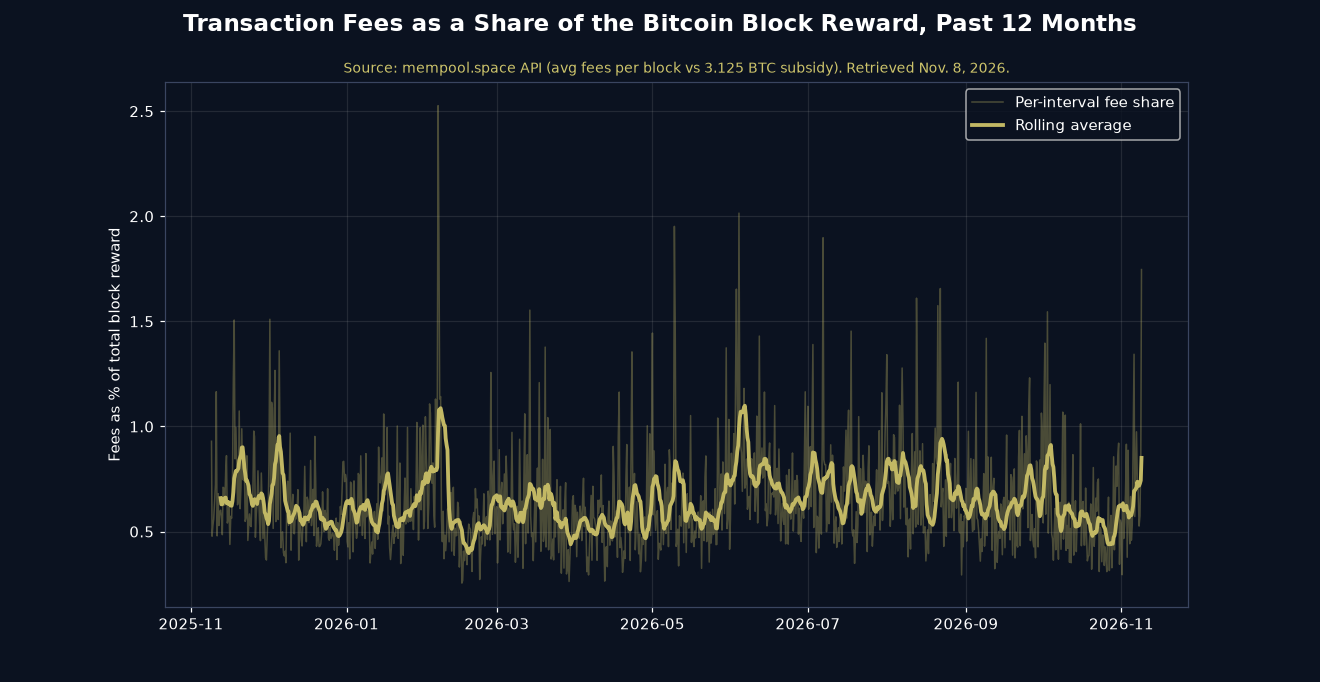
That context matters when reading the chart. A fee share below 1% is not a sign that anything is broken, because the subsidy was designed to carry the network in its early decades.
Fees are small today. The next-block recommended fee on mempool.space is just 1 to 2 sats per virtual byte.
Why Are Low Fees Not a Weakness for Bitcoin?
Low fees mean the chain has room. Blocks are not congested, and users can move value cheaply.
It also means the fee market has a large upside as adoption grows. Even a few more percentage points of the reward coming from fees would be a meaningful change for miners.
Our recent look at how 11,360 transactions fit in one block showed how much capacity each block can carry. More activity per block is the clearest route to higher fee income.
Think of it as a slow handover. The subsidy fades by design while fees get decades to grow into the gap.
That matters because the subsidy is on a fixed path down. Fees are the part that can grow with demand.
We should also be clear that fee growth is not guaranteed. It depends on adoption, layer-2 activity and how people use the base chain.
What Should Bitcoin Investors Watch Before April 2028?
We would keep an eye on a few simple indicators as the halving approaches:
- The fee share of the reward, now near 0.8% over the latest day
- The pace of blocks, which sets the real halving date
- Network hashrate and difficulty after each retarget
Block times matter because the halving is tied to block height, not a calendar. Slower blocks push the date later, and faster ones pull it forward.
For long-term holders, the structure remains the attraction. Supply is fixed, issuance is predictable, and no one can change the schedule.
Roughly 95.8% of all bitcoin is already out there, and the remaining 4.2% will arrive ever more slowly.
The next 74,900 blocks will show how far fees can carry the network as the subsidy keeps shrinking.
DC Forecasts is a leader in many crypto news categories, striving for the highest journalistic standards and abiding by a strict set of editorial policies. If you are interested to offer your expertise or contribute to our news website, feel free to contact us at [email protected]










Discussion about this post