



Bitcoin options traders are still leaning toward upside, even after BTC slipped to about $74,600 late on November 8.
Deribit’s public order book data shows 200,865 BTC of open call contracts against 138,864 BTC of puts.
That works out to a put-to-call ratio of 0.69 across roughly $25.3 billion in notional exposure.
For Bitcoin investors, the most interesting detail is where those calls sit: the single largest strike for the November 27 monthly expiry is $90,000.
The bigger question now is whether that positioning is stubborn optimism or an early read on the next leg.
How Big Is the Bitcoin Options Book Right Now?
We pulled the full BTC options book summary from Deribit’s public API just after midnight Asia/Jerusalem time on November 9.
Open interest across every listed expiry totals about 339,700 BTC.
The book is heavily concentrated in two dates.
- December 25, 2026: 83,666 BTC in calls and 56,760 BTC in puts, or about 41% of all open interest.
- November 27, 2026: 39,935 BTC in calls and 32,743 BTC in puts, about 21% of the total.
- November 13, 2026: 19,839 BTC in calls and 13,496 BTC in puts.
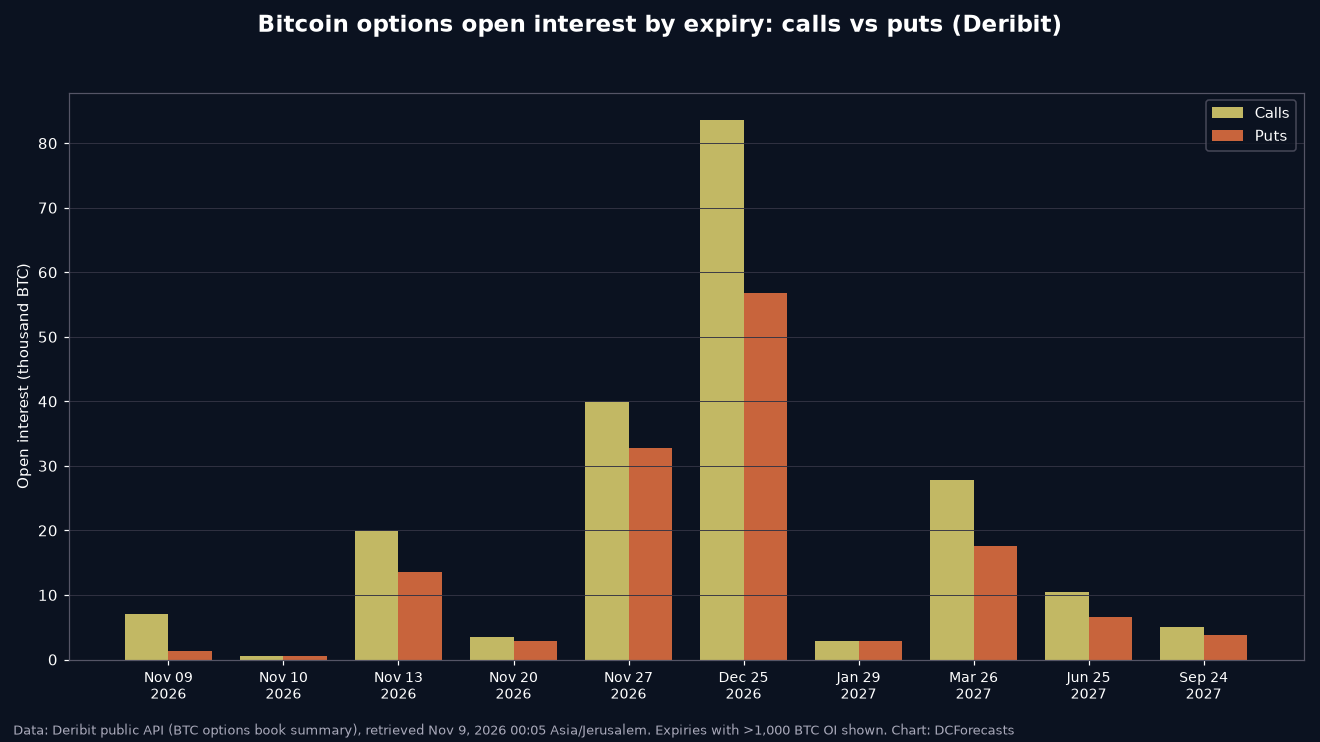
Calls outnumber puts at every major expiry from November 13 through September 2027.

The longer-dated books lean even harder that way.
The March 26, 2027 expiry carries about 27,800 BTC in calls against 17,576 BTC in puts, a ratio of 0.63.
In December, the largest call strikes are $80,000, $100,000 and $120,000, while the biggest put blocks sit at $60,000 and $40,000.
That matters because the spot price has moved the other way.
Why Are Calls Still Winning While BTC Slides?
CoinGecko daily data shows Bitcoin near $84,100 on October 22 and around $74,500 on November 8, a drop of roughly 11%.
The past 24 hours alone shaved about 1.6% off the price.
Yet the latest trading volume still tilted toward calls, with about 3,360 BTC of calls changing hands against roughly 2,000 BTC of puts.
We believe that split says something useful.
Traders are paying for protection, but they are not abandoning upside exposure into a falling tape.
In a panicked market, we would expect put volume to run well ahead of calls. That is not what this snapshot shows.
That fits what we saw in futures, where funding rates sat close to neutral rather than flashing panic.
Leverage has cooled without positioning turning outright bearish.
Where Do the Biggest Strikes Sit for November 27?
The November 27 monthly expiry gives the clearest map of where traders are placing bets.
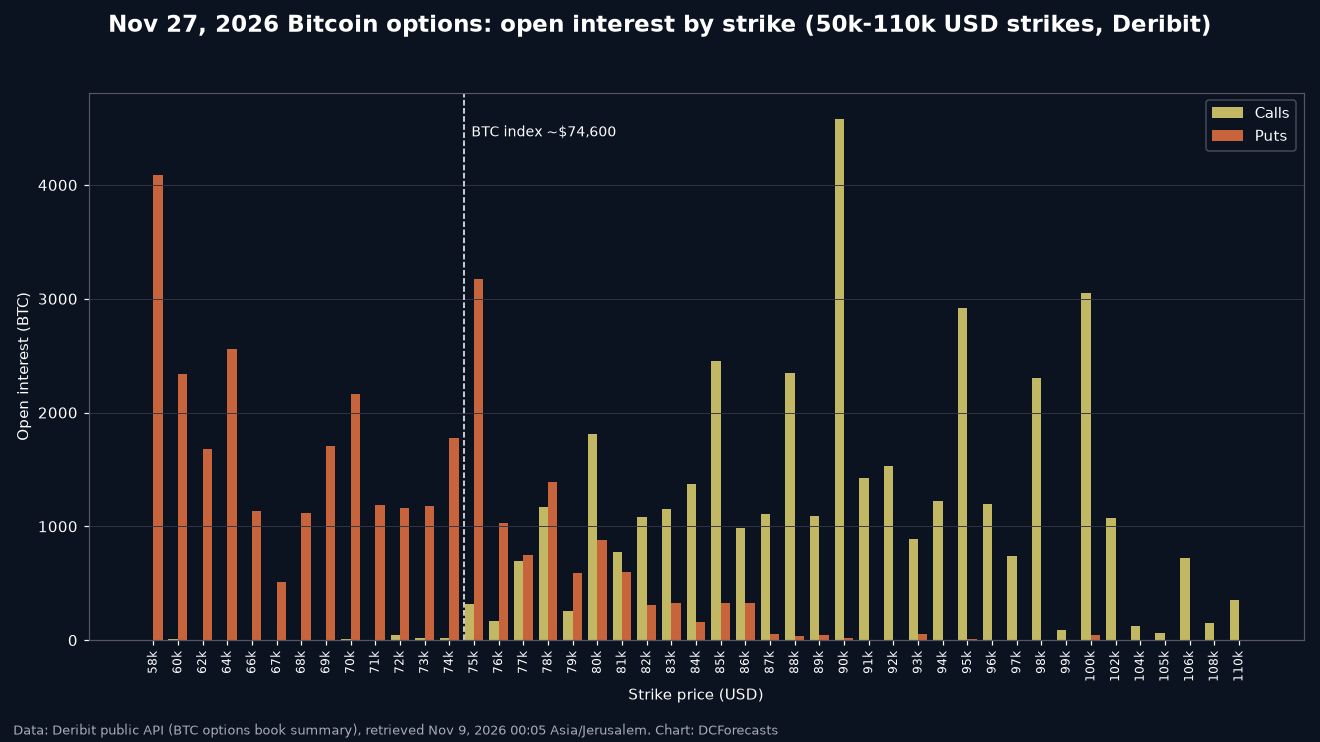
On the call side, the heaviest strikes are $90,000 (about 4,580 BTC), $100,000 (about 3,050 BTC) and $95,000 (about 2,920 BTC).
On the put side, the largest blocks sit at $58,000 (about 4,090 BTC) and $75,000 (about 3,170 BTC).
The evidence here is the placement of contracts, not their direction.
Open interest does not tell us whether a trader bought or sold a given option.
A large $58,000 put position can be a cheap hedge from a long holder, and some $90,000 calls may be written against spot holdings.
Our interpretation is simpler: the market has priced a wide range, and much of the call interest still sits well above today’s price.
What Is Bitcoin Implied Volatility Signalling?
Deribit’s DVOL index, a 30-day measure of Bitcoin implied volatility, closed November 8 at 41.6.
It traded mostly between 34 and 39 through September and October, with a low near 33.6 on September 17.
So option buyers are paying more for movement than they were a month ago.
That is an honest sign of nerves after the slide.
Still, 41.6 is a moderate reading by Bitcoin’s own standards.
The same index closed at 114.7 on November 9, 2022, during the FTX collapse, and above 100 on several days in May and June 2022.
We read it as caution, not capitulation.
It also means a sharp rebound would be partly priced, rather than catching the market completely off guard.
Can BTC Reclaim $80,000 Before the Monthly Expiry?
Using the standard max pain calculation, which finds the price where option holders collectively lose the most at expiry, we get $80,000 for November 27.
The same method gives $78,000 for this Friday’s November 13 expiry and $75,000 for December 25.
Max pain is not a forecast, and spot prices often finish far from it.
But it does mark where the book’s open interest is centred.
From about $74,600, a move to $80,000 needs a gain of roughly 7.2%.
A run to the $90,000 call wall would need about 20.6%.
We would watch three things in the coming weeks:
- Whether the put-to-call ratio stays below 0.8 as the slide continues.
- Whether DVOL eases back under 40, which would suggest calmer hedging demand.
- Whether spot can hold above the 200-day moving average zone we tracked last week.
For us, the key takeaway is that derivatives traders have marked down the price but not the upside.
Bitcoin’s fixed 21 million supply, a maturing options market and deep institutional plumbing give that patience a foundation.
The coming weeks will reveal whether those $90,000 calls were early or simply ahead of the crowd.
DC Forecasts is a leader in many crypto news categories, striving for the highest journalistic standards and abiding by a strict set of editorial policies. If you are interested to offer your expertise or contribute to our news website, feel free to contact us at [email protected]











Discussion about this post