



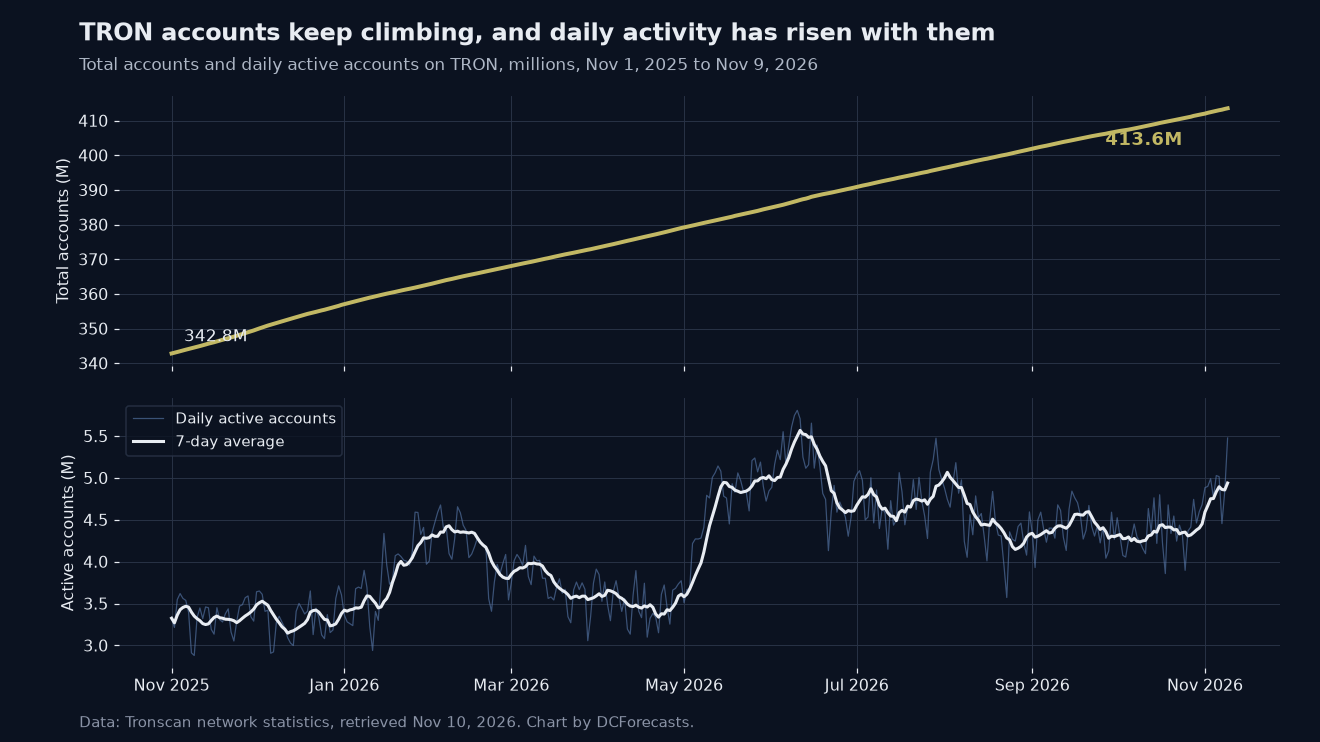
Tron USDT supply has reached $92.3 billion, and the network now carries about $25 billion more of Tether’s dollar token than Ethereum does. At the same time, Tron’s account count has passed 413 million, up roughly 69 million in a single year.
Those two numbers tell a story of a blockchain that has quietly become one of the busiest payment rails in crypto. The details underneath are more mixed than the headline totals suggest, and that is what makes them worth a closer look.
413 million accounts and still climbing
Network statistics published by Tronscan, the TRON block explorer, show 413,556,736 total accounts on November 9, 2026. A year earlier, on November 9, 2025, the count stood at 344,482,111.
That is an increase of about 69.1 million accounts, or 20%, in twelve months. Accounts holding a TRX balance grew at a similar pace, to 247.7 million from 207.0 million.
Total accounts only ever go up, so the more useful signal is how many of them are actually doing something. Here the trend is stronger. Daily active accounts averaged about 4.57 million over the 30 days to November 9, compared with about 3.36 million in the same window a year ago, a rise of roughly 36%.
November 9 itself logged 5,475,789 active accounts. That is the highest daily reading since June, when activity peaked at 5.81 million on June 10.
Fewer brand-new accounts, more people using the ones that exist
One figure moved the other way. New accounts per day averaged about 180,000 over the past 30 days, down from roughly 217,000 a year earlier, a drop of about 17%.
We believe that combination is healthier than it first looks. Growth that relies on a flood of fresh addresses can be inflated by airdrop farming or throwaway wallets. Here, sign-ups slowed while daily usage rose, which points to existing users coming back more often.
Transaction counts back that up. Tron processed about 11.84 million transactions per day over the last 30 days, compared with about 10.01 million a year ago, an 18% increase. The chain’s lifetime total has now passed 16.1 billion transactions.

Not all of that growth is payments, though. Transfers of TRC-10 tokens, Tron’s older native token standard, jumped to about 1.75 million a day from roughly 133,000 a year ago, accounting for a large share of the extra activity.
Why does Tron hold more USDT than Ethereum?
The bigger shift is in where Tether lives. According to DefiLlama’s stablecoin dashboard, USDT issued on TRON grew from about $76.9 billion on November 9, 2025 to $92.3 billion on November 10, 2026, a gain of roughly 20%.
USDT on Ethereum moved in the opposite direction over the same period, falling from about $85.8 billion at the start of November 2025 to $67.3 billion now. The two lines crossed at the end of January, and Tron has held the lead without interruption since February 5, 2026.
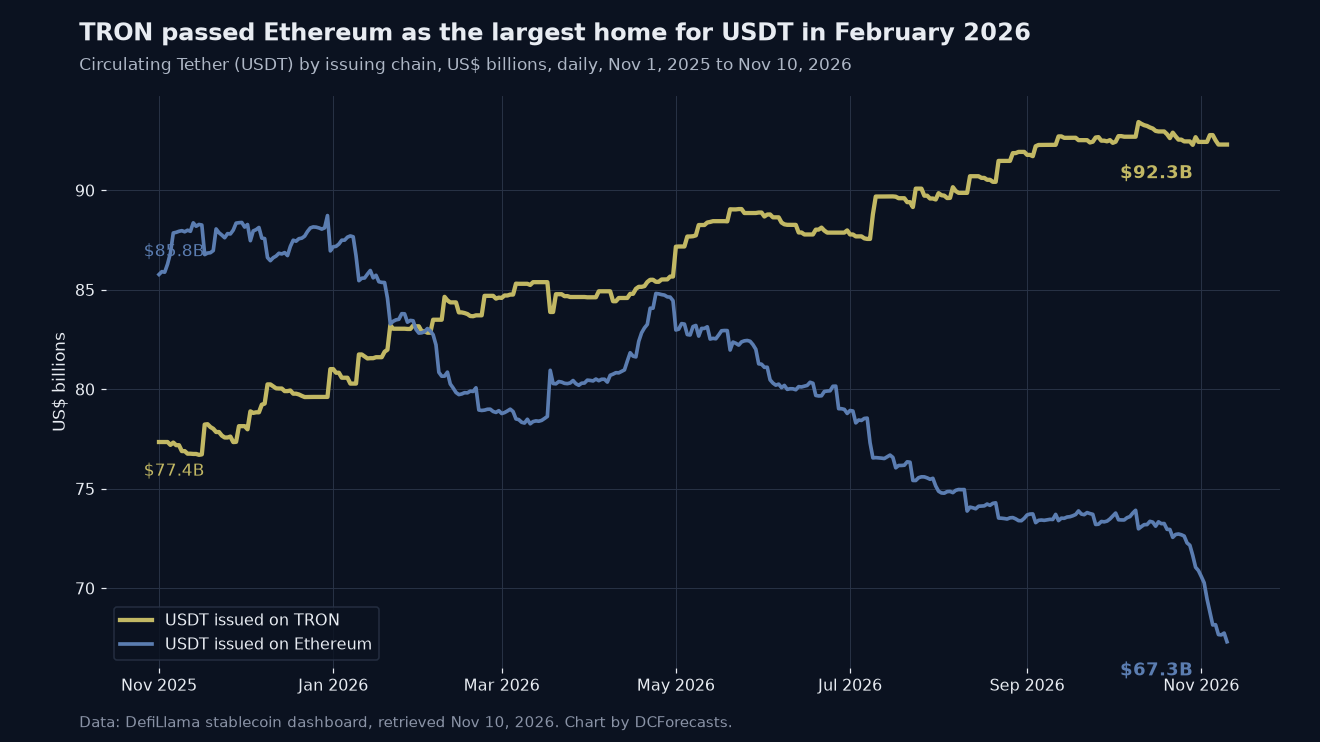
Across all dollar stablecoins, DefiLlama puts the total on Tron at about $93.6 billion, which means Tether accounts for nearly all of it. Low fees and fast confirmation times have helped make the network a common choice for exchange deposits and cross-border transfers.
For readers following stablecoin liquidity more broadly, we recently looked at how stablecoins now compare with Bitcoin’s market value, and at Europe’s effort to narrow the gap with dollar tokens.
The one number that did not keep pace
There is a wrinkle. Even as USDT supply on Tron climbed 20%, the number of USDT transfers on the network did not follow. Tronscan data shows about 2.21 million USDT transactions a day over the past 30 days, versus about 2.37 million a year earlier, a decline of roughly 7%.
In plain terms, more dollars are sitting on Tron, but they are moving in slightly fewer transactions. That could reflect larger average transfers, more balances parked by exchanges and treasuries, or activity shifting toward other tokens on the chain. The data alone does not settle which.
We think it is a point worth watching rather than a warning sign. A rising supply base gives the network more liquidity to work with, and transfer counts have bounced between growth and decline before.
What it means for TRX holders
TRX traded near $0.319 on Tuesday morning, up about 0.9% over 24 hours, according to CoinGecko, giving it a market value of roughly $30.3 billion. Bitcoin was changing hands near $74,700, up about 1.2% on the day.
Network usage and token price do not always move together. Even so, higher daily activity means more demand for the energy and bandwidth that transactions consume on Tron, and that resource model is tied directly to TRX.
For anyone tracking the trx price, the network’s fundamentals are a useful backdrop. Accounts are up 20% in a year, daily users are up about 36%, and the chain now hosts more USDT than any other.
A payments chain with room to grow
Tron’s past year shows a network maturing rather than simply expanding. New sign-ups have cooled, but the people already on the chain are using it more, and the dollar balances they hold have grown by about a fifth.
We believe the stablecoin economy is still early, and every dollar that settles on a public blockchain strengthens the case for open, borderless money that Bitcoin pioneered. The next test for Tron is whether USDT transfer counts can start rising again alongside its growing balance sheet. Either way, the steady expansion of on-chain dollars is a constructive signal for crypto markets as a whole.
DC Forecasts is a leader in many crypto news categories, striving for the highest journalistic standards and abiding by a strict set of editorial policies. If you are interested to offer your expertise or contribute to our news website, feel free to contact us at [email protected]












Discussion about this post