



The Morgan Stanley bitcoin ETF was the only US spot bitcoin fund to take in new money on Monday, November 9. While the market’s largest fund saw another day of withdrawals, the Morgan Stanley Bitcoin Trust (MSBT) added $22.1 million.
That fits a pattern that has held since the fund launched in April. Across 150 trading sessions, MSBT has recorded just one day of net outflows. The contrast with the rest of the market over the past two weeks says a lot about who is still buying bitcoin through ETFs, and how.
Another outflow day, concentrated in one fund
US spot bitcoin ETFs saw combined net outflows of $201.0 million on November 9, according to daily data compiled by Farside Investors. BlackRock’s iShares Bitcoin Trust (IBIT) accounted for $213.2 million of withdrawals, and ARK’s ARKB lost $9.9 million.
Every other fund was flat, apart from MSBT. Its $22.1 million inflow was the fund’s biggest single day since September 23.
For IBIT, Monday marked the seventh straight session of net outflows, starting on October 30. Over those seven sessions it shed about $1.66 billion, while the whole group of US spot bitcoin ETFs lost about $2.13 billion.
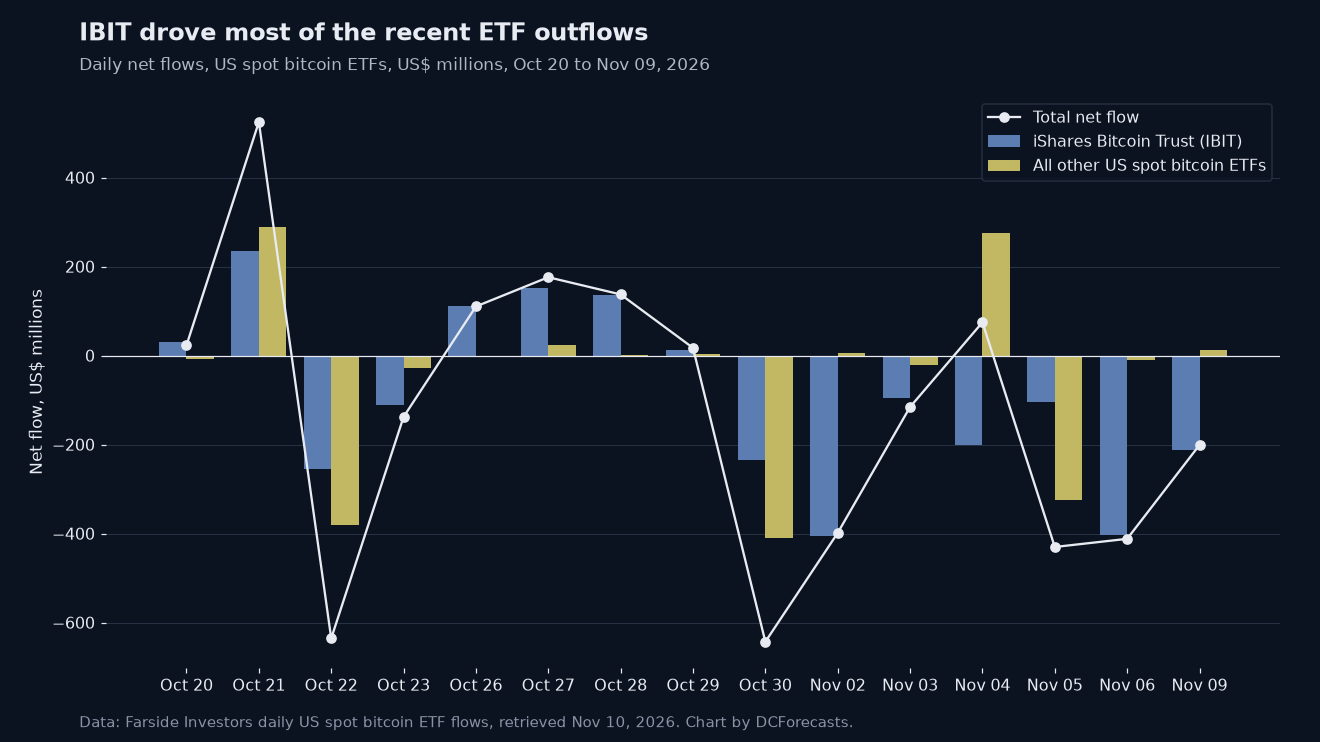
Over the 15 sessions from October 20, total bitcoin ETF flows came to roughly $1.91 billion of net outflows. IBIT was responsible for about $1.35 billion of that, or around 70%.
How the Morgan Stanley bitcoin ETF built a near-perfect record
MSBT started trading in early April after Morgan Stanley filed its final prospectus with the SEC on April 6, 2026. The prospectus on the SEC’s EDGAR system describes a passive fund that tracks the price of bitcoin, with BNY and Coinbase Custody Trust Company as its bitcoin custodians.
Since its first flow day on April 8, the fund has gathered $835.8 million in cumulative net inflows, based on Farside’s figures. It has posted inflows on 79 days, recorded no change on 70 and logged a single outflow of $5.3 million on May 29.
That means MSBT has now gone 113 consecutive sessions without a withdrawal. Its largest single-day inflow was $99.0 million on September 22.

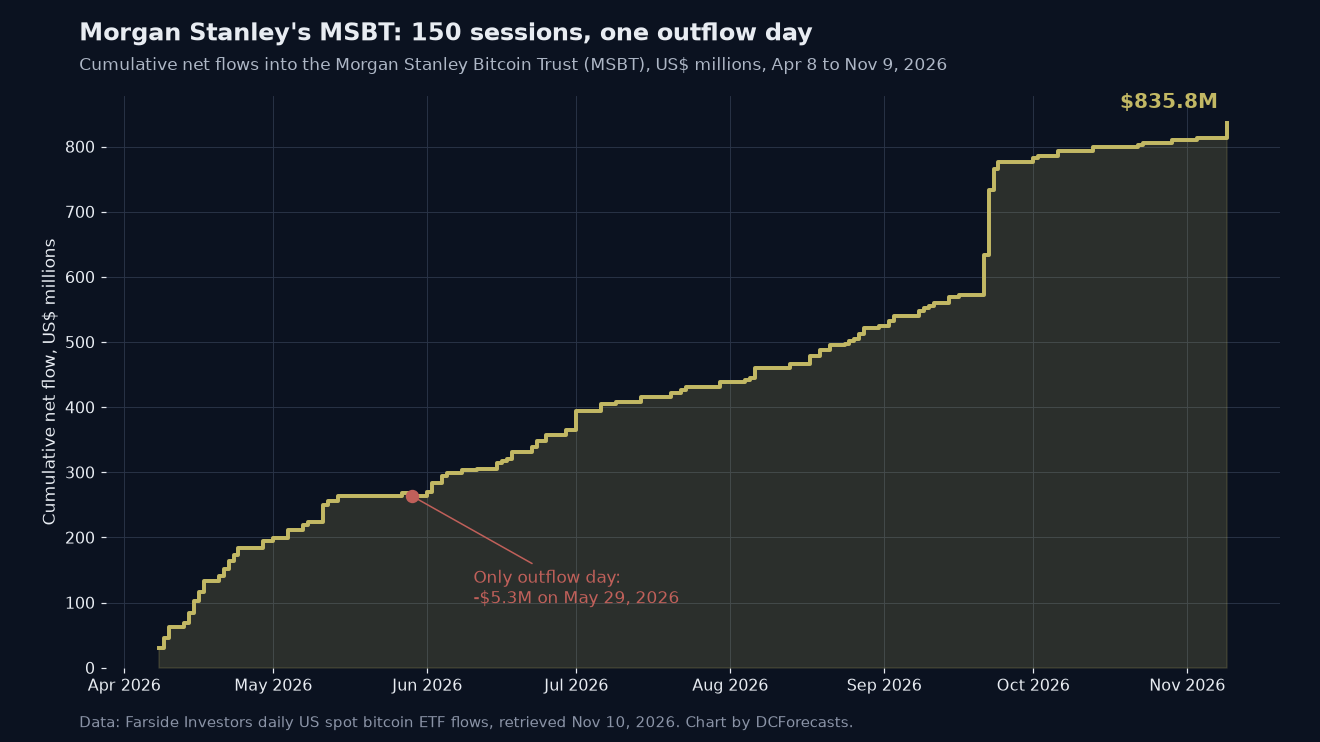
We believe the steady, step-like shape of those inflows matters more than their size. It looks like money arriving through planned allocations rather than short-term trading, the kind of demand that tends to stay put when prices wobble.
Outflow months have not lasted in 2026
This year’s flow data shows how quickly sentiment can swing. Farside’s figures put May and June at combined net outflows of about $6.9 billion across US spot bitcoin ETFs, the weakest two-month stretch of 2026.
The money came back. August brought roughly $3.54 billion of net inflows and September another $2.65 billion, more than offsetting a quiet July.
MSBT recorded net inflows in every calendar month since it launched, including May and June, when the wider group was losing billions. September was its strongest month at about $251 million.
October turned negative for the group again at about $516 million of outflows, and November so far stands near $1.48 billion of outflows. Earlier outflow stretches this year were followed by strong inflow months, and we believe the current one can follow the same path.
Why spot bitcoin ETF flows can move in opposite directions
IBIT and MSBT hold the same asset, so the gap between them is about investors, not bitcoin. IBIT is by far the largest and most liquid fund, with about $64.9 billion of cumulative net inflows since January 2024. That makes it a likely vehicle for hedge funds, basis traders and anyone who wants to reduce exposure quickly.
When those investors pull back, IBIT tends to show it first. A run of outflows from the biggest fund does not by itself signal a change in long-term demand.
A newer fund like MSBT is more likely to draw on a different pool of buyers that is still building positions. Those investors also tend to add on a schedule rather than react to daily price moves.
The wider picture is mixed but far from weak. Cumulative net inflows across all US spot bitcoin ETFs stand at about $55.6 billion, below the October 2025 peak of $62.7 billion. For 2026 so far, the group shows net outflows of roughly $1.03 billion.
Earlier this week we looked at how Fidelity’s FBTC rebuilt its holdings in the third quarter and how the Grayscale Bitcoin Mini Trust went a quarter without redemptions. Both point to the same theme: demand is spreading across more funds.
What the flows mean for bitcoin now
Bitcoin traded near $74,500 on Tuesday morning, up about 0.4% over 24 hours, according to CoinGecko. The recent ETF selling has kept a lid on prices, and it would be wrong to pretend otherwise.
Still, the selling has been narrow. It came mostly from one fund, while a newer fund kept adding through the whole stretch. We believe that kind of steady buying lays the groundwork for the next leg of ETF demand once the current wave of withdrawals runs its course.
A fund that has had one outflow day in seven months is a reminder that patient money is still finding its way into bitcoin.
DC Forecasts is a leader in many crypto news categories, striving for the highest journalistic standards and abiding by a strict set of editorial policies. If you are interested to offer your expertise or contribute to our news website, feel free to contact us at [email protected]












Discussion about this post