



Deutsche Bank’s digital asset custody service is now live, giving paying institutional and corporate clients a way to hold bitcoin inside Germany’s largest bank.
The lender confirmed on Wednesday, November 11, that the service had opened for paying clients, two months after it first announced the plan in September.
Clients can store and transfer five assets: bitcoin, ether and three stablecoins, USDC, EURC and EURAU. The bank holds the private keys itself.
For Bitcoin investors, the point is simple. One more of Europe’s largest banks has decided the asset belongs inside its own product lineup, not outside its walls.
The open question is how quickly corporate treasurers and fund managers actually move coins into it.
What Deutsche Bank Switched On
The service is aimed at institutional and corporate clients, including asset managers, hedge funds, brokers and companies. Retail customers are not part of the first rollout.
According to the bank’s product page, keys sit in hardware security modules, with warm and cold storage, segregated client assets, multi-factor authentication and a client-defined approval process for transfers.
Clients reach it through Autobahn, the bank’s existing corporate banking portal. That detail matters more than it sounds.
A treasurer who already moves euros and dollars through Autobahn can now see bitcoin in the same place, without onboarding a separate crypto firm.

The bank has not named its first clients or published its fees. It also reminds customers that crypto-assets are not covered by deposit guarantee schemes the way eligible bank deposits are.
How MiCA Made Bank Custody Possible
The legal basis is the European Union’s Markets in Crypto-Assets Regulation, known as MiCA.
Under Article 60, a licensed credit institution does not need a separate crypto licence. It must instead notify its home supervisor at least 40 working days before it starts offering the services.
Deutsche Bank’s notification to BaFin, Germany’s financial regulator, is dated October 12, 2026, according to ESMA’s interim register of crypto-asset service providers.
The entry covers two services: custody and administration of crypto-assets for clients, and transfers on their behalf. Trading and order execution are not on the list.
The register’s October 30 file shows the entry extended from Germany to 29 other European Economic Area countries. In practice, that gives the bank a route to serve eligible clients across the bloc from Frankfurt.
We believe this is the quiet strength of MiCA. As we noted when Brussels began drafting one rulebook for tokenized assets, clear rules tend to pull banks in rather than push them away.
Why Bitcoin Is the Heavyweight in the Lineup
Five assets made the first list, but they are far from equal in size.
CoinGecko data on Wednesday morning put bitcoin’s market value near $1.48 trillion. Ether stood at about $259 billion and USDC near $70 billion.
The two euro stablecoins are much smaller. EURC was worth roughly $510 million, while EURAU had a market value of about $336,000.
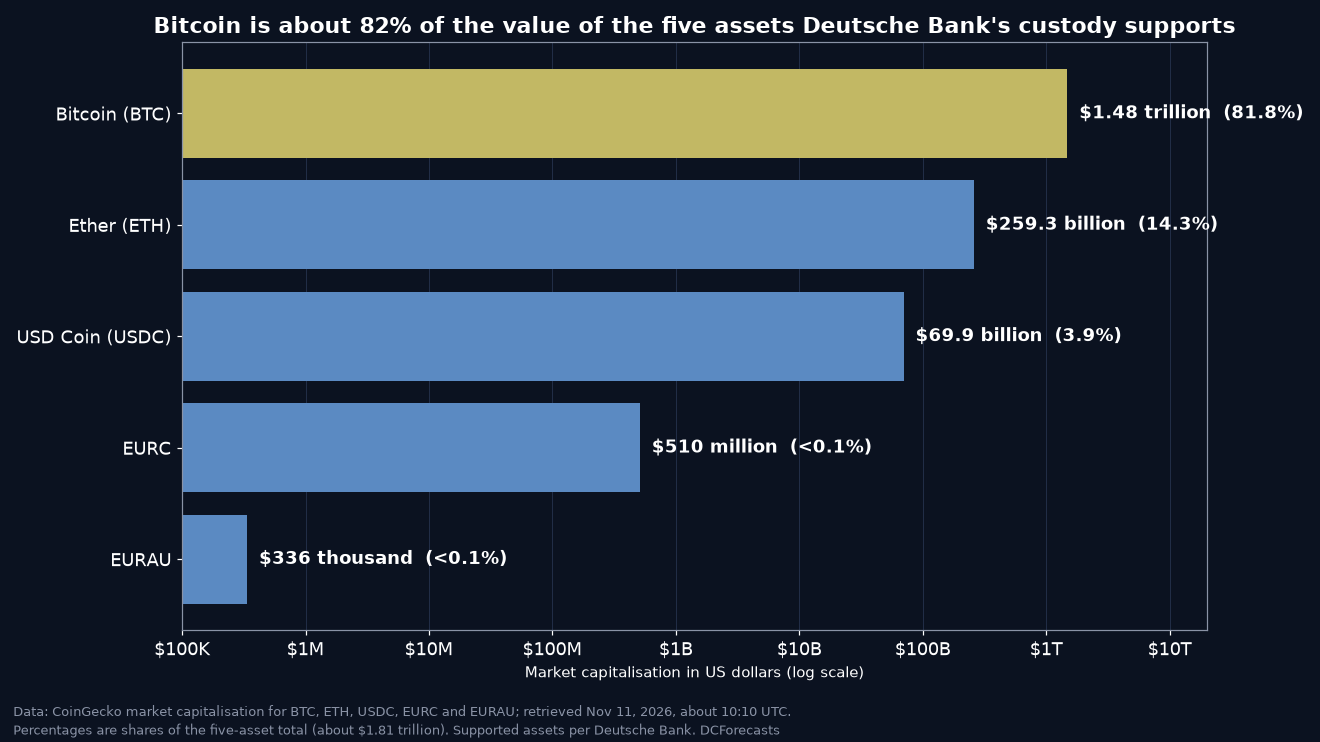
Taken together, bitcoin makes up about 82% of the combined value of the supported assets. Its share of the entire crypto market was about 60.4%.
That does not tell us what clients will deposit. It does show which asset a bank custody desk is most likely to be asked about first.
The timing is also worth noting. Bitcoin traded near $73,700 on Wednesday, down about 0.9% over 24 hours, after this month’s slide from higher levels.
For long-term allocators, a bank opening its vault during a pullback is a constructive signal. Infrastructure is being built for demand that institutions expect to last beyond one market cycle.
Institutional Crypto Custody Is Becoming a Bank Product
Deutsche Bank is not acting alone. US lenders have been moving in the same direction this month.
We recently covered how PNC now lets corporate clients get paid in USDC, and how Goldman, Citi and other banks committed $270 million to a joint stablecoin.
On the investment side, demand for regulated bitcoin exposure has stayed steady. Morgan Stanley’s bitcoin ETF has recorded just one outflow day since April.
Institutional crypto custody is the link between those trends. Funds and companies need a trusted place to hold the asset before they can use it, lend against it or settle with it.
Paul Maley, Deutsche Bank’s global head of trust and securities services, made the broader ambition clear.
“In the medium term we aim to deliver a fully integrated, regulated ecosystem that supports the custody, tokenisation, and settlement of digital assets,” he said.
What Comes After Custody?
The bank also signed a memorandum of understanding on Wednesday with Deutsche Asset Management, the fund group it majority owns and which was known until recently as DWS.
The agreement is meant “to explore comprehensive commercial and technical collaboration opportunities in the digital asset space.” No joint product has been announced.
Deutsche Bank has also said it wants to bring the custody business to Asian financial centres in 2027, alongside services such as stablecoin conversion, tokenized deposits and digital bond issuance.
Those plans remain on the roadmap, not in the product. For now, the service is storage and transfer, which is the foundation everything else will need.
We would watch three things next: the first named clients, any move into trading or tokenized securities, and whether rival European banks file their own MiCA notifications.
Bitcoin’s supply schedule does not change when a bank opens a vault. What changes is how easily large holders can reach it, and Wednesday made that path in Europe noticeably shorter.
DC Forecasts is a leader in many crypto news categories, striving for the highest journalistic standards and abiding by a strict set of editorial policies. If you are interested to offer your expertise or contribute to our news website, feel free to contact us at [email protected]












Discussion about this post