



A plan to put the evidence trail of an Indian state’s police force on Cardano is asking the network’s treasury for 9.6 million ADA, and its backers say the first deployment alone would add at least 1.53 million mainnet transactions a year.
The request comes from Trivolve Tech, the developer behind a forensic evidence application that already runs with police in Uttar Pradesh. Its new Police Force Management System, or PFMS, would start in Telangana and cover roughly 3,500 police facilities, 113,000 personnel and 3.2 million evidence items.
The proposal now faces a tough vote. On-chain tallies show it well short of the support it needs from Cardano’s delegated representatives, with voting set to close on November 20.
What the system would actually do
Trivolve Tech splits a criminal case into five stages: pre-crime evidence, crime investigation, evidence storage, prosecution and the court of law. Its existing Forensic Management System covers only one of them, the journey of evidence from a crime scene to a forensic laboratory.
PFMS would stretch the same approach across all five. Every critical action, from a CCTV clip being captured to an exhibit leaving the evidence room for court, would be stamped on Cardano mainnet as a cryptographic fingerprint.
The sensitive material itself stays off-chain on government systems. The blockchain only holds the hash, which lets anyone with access check later whether a record has been altered since it was created.
The proposal makes the case in blunt terms. It says a case in Telangana takes an average of more than 7.5 years to resolve, “much of it spent arguing over whether the records can be trusted rather than over what happened.”
A working system, not a whitepaper
The strongest part of the pitch is that one piece is already live. According to the proposal, the forensic application has stamped more than 156,000 transactions on Cardano mainnet over more than a year and currently runs at roughly 11,000 transactions a month.
Trivolve Tech says that already ranks it among the top ten applications on Cardano’s transaction leaderboard. Founder and CEO Rahul Konudula walked through the design in a Cardano Governance Hour session with the Cardano Foundation earlier this month.

“The entire chain of evidence is now being tracked and secured on Cardano,” Konudula said while describing how the system fits together.
The existing application also tackles a simpler, older problem. Evidence boxes have traditionally carried case numbers that everyone in the chain can see. The system replaces those with separate codes for each authorized handler, scanned through secure QR tags, which makes it harder for people at different stages to coordinate tampering.
Where 1.53 million transactions would come from
The transaction forecast is built stage by stage from the state’s own record volumes. Pre-crime evidence, which includes CCTV and bodycam recordings, control room logs, number plate reads and patrol records, makes up the largest share at 630,000 transactions in the first year.
Crime investigation adds another 420,000 and evidence storage 315,000. Prosecution records such as chargesheets and witness statements contribute 105,000, and court records about 60,000.
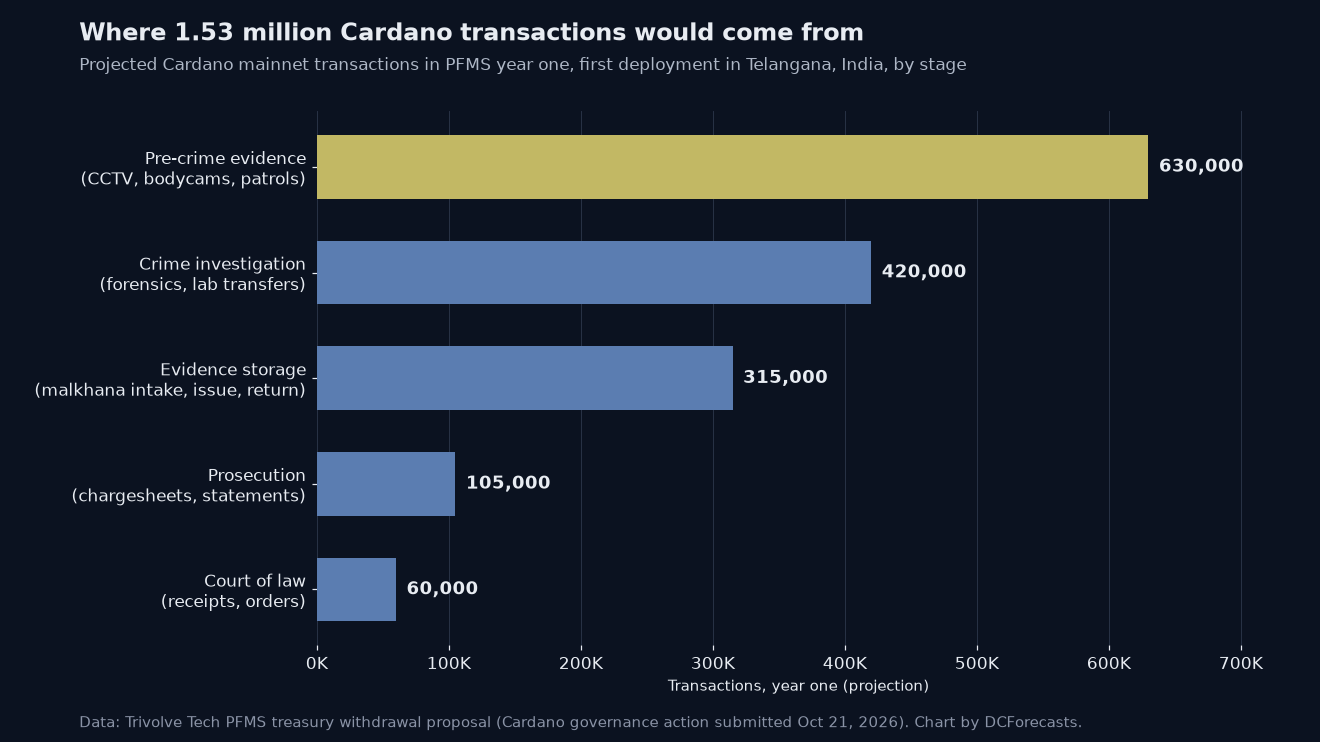
Trivolve Tech calls 1.53 million a “conservative floor,” because it counts only the record types included at launch. The number is designed to grow as Telangana rolls the system out district by district and as new record types are added.
The registry behind it is large. The proposal expects about 5.1 million decentralized identifiers in Telangana alone, including about 1.81 million devices such as cameras, bodycams, breathalysers and patrol vehicle GPS units.
How the 9.6 million ADA would be spent
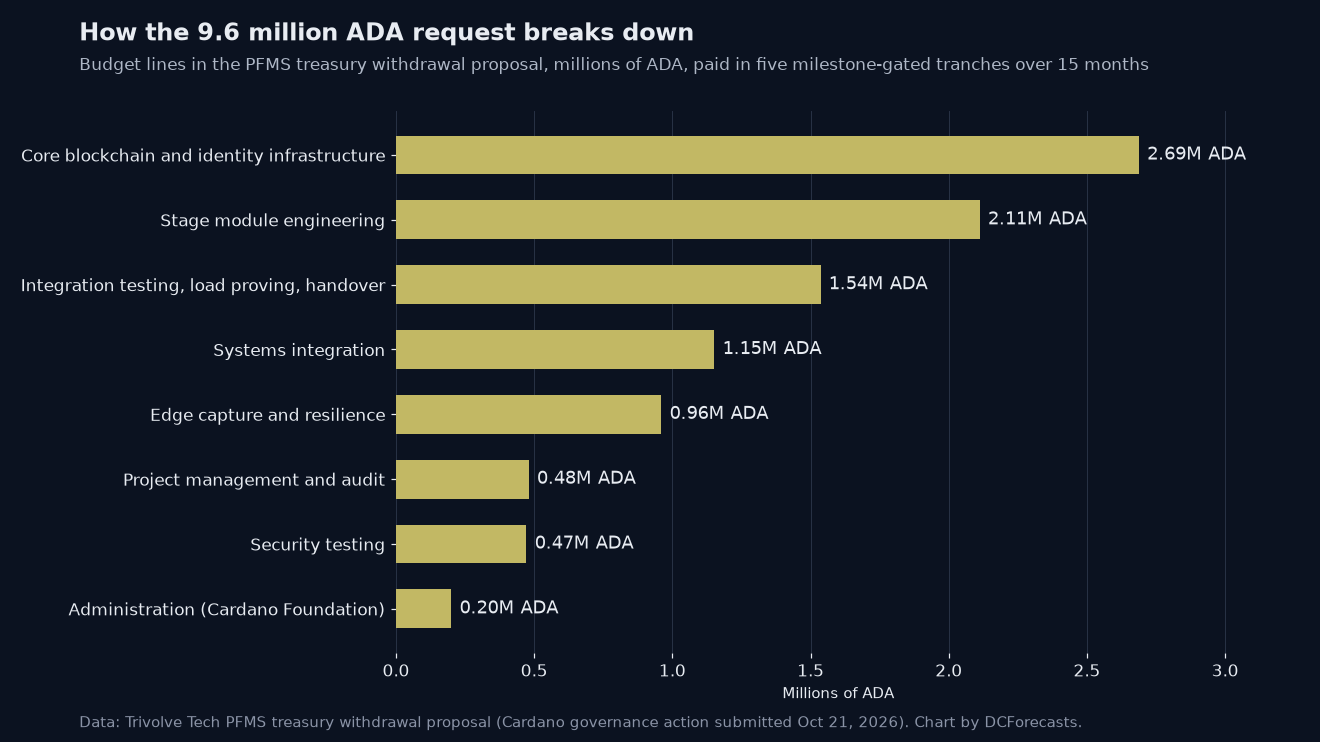
The treasury request covers 15 months of work and is paid out in five tranches. The first 1.8 million ADA is released when the administrator contract is signed, followed by 2 million ADA each at months 3, 8 and 12, and a final 1.8 million ADA at month 15, each tied to verified milestones.
The biggest budget line is core blockchain and identity infrastructure at 2.69 million ADA, followed by stage module engineering at 2.11 million ADA. The Cardano Foundation is named as administrator and receives 200,000 ADA for that role.
At the proposal’s planning rate of $0.23 per ADA, the request is worth about $2.21 million. The amounts are fixed in ADA, and spending is hard capped at $0.30 per ADA, or $2.88 million, with anything above that returned to the treasury.
Trivolve Tech says it receives no fees from the state government for building PFMS. Once it is live, the state would pay for its own infrastructure and every Cardano transaction fee.
A revenue stream back to the treasury
The proposal also includes a way for the treasury to earn money back. PFMS would offer an optional, fast-tracked verification service to authorized parties such as defense lawyers and prosecutors, starting at $1.89 per request and rising to hundreds of dollars for large case files.
Of that revenue, 70% would go to the Cardano treasury, 20% to maintaining core Cardano libraries and 10% to Trivolve Tech. The core code would be released as open source under the Apache 2.0 license, so other police forces could adopt it without paying for a new build.
The vote that decides it
None of this happens without approval. Treasury withdrawals on Cardano need a yes vote from 67% of active delegated representative stake, as well as backing from the Constitutional Committee.
A Koios on-chain voting snapshot shows the proposal at 27.59% DRep yes against 72.41% no, with 40 representatives voting yes, 53 voting no and 7 abstaining. Three committee members had voted yes and none against.
That gap is wide with about ten days left, and much of the no side comes from stake that has not cast an active vote. For Cardano, the outcome will be an early test of whether its treasury will fund real-world government work at scale. For the wider industry, it is another sign that public blockchains are being taken seriously as neutral record-keepers for institutions that need to prove nothing has been changed.
DC Forecasts is a leader in many crypto news categories, striving for the highest journalistic standards and abiding by a strict set of editorial policies. If you are interested to offer your expertise or contribute to our news website, feel free to contact us at [email protected]












Discussion about this post