



Exodus built its name on a self-custodial crypto wallet. In the third quarter, it moved as many dollars through payment cards as through crypto swaps: about $1.1 billion each. That shift is reshaping the business behind Exodus stock, and its latest quarterly report shows both the promise and the cost of the change.
The figures come from the company’s Form 10-Q for the quarter ended September 30, filed with the U.S. Securities and Exchange Commission on November 9. Exodus trades on NYSE American under the ticker EXOD.
A wallet company that now issues cards
In May, Exodus completed its acquisitions of Monavate and Baanx, two firms that issue payment cards and run payment infrastructure for traditional merchants and onchain finance customers. During the third quarter, the Baanx business began operating as Monavate Onchain.
The filing values the consideration at about $131.7 million. That figure consists of $106.9 million in previously issued loans that were settled as part of the deal and a $24.8 million deferred payment obligation. Exodus recorded $99.3 million of goodwill on its balance sheet as a result.
The company now reports two segments. Digital asset services covers the wallet, its swap aggregation, fiat onboarding and staking. Payment processing covers card issuance and payment programs under the Monavate brand.
Payments now bring in a third of revenue
Total revenue rose 7.2% to $32.5 million from $30.3 million a year earlier. Payment processing contributed $11.0 million, or 33.7% of the total, in its first full quarter inside the company.
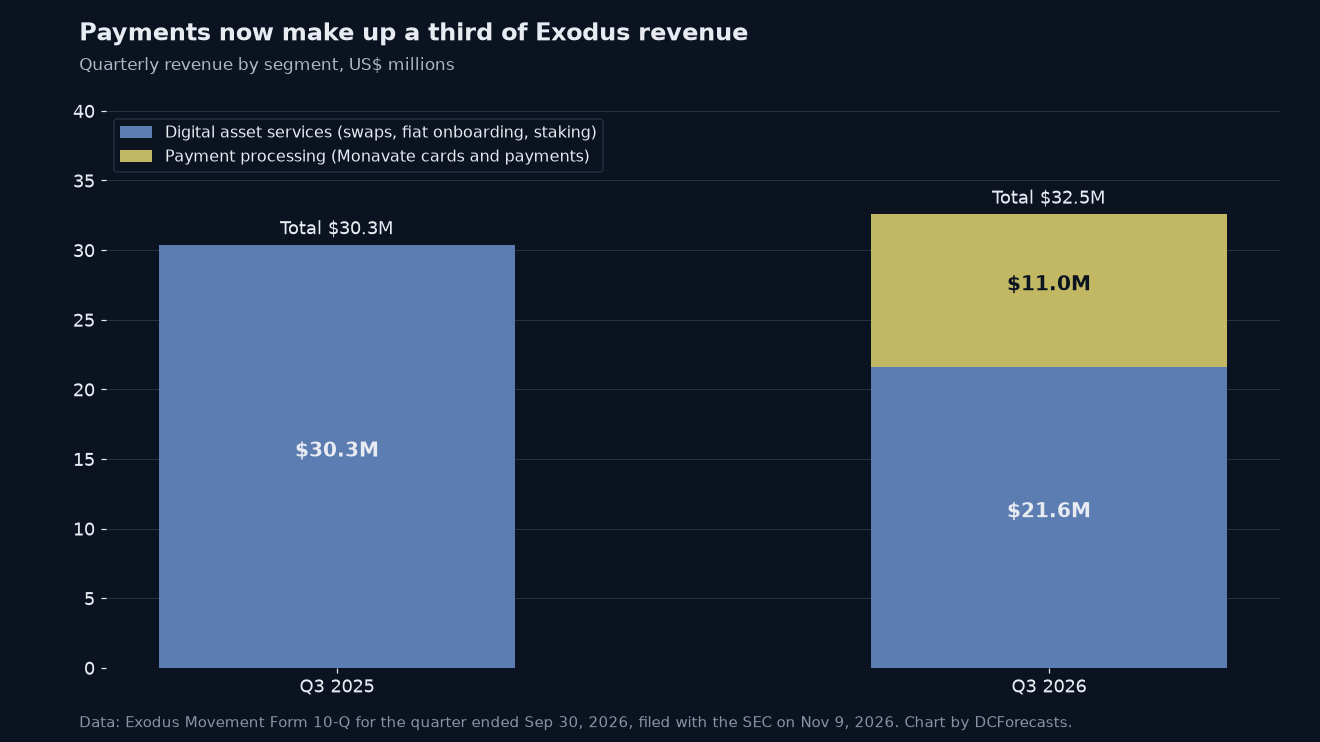
Program management fees made up $7.1 million of that segment, with $0.8 million of net interchange revenue and $3.0 million from other payment services. Those fees are tied to card programs Exodus runs for enterprise clients rather than to crypto price swings.
Digital asset services revenue fell to $21.6 million from $30.3 million. Exchange aggregation, the fees Exodus earns when users swap one coin for another through integrated partners, dropped to $18.8 million from $26.9 million. Staking revenue slipped to $0.5 million from $1.8 million.
One crypto line grew sharply. Fiat onboarding revenue, earned when users buy digital assets with traditional money inside the app, climbed about 75% to $2.3 million from $1.3 million.

That matters because fiat onboarding is where new money enters crypto. Growth there, even while swap fees cooled, suggests users kept converting cash into digital assets during a quarter when broader trading activity slowed.
Card volume matched swap volume
Exodus processed $1.1 billion of gross payment volume during the quarter and counted 1.6 million active cards, meaning unique cards that made at least one transaction. The company notes one person can hold more than one card.
Quarterly exchange volume came in at $1.1 billion, down 39% from $1.8 billion a year earlier. Monthly active users eased to 1.4 million from 1.5 million, and quarterly funded users, people who opened a wallet that held a balance, fell to 1.4 million from 1.8 million.
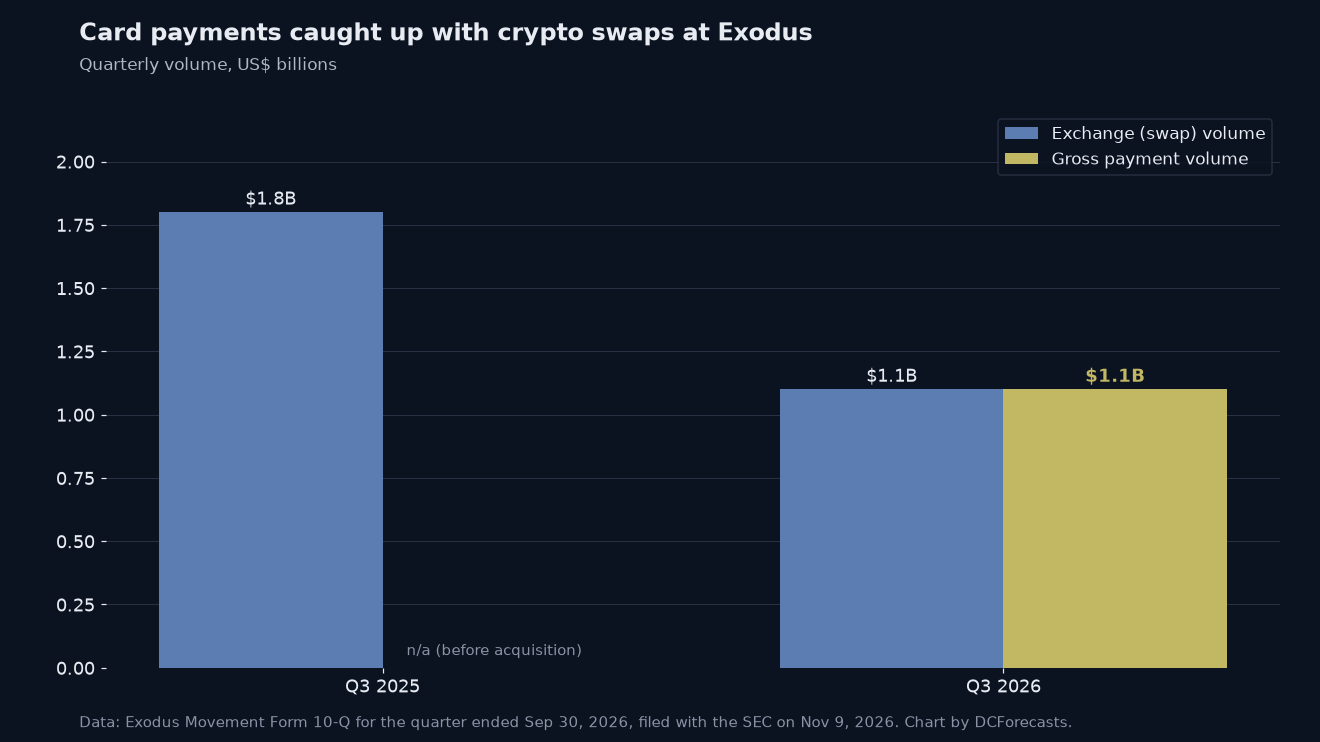
The comparison shows how the mix has changed. A year ago, every dollar of Exodus revenue came from crypto services. Now card payments carry almost as much volume as the swap engine that defined the company.
Integration costs pushed the quarter to a loss
Exodus posted a net loss of $9.7 million, compared with net income of $17.0 million a year earlier. Adjusted EBITDA was a loss of $3.9 million, against a $5.9 million profit in the third quarter of 2025.
General and administrative expenses nearly doubled to $28.9 million from $14.9 million as the acquired businesses joined the payroll. In July, Exodus announced an operating realignment that cut about 25% of its global workforce, with expected charges of $4.6 million to $5.7 million, to align costs with its plan to build a full-stack card issuance and payments platform.
The company recorded an $11.4 million net gain on digital assets during the quarter.
A smaller Bitcoin balance
Exodus held 293 Bitcoin on September 30, with a fair value of $24.5 million, compared with 1,704 Bitcoin worth $149.2 million at the end of 2025. Total digital assets on the balance sheet fell to $25.3 million from $156.4 million over the same period.
The balance sheet now leans on cash and stablecoins tied to the payments business. Exodus reported $9.6 million in cash, $54.3 million in restricted cash and $12.3 million in stablecoins, including restricted holdings, along with $50.3 million of customer deposit liabilities.
What it means for EXOD stock and crypto spending
For EXOD stock, the next few quarters will test whether card program fees can offset softer swap activity and return the company to positive adjusted EBITDA once integration costs fade.
The bigger picture is encouraging for crypto adoption. Self-custody remains popular, as the 700,000 Telegram wallets opened in 48 hours showed this week. Exodus is betting that the next step is letting people spend digital assets as easily as they store them. Bakkt is making a similar push into stablecoin payments, a sign that the rails connecting Bitcoin and other digital assets to everyday commerce keep getting wider.
This article is for information only and is not investment advice. Figures are taken from Exodus Movement’s quarterly report filed with the SEC.
DC Forecasts is a leader in many crypto news categories, striving for the highest journalistic standards and abiding by a strict set of editorial policies. If you are interested to offer your expertise or contribute to our news website, feel free to contact us at [email protected]












Discussion about this post