



Visa has added Monad to the list of blockchains its partners can use to settle stablecoin payments, just as the card giant’s stablecoin settlement business runs at a pace of more than $25 billion a year.
The Monad Foundation announced on November 10 that participating Visa issuers and acquirers can now settle their Visa obligations in stablecoins on Monad, a high-performance Layer 1 that runs the same smart contract environment as Ethereum.
Visa reported that annualized run rate as of September 2026, roughly ten times its level a year earlier, with more than 225 stablecoin-linked card programs live worldwide.
For crypto, the interesting part is not one new chain. It is how quickly stablecoins are moving from trading into the plumbing of everyday card payments.
The open question is whether newer networks like Monad can win real settlement volume from far bigger stablecoin hubs.
What Visa actually added
When a cardholder taps a Visa card, the merchant’s bank and the cardholder’s bank still have to settle with Visa afterwards. That back-office step has traditionally run on a five-business-day schedule over bank rails.
Stablecoin settlement lets those institutions pay or receive what they owe in tokens such as USDC instead, including on weekends and holidays.
Cardholders and merchants see no change. The shift happens entirely behind the scenes, but it can free up cash that banks would otherwise leave waiting over a weekend.
“Our goal is to give our partners the flexibility to settle on the blockchain networks that best meet their needs,” said Dan Roesbery, Visa’s vice president for global onchain partnerships.

The announcement does not give any Monad-specific settlement volume or name a bank that is already using it. The $25 billion figure covers Visa’s whole program, not activity on Monad.
How fast Visa’s stablecoin payments business is growing
Visa first settled transactions in a stablecoin in 2023, when it piloted USDC. Its own milestones since then show a steep climb.
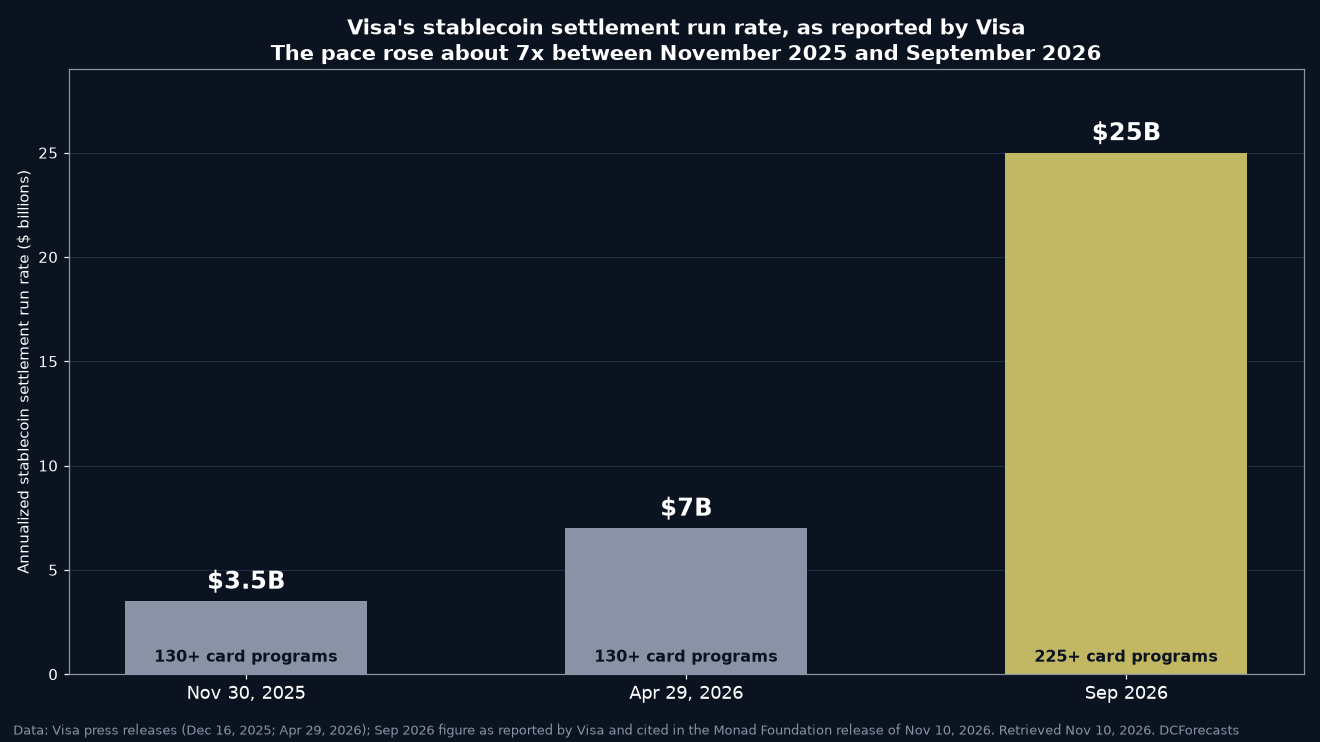
On December 16, 2025, Visa said its monthly stablecoin settlement volume had passed a $3.5 billion annualized run rate as of November 30, and launched USDC settlement for U.S. banks, starting with Cross River Bank and Lead Bank on Solana.
On April 29, 2026, it added Arc, Base, Canton, Polygon and Tempo to Avalanche, Ethereum, Solana and Stellar, taking the pilot to nine blockchains. The run rate had reached $7 billion, up 50% from the previous quarter.
By September, the pace had more than tripled again to $25 billion. That is about seven times the November 2025 level in ten months.
We think this is one of the clearest signs yet that stablecoins are earning a permanent place in traditional payments.
Why Monad pitched privacy
Monad’s case rests on speed and familiarity. The network says it delivers 400-millisecond blocks and 800-millisecond finality, with more than 200 independent validators across over 30 countries.
Because it is fully compatible with Ethereum tooling, banks already using Ethereum-based custody, wallet and compliance systems can usually extend them rather than build from scratch.
The bigger pitch is confidentiality. The foundation says Monad’s planned Private Settlement feature will let institutions hide commercially sensitive details while still sharing them with auditors and regulators.
That feature is not live yet. The release says users will benefit from it “in coming months,” so banks that need privacy before settling onchain will have to wait.
“The next phase will be defined by whether institutions can keep sensitive flows confidential without leaving open networks,” said Keone Hon, co-founder and general manager of the Monad Foundation.
Monad is still a small stablecoin market
The numbers put Monad’s challenge in perspective.
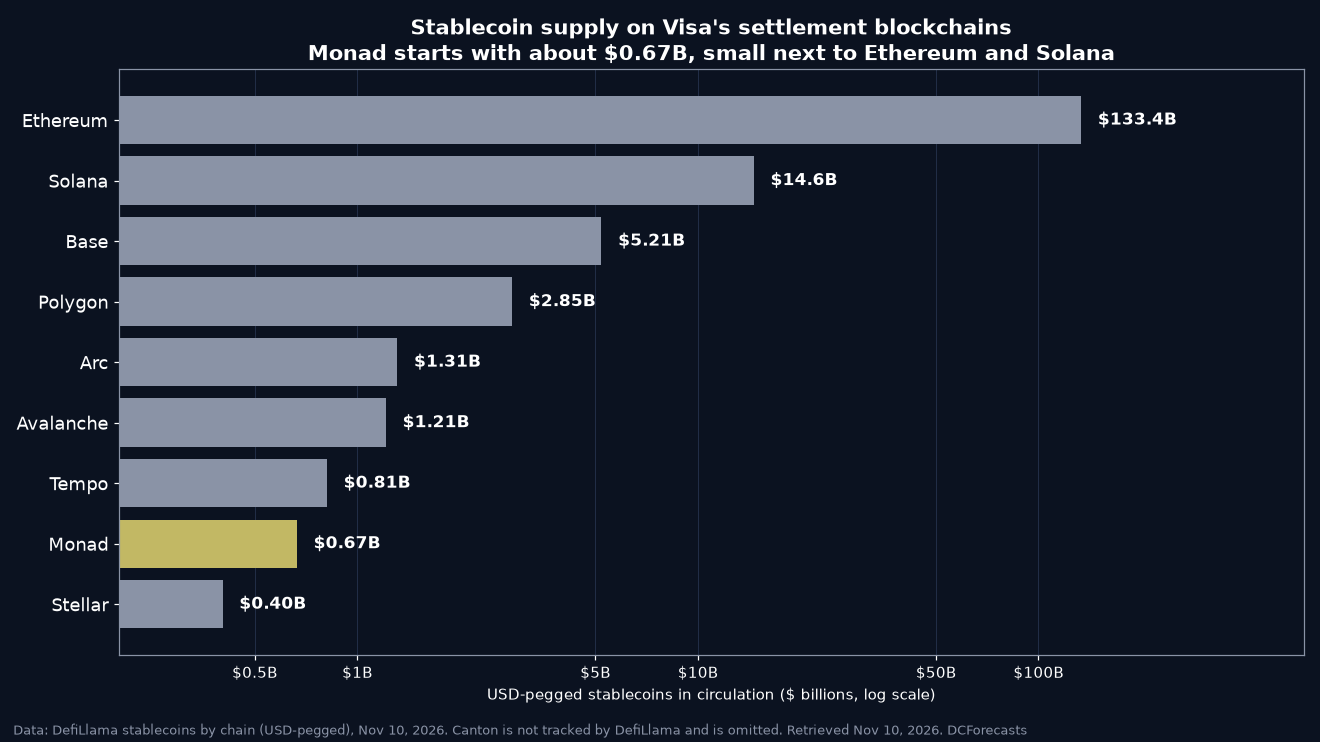
DefiLlama data shows about $665 million of dollar stablecoins on Monad, against $133.4 billion on Ethereum and $14.6 billion on Solana.
Monad’s stablecoin base is also below the roughly $813 million it reached on October 13, though it is far above the less than $3 million DefiLlama recorded when its Monad data began in late November 2025.
The MON token traded near 1.65 cents on CoinGecko, down 1.5% over 24 hours, with a market value of about $195 million.
Deep stablecoin liquidity makes settlement cheaper and easier, so Visa’s backing could help Monad attract more of it. We would treat that as a possibility, not a given.
What this means for the wider crypto market
Stablecoins have become one of the industry’s biggest sources of liquidity. As we noted when stablecoins reached 19.5% of Bitcoin’s market value, that dry powder is a key part of how capital moves into digital assets.
Card networks settling in stablecoins give those dollars a second job beyond trading. Banks are also preparing their own tokens, as seen in the push by 37 banks to close the euro stablecoin gap.
For Bitcoin holders, deeper and better-regulated stablecoin rails mean easier, around-the-clock movement of dollars in and out of the market. We see that as constructive for the whole ecosystem.
We would watch for three things next: the first named institutions settling on Monad, the launch date for Private Settlement, and Visa’s next run-rate update.
If the $25 billion pace keeps compounding, the question will shift from whether stablecoin payments work to which chains end up carrying them.
DC Forecasts is a leader in many crypto news categories, striving for the highest journalistic standards and abiding by a strict set of editorial policies. If you are interested to offer your expertise or contribute to our news website, feel free to contact us at [email protected]












Discussion about this post