



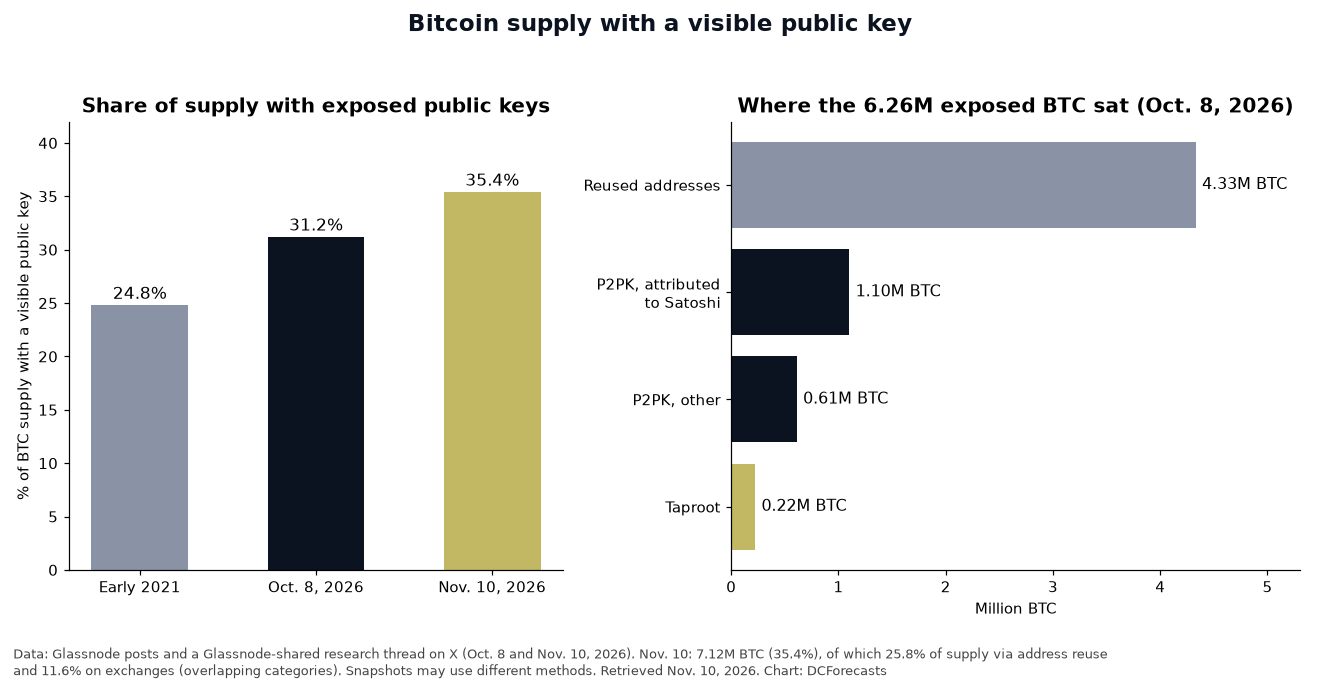
The quantum computing Bitcoin debate got a fresh number on Tuesday. Glassnode said 7.12 million BTC, or 35.4% of all coins, now sit behind a public key that anyone can read on the blockchain.
That is the slice a future quantum computer could, in theory, target. But the same data carries a reassuring detail that is easy to miss.
Most of that exposure comes from how wallets handle coins, not from a flaw in Bitcoin itself. Glassnode’s own advice was simple: move those coins to a fresh address.
What Glassnode reported on November 10
In a post on X, the on-chain analytics firm said 25.8% of Bitcoin’s supply is exposed because of address reuse. It put 11.6% of supply on exchanges.
Those two groups overlap, so they cannot simply be added. Together they would come to 37.4%, above the 35.4% total, because some exchange coins also sit at reused addresses.
“Moving those coins to a fresh address ends this exposure,” Glassnode wrote about the reused-address coins.
By our math, reuse alone accounts for about 73% of all exposed supply. That is the part holders and custodians can fix without waiting for any protocol change.
Why a visible public key matters
Bitcoin addresses normally hide the public key behind a hash. The key only appears on-chain when coins are spent from that address.
If someone keeps receiving coins at an address they have already spent from, the key stays public while those coins wait. Early pay-to-public-key outputs, known as P2PK, and Taproot outputs reveal keys by design.

A powerful enough quantum computer running Shor’s algorithm could, in principle, work out a private key from a public one. The authors of the BIP 360 draft say plainly that “it is unclear when or if” such machines will become viable.
So this is a planning question, not an emergency. Glassnode’s measure tracks visible keys, not stolen ones, and it does not predict when any attack might be possible.
Where the exposed Bitcoin sits
A research thread Glassnode reshared on October 8 gave a fuller picture. At that point, 6.26 million BTC, or 31.2% of supply, had a visible key.
Address reuse made up 4.33 million BTC of that. Another 1.71 million BTC sat in P2PK outputs, 1.10 million of which are attributed to Satoshi Nakamoto, and 222,000 BTC sat in Taproot outputs.
Glassnode separately said the balance in reused addresses rose from 3.79 million to 4.33 million BTC over the year to October.
The thread also put the exposed share at 24.8% in early 2021. The trend is up, and we think that is worth saying clearly.
The October and November snapshots may not use identical methods, so the jump between them should be read with care.
How developers are preparing for quantum computing Bitcoin risks
The good news is that Bitcoin’s developers are already working on the problem, years before any real threat is known to exist.
BIP 360, written by Hunter Beast, Ethan Heilman and Isabel Foxen Duke, proposes a soft fork that adds a new output type called Pay-to-Merkle-Root. It works much like Taproot but removes the key path spend that exposes a public key.
The draft says this protects against “long exposure” attacks on keys left visible for a long time. Faster attacks during the minutes a transaction waits to confirm may need post-quantum signatures later.
A separate draft, BIP 361, sketches how coins could migrate away from legacy signatures once a safe output type exists. Neither draft sets a deadline that binds holders today.
Other ideas are on the table too. We covered one of the more creative ones in our look at Cory Fields’ quantum landmines proposal.
What holders can do now
The practical steps are not complicated. Avoid reusing addresses, and send change from spends to a fresh address.
Coins sitting at an address that has already spent can be moved to a new one, which hides the key again. Most modern wallets create fresh addresses by default.
Exchanges and custodians hold a big share of the reused supply. They can move coins in bulk, which could shrink the exposed figure quickly once they choose to.
For long-term holders, the main lesson is good wallet habits. Security work around hardware wallets and seed phrases already shows how much those habits matter.
Why this is a strength story for Bitcoin
We believe the real takeaway is how open the process is. Anyone can measure exactly which coins are exposed, watch the number change and see the fixes being debated in public.
Most of the 35.4% can be cleaned up by the people holding it, without changing a line of Bitcoin’s code. The rest is the focus of careful, slow-moving soft fork work.
That combination of transparency and preparation is exactly what long-term holders should want from a network meant to last for decades.
DC Forecasts is a leader in many crypto news categories, striving for the highest journalistic standards and abiding by a strict set of editorial policies. If you are interested to offer your expertise or contribute to our news website, feel free to contact us at [email protected]












Discussion about this post