



Two of the world’s largest banks went into the end of September holding more spot Bitcoin ETF shares than they had three months earlier. Barclays rebuilt its stake in BlackRock’s iShares Bitcoin Trust (IBIT), and Citigroup opened a new position worth $118.9 million in Fidelity’s Wise Origin Bitcoin Fund, better known by its FBTC stock ticker.
The figures come from quarterly Form 13F reports filed with the U.S. Securities and Exchange Commission. Barclays filed on Nov. 6 and Citigroup on Nov. 4. Both show positions as of Sept. 30, 2026.
Barclays Grows Its IBIT Holding by 48%
Barclays PLC’s filing lists 3,942,900 IBIT shares across three entries, with a reported value of $186.7 million. At the end of June, the bank reported 2,658,147 shares worth $88.5 million.
That is an increase of about 1.28 million shares, or 48%, in one quarter. The dollar value more than doubled, which reflects both the extra shares and the fund’s higher price at the end of September.
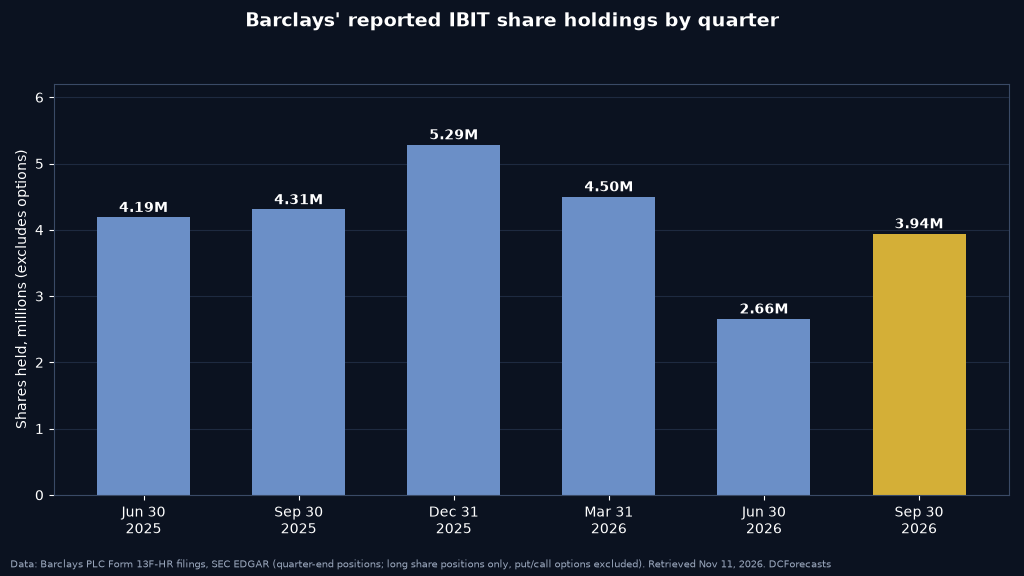
The longer history shows why the September number matters. Barclays’ IBIT share count peaked at 5.29 million at the end of 2025, then fell for two straight quarters to 2.66 million in June. The third quarter is the first increase in a year.
In other words, the bank was not walking away from Bitcoin exposure. It came back into the fund, even if the position is still below its previous high. Its September stake is also nearly as large as the 4.3 million shares it reported a year earlier, at the end of September 2025.
Citi Adds a $119 Million FBTC Position
Citigroup’s change is more striking because it starts from almost nothing. The bank’s September filing shows 1,636,387 FBTC shares worth $118.87 million. Its June report showed no FBTC position at all.
Citi also kept growing its IBIT stake. It reported 521,144 shares worth $24.67 million, up from 347,114 shares at the end of June. That is an increase of about 50% in share terms.
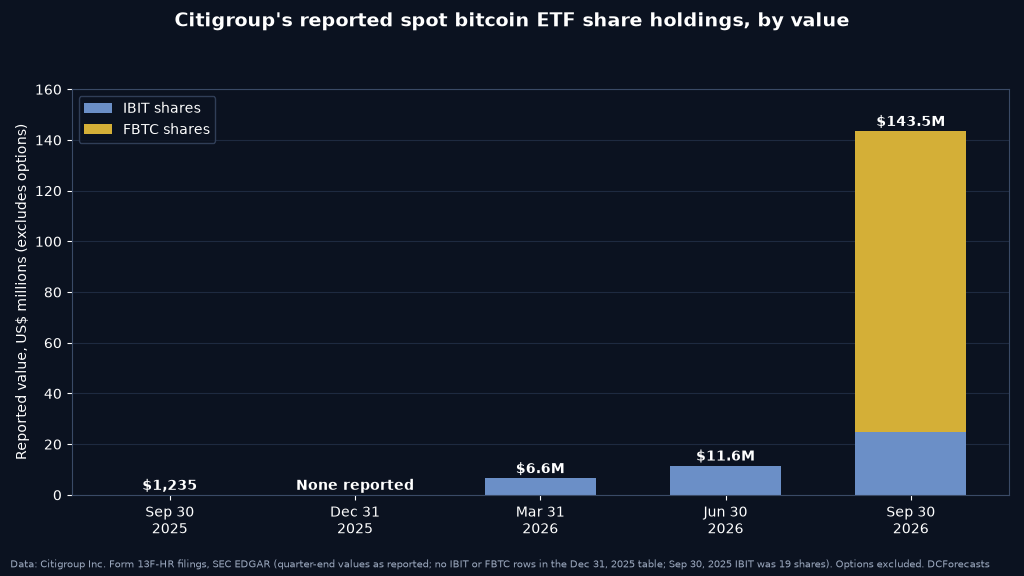
A year ago, Citi’s 13F showed just 19 IBIT shares, worth $1,235. Its December 2025 report showed no IBIT or FBTC shares. Since then the position has grown every quarter, to $6.6 million in March, $11.6 million in June and $143.5 million in September, including FBTC.

Taken together, Barclays’ IBIT shares and Citi’s IBIT and FBTC shares had a combined reported value of about $330 million at the end of September, before options.
What the Options Lines Do and Don’t Show
Both banks also reported IBIT options. Barclays listed calls covering 8,479,800 underlying shares and puts covering 8,169,700 shares. Citi listed calls on 400,000 shares and puts on 505,000 shares, both lower than in June, when it reported calls on 2.91 million shares and puts on 1.6 million.
These filings don’t explain why each position is held. A bank’s ETF shares can support client trading, market making, hedging or its own investments, and 13F tables don’t separate those uses.
The reports also have limits by design. They show long positions at quarter end, not when shares were bought or at what price. Short positions aren’t netted against them, so the numbers are a snapshot, not a complete picture of each bank’s net Bitcoin exposure.
Even with those caveats, the direction is useful. Banks don’t add hundreds of millions of dollars in Bitcoin ETF shares to their books without client demand, trading activity or a view on the asset.
Bitcoin Keeps Moving Into the Banking System
The filings fit a wider pattern of large banks building Bitcoin and digital asset services. This week, Deutsche Bank’s digital asset custody service went live with Bitcoin, Ether and three stablecoins for institutional clients.
Citi is also part of a group of banks that committed $270 million to run a joint stablecoin project for five years. Its growing ETF positions add a direct Bitcoin line to that blockchain work.
Spot ETFs have become the easiest way for regulated institutions to hold Bitcoin exposure. A bank doesn’t need its own custody setup or private key management to hold IBIT or FBTC. It can treat the shares like any other listed security, which helps explain why bank positions keep appearing in each new round of 13F filings.
More Filings Are Due Soon
Institutional managers with at least $100 million in qualifying U.S. securities must file 13F reports within 45 days of each quarter end. For the September quarter, that puts the deadline in mid-November, so more banks, pension funds and asset managers will publish their Sept. 30 holdings in the coming days.
Those reports will reflect positions held before Bitcoin’s pullback this month. For long-term holders, the more important signal is structural: two global banks chose to add Bitcoin ETF shares in the third quarter, and one of them did it with a fund it hadn’t owned before.
As more filings arrive, they will show whether Barclays and Citi were early or part of a wider move by banks into regulated Bitcoin products.
DC Forecasts is a leader in many crypto news categories, striving for the highest journalistic standards and abiding by a strict set of editorial policies. If you are interested to offer your expertise or contribute to our news website, feel free to contact us at [email protected]












Discussion about this post