



The ZEC price rally has turned a funding question into a live vote. Zcash coinholders and community panels will decide from Nov. 16 to Nov. 30 whether Zcash Community Grants should remove 50,000 ZEC from its treasury and hand that value back to the network’s miners over time.
At Thursday’s price of about $984, that is roughly $49 million in coins.
The plan comes from Zcash co-founders Sean Bowe of Tachyon Group and Zooko Wilcox of Shielded Labs, together with Shielded Labs’ Jason McGee. Their draft Zcash Improvement Proposal, first written on Oct. 29, was merged into the public ZIP repository on Nov. 11.
The bigger question is how a privacy network should fund itself when its treasury suddenly holds far more money than it spends.
What the Draft Would Change
The proposal does two things.
First, it ends the grants committee’s automatic 8% share of every block subsidy. That same 8% would keep being issued, but it would flow into a new Future Dev and Legal Defense Fund Lockbox instead.
Nobody could spend from that lockbox at first. The draft says a separate, future ZIP would have to define a decentralized way to withdraw funds for development and legal defense.
Second, the five-member ZCG committee would have to remove 50,000 ZEC from circulation within 30 days of the change activating. The draft names ZIP 233’s removal mechanism as the intended route, with an unspendable address only as a last resort.
The removed coins are not a simple burn. Their value is credited to the Network Sustainability Mechanism under ZIP 237, which releases ZEC back into circulation through future block rewards.

Nothing changes for the other pieces of the split. Miners keep 80% of each block subsidy, and the separate 12% Coinholder-Controlled Fund stays as it is.
Why the ZEC Price Forced the Issue
The trigger is simple arithmetic. ZCG reported holdings of 91,452.98 ZEC, plus $8,796,224 in cash, against $2,417,165 of outstanding grant liabilities, according to the dashboard figures the draft cites.
The Financial Privacy Foundation, which pays out ZCG grants, reported $4,718,359 of ZCG expenses in the first half of 2026. That is about $9.4 million a year.
Meanwhile, the 8% stream adds roughly 144 ZEC a day, or 52,560 ZEC a year. The authors valued that at about $68 million a year using an assumed price of $1,300, more than seven times ZCG’s spending.
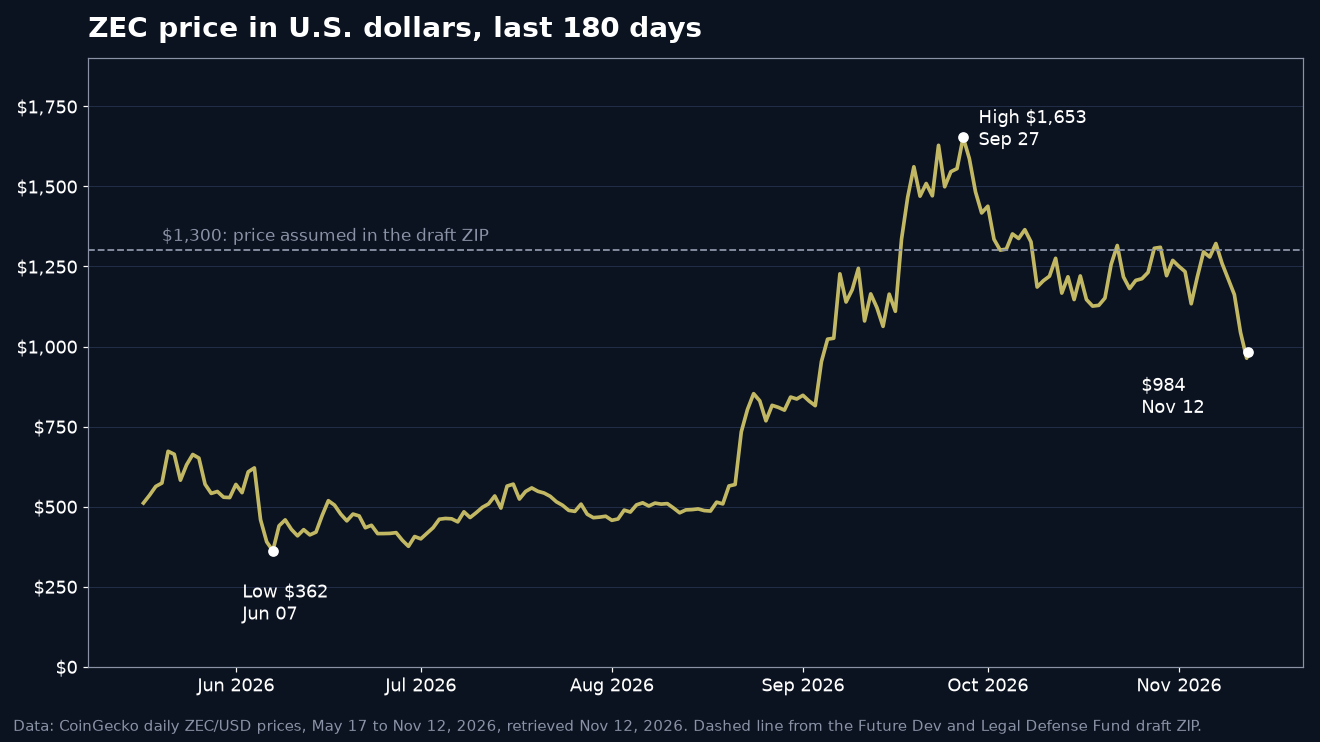
The market has cooled since those numbers were drafted. CoinGecko data show ZEC climbed from a 180-day low of $362 on June 7 to a high of $1,653 on Sept. 27, then eased to about $984 by Nov. 12.
That is roughly 40% below the peak, yet still about 2.7 times the June low.
Even at today’s lower price, the yearly stream would be worth around $51.7 million. That is still about 5.5 times what ZCG spent at its 2026 pace.
How Long Would the Grants Program Last?
This is the heart of the debate. Supporters say the committee is over-funded, while grantees want certainty that the work behind wallets and developer tools keeps getting paid.
Using the $1,300 assumption, the draft estimates ZCG’s treasury could cover about 13.3 years of 2026-level spending today. Removing 50,000 ZEC would leave about 6.4 years.
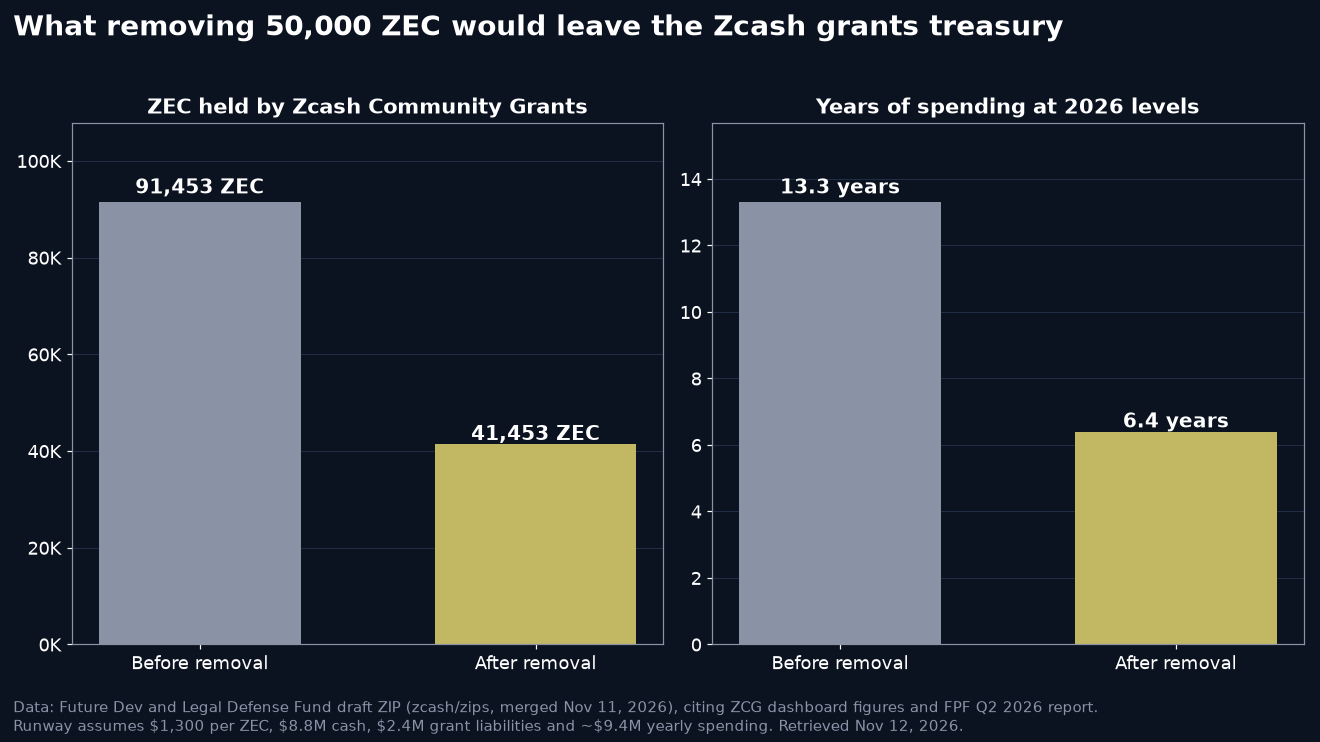
At the Nov. 12 price, our own calculation using the same inputs gives about 10.2 years before the removal and roughly 5 years after it.
We believe that is the number voters should weigh most carefully. Five to six years of runway is still a substantial cushion for a grants program, but it is no longer the open-ended war chest the rally created.
Zcash News: How the Vote Will Work
Five groups that coordinate the coinholder voting process, Project Tachyon, Shielded Labs, Valar Group, the Zcash Foundation and ZODL, set the timetable. Polls close at 23:59 UTC on Nov. 30.
If the polls show “rough consensus,” those groups say they will support a network upgrade called NU7.1. Engineering teams and miners would then agree on a target date.
No activation height has been set. The draft has not yet received a ZIP number, and it still needs both community support and that upgrade before anything takes effect.
It also replaces an earlier outline from ZCG itself, which would have cut its own funding and shifted part of its treasury toward miners. ZCG dropped that plan on Nov. 3 after criticism.
The vote lands during a busy stretch for Zcash mining. As we covered when a separate draft proposed moving Zcash to 20-second blocks, NU7.1 is becoming the vehicle for several changes at once.
Outside money is also arriving. Grayscale recently said it would reinvest a year of its Zcash ETF fees into the ecosystem, which could soften any squeeze on grant funding.
A Funding Debate Bitcoin Never Has to Hold
For us, the most striking part of this story is the contrast with Bitcoin. Every new bitcoin goes to the miner who finds the block, currently 3.125 BTC per block since the April 2024 halving.
There is no protocol-level treasury to fight over, no committee to fund and no lockbox to design. Bitcoin’s developers are paid voluntarily by companies, foundations and individuals.
Zcash chose a different path, and its grants have paid for real privacy research. This vote is a healthy sign that its community is willing to rethink that model in public rather than let a windfall drift.
The coming weeks will show whether ZEC holders want to send that windfall back to the miners who secure the chain, or keep it working for the builders.
DC Forecasts is a leader in many crypto news categories, striving for the highest journalistic standards and abiding by a strict set of editorial policies. If you are interested to offer your expertise or contribute to our news website, feel free to contact us at [email protected]










Discussion about this post