



The XRP Ledger has a draft plan to let accounts and validators sign with ML-DSA-44, a signature scheme designed to withstand future quantum computers. The catch is size: according to the XRP Ledger Foundation’s own estimate, a payment signed this way would take 5,331 bytes to store, 3.13 times the 1,704 bytes of an ordinary payment.
The proposal sits in the Foundation’s 2027 protocol roadmap, last updated on Nov. 4. It has no formal XRPL Standards number yet, is not active on mainnet, and still needs a migration study, an audit and a validator vote before it could go live.
The XRP Ledger is not alone in this work. Bitcoin developers have been preparing too, and the timing of the XRP proposal shows how seriously the wider industry now treats long-term quantum risk.
What the ML-DSA Proposal Would Change
ML-DSA is the lattice-based signature standard that the U.S. National Institute of Standards and Technology published as FIPS 204 in August 2024. ML-DSA-44 is its smallest version, also known by its earlier name, Dilithium2.
The draft specification, filed as discussion #295 in the XRPL Standards repository, adds a third key type called dilithium alongside the secp256k1 and Ed25519 keys that every XRP Ledger account uses today. It was opened in July 2025 and last revised in May 2026.
The new key type would be available everywhere the network signs something. That includes ordinary account transactions, multisigning, batch transactions and payment channel claims, as well as validator manifests, validations, consensus proposals and the signed validator lists that tell nodes whom to trust.
The switch is gated behind an amendment named Quantum, and the draft sets its default vote to no. Until validators approve it, nodes must reject any message signed with the new key type. Accounts would not move automatically either: the specification says holders who want long-term protection must rotate to a dilithium key, and that wallets, exchanges and custodians should build tools for that rotation.
The Size Problem in Numbers
Elliptic curve signatures are compact, and that has kept blockchain transactions small. Post-quantum signatures are not.
Under the draft, an ML-DSA-44 public key is 1,312 bytes and a signature can be up to 2,420 bytes, for 3,732 bytes in total. A regular XRP Ledger payment carries a 33-byte public key and a signature of up to 72 bytes, or 105 bytes.

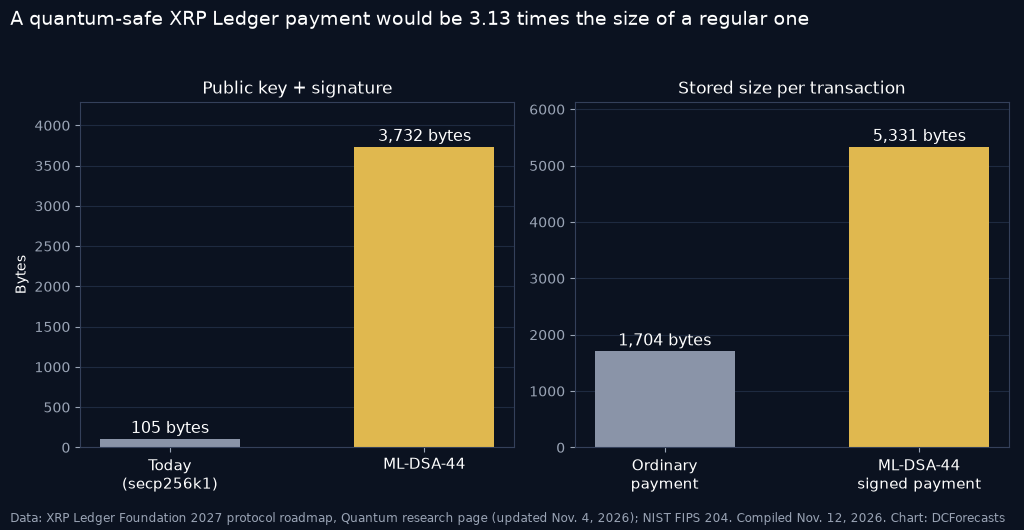
The Foundation’s research page turns that into ledger growth. At one quantum-signed transaction per ledger, the extra data would add about 42 GB a year. At 1,000 per ledger, it would reach about 42,029 GB a year. The migration study will also have to decide whether larger transactions need their own fee rule.
The trade-off is familiar to anyone who followed yesterday’s post-quantum sBTC transfer on Stacks, which used a hash-based signature of 16,384 bytes. Stronger long-term security, for now, means much heavier data.
Timeline, Cost and the NIST Deadlines Behind It
The roadmap schedules a post-quantum migration study for the first half of 2027. Development, review and audit would follow in late 2027 or 2028. The Foundation sizes the job at 640 hours of building and 400 hours of review, with outside costs of $215,000 to $255,000, including a $100,000 audit.
Its research page says the push is driven by large holders first, meaning exchanges, custodians and issuers, then by validators, whose long-lived keys sign the network’s consensus messages. Regulated institutions come third.
That last group has a firm calendar to follow. NIST’s transition report, IR 8547, says quantum-vulnerable public-key cryptography will be deprecated after 2030 and disallowed under NIST standards after 2035. ECDSA and EdDSA, the families behind today’s crypto signatures, are among the algorithms it lists.
The Foundation also cites research published in March 2026 that put the cost of breaking the 256-bit elliptic curve problem at fewer than 1,200 logical qubits. No machine of that kind exists today, but the estimates have been falling.
Why Bitcoin Holders Should Watch This Too
Bitcoin faces the same physics. Its signatures also rely on secp256k1, and as we reported, 35.4% of Bitcoin now has a visible public key, much of which can be protected simply by moving coins to fresh addresses.
The difference is in how each network moves. Bitcoin changes slowly and by broad consensus, which has protected it from rushed upgrades for more than 16 years. Every working proposal elsewhere, including this one, adds real data on transaction size, storage and wallet design that Bitcoin developers can learn from before any decision has to be made.
We believe that is good news for the whole industry. Quantum computing is a long-horizon risk, and the fact that major networks are measuring its costs years ahead of time is a sign of maturity, not alarm.
For XRP Ledger users, nothing changes today. The proposal still has to clear a study, an audit and a validator vote, and accounts that never rotate keys would keep working exactly as they do now.
DC Forecasts is a leader in many crypto news categories, striving for the highest journalistic standards and abiding by a strict set of editorial policies. If you are interested to offer your expertise or contribute to our news website, feel free to contact us at [email protected]











Discussion about this post