


The U.S. Securities and Exchange Commission brought fewer new cases in its 2026 fiscal year than in any of the five years before it. It also sent far more money back to people who had been cheated.
Those two facts sit side by side in the agency’s annual enforcement report, published on Nov. 10. For the crypto industry, the more telling detail is what kind of crypto cases made the list.
The digital asset matters the SEC chose to highlight were a social media trading scam, a Ponzi scheme, a years-old BitConnect promotion case and a failed audit of FTX. Legitimate exchanges and token projects were nowhere in the summary.
The SEC Enforcement Actions by the Numbers
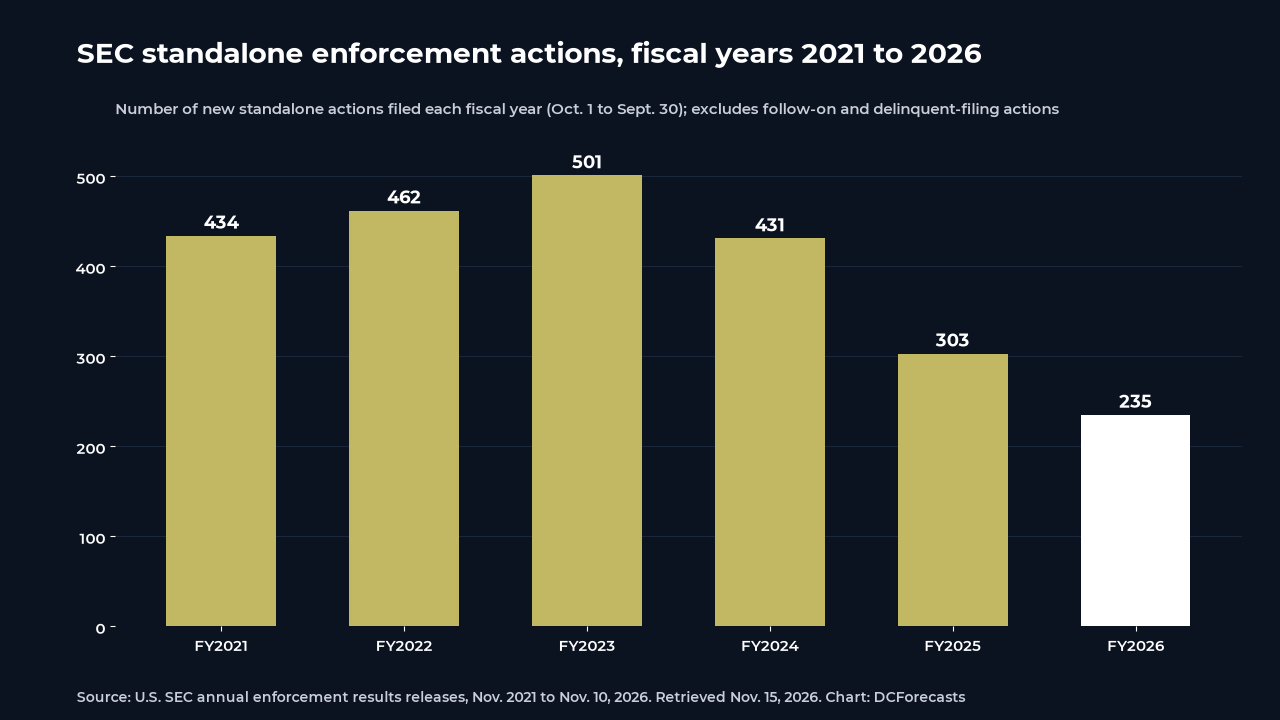
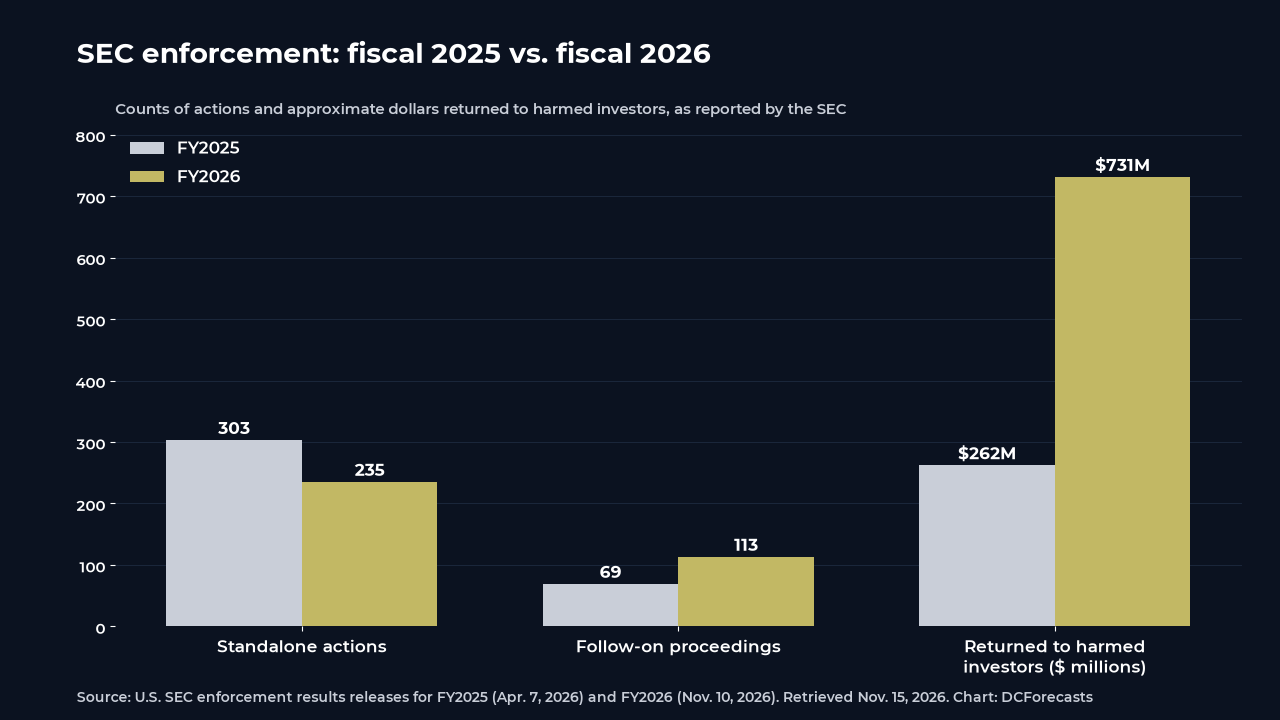
According to the SEC’s fiscal 2026 results, covering the 12 months to Sept. 30, the Commission filed 348 enforcement actions. That total included 235 standalone actions and 113 follow-on administrative proceedings, which bar or suspend individuals after a criminal conviction, injunction or similar order.
Standalone actions are the cleanest year-to-year measure because they count new cases. At 235, they were down 22% from 303 in fiscal 2025, which the SEC reported in an April 2026 release.
Fiscal 2025’s headline total of 456 also included 84 actions against delinquent filers. The 2026 release does not list that category, so the two headline totals are not directly comparable.
The longer trend is clear. Standalone actions peaked at 501 in fiscal 2023, then fell to 431 in fiscal 2024, according to the SEC’s fiscal 2024 report.
Fewer Cases, More Money Back to Victims
The Commission obtained orders for $1.095 billion in monetary relief in fiscal 2026. That figure splits into $752 million of disgorgement and prejudgment interest and $343 million of civil penalties.
The SEC noted that $235 million of the disgorgement was deemed satisfied by a court in a separate, non-SEC case. Stripping that out leaves roughly $860 million.

That is smaller than fiscal 2025. Last year’s reported $17.9 billion was dominated by the long-running Stanford Ponzi litigation. Excluding that case and similar deemed-satisfied amounts, the agency put fiscal 2025 relief at $1.4 billion of disgorgement and $1.3 billion of penalties.
The number that moved the other way is money returned. The SEC said it returned about $731 million to more than 250,000 harmed investors in fiscal 2026, compared with about $262 million a year earlier. That is close to three times as much.
What SEC Crypto Enforcement Looks Like Now
The fiscal 2026 report reads very differently from the agency’s output a few years ago. Its crypto references are about people who used digital assets as a cover story to take investors’ money.
The SEC said it charged three purported crypto asset trading platforms and four investment clubs that allegedly took at least $14 million from retail investors. The alleged scheme recruited victims on social media with investment tips supposedly generated by artificial intelligence, then moved the funds overseas.
In February 2026, a jury found Ismael Sanchez liable for securities fraud and registration violations tied to CryptoFX, a Houston-based scheme that the SEC describes as a $300 million Ponzi operation that targeted more than 40,000 mostly Latino investors.
The agency also settled with an audit engagement partner over negligent audits of FTX, and won monetary relief against a defendant charged in 2021 over promoting the BitConnect “lending program.”
The shift was set out plainly in the fiscal 2025 report. There, the Commission said it had made “a necessary course correction” on crypto, and it listed seven crypto cases dismissed from February 2025, including those against Coinbase, Kraken’s parent Payward, Consensys and Binance.
New Tools Aimed at Fraud
The SEC built new units around that focus. A Retail Fraud Working Group now targets Ponzi schemes, impersonation scams and manipulation aimed at everyday investors. The agency said more than a dozen new investigations have already come from it.
A new Office of Super Intelligence and Analytics is meant to spot misconduct earlier. The SEC says its work includes “improved blockchain and financial-flow analysis.”
“Enforcement actions and financial remedies are important measures of activity, but they are not the only or most telling measures,” SEC Chairman Paul S. Atkins said in the release.
Enforcement Director David Woodcock said the division had built a program that is “more focused, effective, and prepared to address both longstanding and emerging threats to our markets.”
Why Clear Rules Matter for Bitcoin
Bitcoin has never fit the mold of a startup token raising money from the public. There is no issuer to charge and no company to sue. A regulator that saves its resources for scams leaves room for the asset’s market infrastructure to grow.
That build-out has been visible this month. Coinbase moved its custody business into a federally chartered trust bank. Meanwhile, U.S. agencies kept going after the people who actually steal crypto, as with the Justice Department’s update on frozen Binance heist funds.
A lighter SEC docket does not mean fraud has disappeared. The CryptoFX and social media cases show that crypto-themed scams remain a real risk for retail investors.
What has changed is the target. The SEC is spending its time on schemes that take investor money, not on whether a regulated exchange filed the right paperwork. We believe that kind of clarity is good news for Bitcoin investors and for the U.S. companies building around it.
This article is for information only and is not investment advice.
DC Forecasts is a leader in many crypto news categories, striving for the highest journalistic standards and abiding by a strict set of editorial policies. If you are interested to offer your expertise or contribute to our news website, feel free to contact us at [email protected]












Discussion about this post