



Coinbase custody now has a federal home. The Office of the Comptroller of the Currency (OCC) granted final conditional approval to Coinbase National Trust Company on Nov. 6 and authorized it to open for business on Nov. 9.
The decision letter, published in the OCC’s Corporate Decision #1370, does more than hand over a charter. It spells out exactly what the new bank can do, how much capital it must keep, and how Coinbase’s existing custody clients will move across.
For Bitcoin holders, the headline is simple. One of the largest crypto custodians in the world will now hold client assets under a national bank charter, subject to fiduciary duties and federal supervision.
From Application to Opening in 402 Days
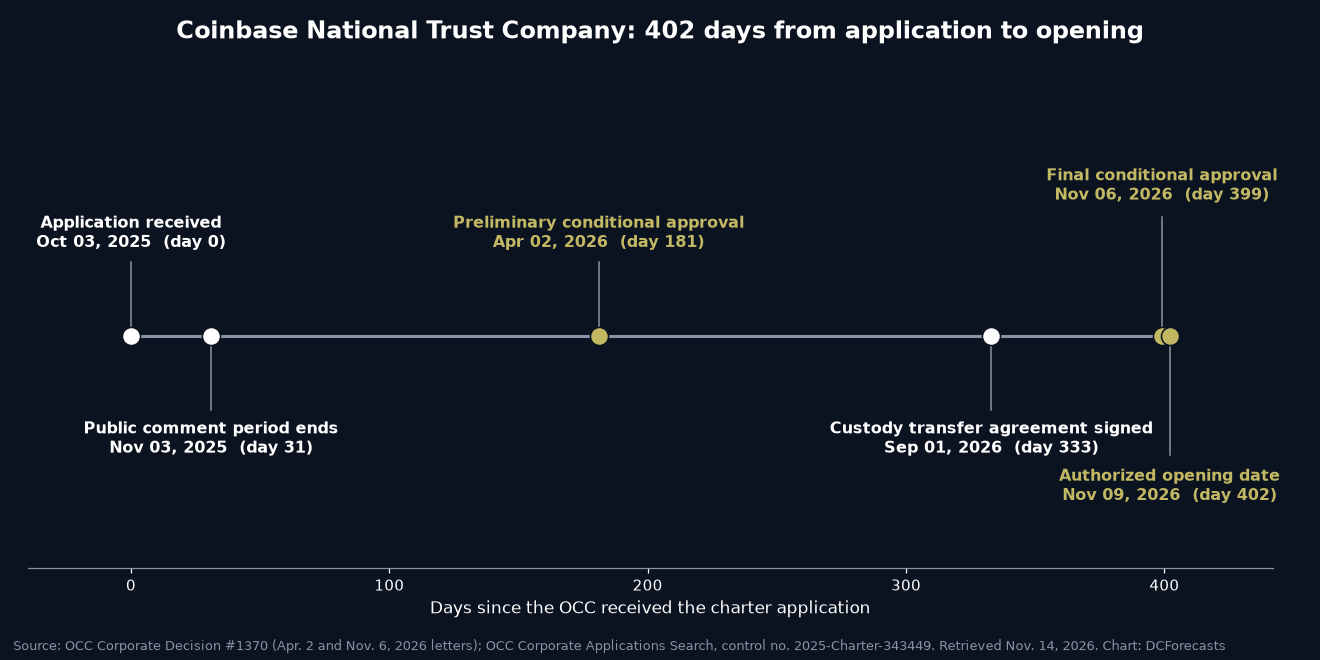
According to the OCC’s applications register, the regulator received Coinbase’s charter application on Oct. 3, 2025. The public comment period closed a month later, on Nov. 3.
Preliminary conditional approval followed on April 2, 2026, day 181 of the process. Final approval came on Nov. 6, day 399, after the OCC found that the organizers had met every pre-opening requirement.
The bank is based at One Madison Avenue in New York and is led by President and CEO Rick Schonberg. The OCC also said it did not object to Brett Baker-Bourgeois as chief operating and trust officer, or to Rebecca Shaw as Bank Secrecy Act officer.
What the Charter Allows
The letter approves the bank’s plan to exercise fiduciary powers under 12 USC 92a. In plain terms, it “will provide cryptocurrency custody in a fiduciary capacity.”
The OCC tied that authority to New York law, which already lets state trust companies offer crypto custody as fiduciaries. Because the bank is located in New York, it may do the same as a national bank.
That fiduciary label matters. It means the bank’s custody services are subject to fiduciary duties and standards of behavior, the same framework that governs how traditional trust banks look after client securities.

The approval is narrow by design. The bank must limit itself to trust company activities in its business plan and must not meet the definition of a “bank” under the Bank Holding Company Act. It is not set up to take deposits or make commercial loans.
One standard requirement also stands out. As a national bank, the trust company must complete its subscription for stock in a Federal Reserve Bank, making it a member of the Federal Reserve System, and keep an internal control system that meets Bank Secrecy Act reporting rules.
The Conditions: $60 Million and Three Years of Oversight
The OCC attached six conditions, enforceable under federal banking law. The capital rules stand out.
- The bank must keep at least $60 million in tier 1 capital, with the greater of half of that capital or $30 million held in eligible liquid assets such as cash and short-term Treasury bills.
- It must separately hold 180 days of operating expenses in liquid assets, sized for a distressed wind-down rather than normal operations.
- It must give 60 days’ notice and win OCC no-objection before any significant change to its business plan, including any offer of transactional services to custody customers.
- New directors and senior officers, including its chief technology and information security officers, need OCC clearance before they start.
Most of these conditions last for the bank’s first three years. The OCC also requires the bank to conform its activities to the GENIUS Act, the federal stablecoin law, and the regulator’s implementing rules as they take effect.
How Coinbase Custody Clients Will Move
Today, Coinbase Custody Trust Company, a New York-chartered trust company, serves Coinbase Prime clients. The two entities signed a Master Assignment and Assumption Agreement on Sept. 1, 2026, to shift those client relationships to the national bank over time.
Moving client accounts and digital assets between affiliates would normally run into Regulation W, the rule that limits transactions between a bank and its sister companies. The OCC approved the transfer as exempt from Regulation W’s quantitative limits and collateral requirements, using a carve-out for newly formed banks.
That clears the main technical hurdle for a gradual migration. Clients should not need to rebuild their custody setup from scratch.
Why This Is Good News for Bitcoin
We believe federal charters like this one are among the most important plumbing upgrades the Bitcoin market has seen. Pension funds, endowments and asset managers often need a qualified, bank-supervised custodian before they can hold an asset at all.
Coinbase joins a growing list. The OCC’s decisions index shows several crypto trust banks moving through the same process, including Laser Digital and others that received preliminary approvals this year.
Traditional banks are building from the other side. Deutsche Bank recently switched on digital asset custody for Bitcoin and Ether, and the CFTC has let Coinbase’s derivatives clearinghouse settle through trust companies.
Each step makes it easier for large, conservative money to hold Bitcoin through familiar structures. A custodian that answers to the same regulator as the nation’s biggest banks removes one more reason for an investment committee to say no.
The next milestone is the client migration itself. As accounts move across, Coinbase custody will increasingly sit inside the federal banking system rather than beside it.
DC Forecasts is a leader in many crypto news categories, striving for the highest journalistic standards and abiding by a strict set of editorial policies. If you are interested to offer your expertise or contribute to our news website, feel free to contact us at [email protected]












Discussion about this post