



The Federal Reserve is preparing to spend less time processing paper checks and charge banks more for the work, while its FedNow instant payment service keeps setting new volume records.
The Fed Board announced its 2027 prices for the payment services the 12 Reserve Banks sell to banks and credit unions on Nov. 12. Most of the changes are small. The average increase across established services is 1.4%.
Checks are the exception. The Federal Register notice behind the announcement describes the first steps in what it calls “a series of anticipated strategic changes” to the Fed’s check business over the coming years.
A 39-Hour Weekend Pause for Checks
Starting in May 2027, the Reserve Banks will cut back check processing when volumes are thin.
Today the service runs from Sunday at 2:00 p.m. ET through the following Saturday at 10:00 p.m. ET, holidays included. Under the new schedule, it will open Sunday at 7:00 p.m. ET, five hours later, and close Saturday at 4:00 a.m. ET, 18 hours earlier.
That stretches the weekend maintenance window from 16 hours to 39 hours. The check service will also close on holidays for the first time.
The notice stresses that none of this changes how consumers and businesses write or receive checks. It only affects how banks and credit unions clear them through the Fed.
Fees Rise as the Check Business Loses Money
The pricing math explains the shift. The Reserve Banks expect check services to recover just 78.9% of their costs and targeted return in 2027, down from a forecast 94.5% this year.
Revenue is projected at $110.8 million, up 3.2%. Expenses are projected at $137.7 million, up 24.3%, because the Fed must invest in keeping its core check-processing systems reliable.

Check customers will pay about 5.4% more on average. Return reclear fees show the pattern: the daily fee rises from $12 to $15, and the Level 1 per-item charge goes from $0.85 to $1.02.
Check Volume Keeps Falling
The fee increases are chasing a shrinking market. According to the Fed’s annual check data, the Reserve Banks collected 2.80 billion commercial checks in 2025, down 6.1% from 2024 and down from 16.99 billion in 2000.
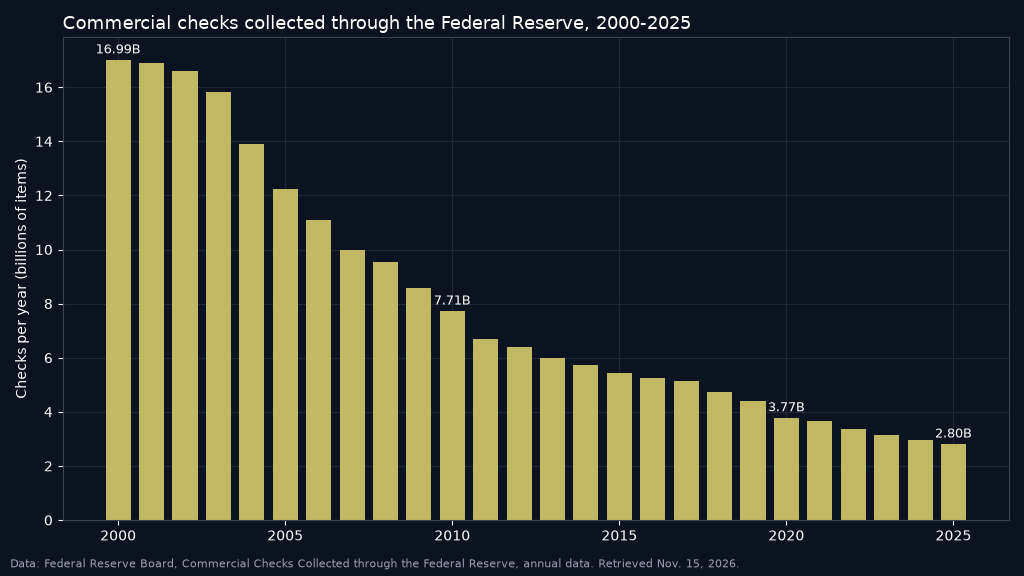
The decline is speeding up again. Through August 2026, forward check volume was 8.7% lower than a year earlier. The Reserve Banks now expect an 8.1% drop for the full year, steeper than the 6.0% they budgeted for.
The money involved is still large. The checks the Fed collected in 2025 were worth $8.13 trillion, with an average value of $2,908 per check.
The Fed did not move without asking. A December 2025 request for information drew more than 330 unique comments. Many said checks still meet needs that other payment methods do not, and there was limited support for any substantial or rapid wind-down. The Board says it will keep watching whether its role in check processing needs a broader rethink.
FedNow Is Growing From a Small Base
The other side of the story is FedNow, the Fed’s instant payment rail, which launched in July 2023 and runs around the clock.
According to FedNow statistics published by the Federal Reserve, the service settled 6.38 million payments worth $370.9 billion in the third quarter of 2026. That was up 27.6% from the second quarter and roughly 2.5 times the 2.51 million payments a year earlier.
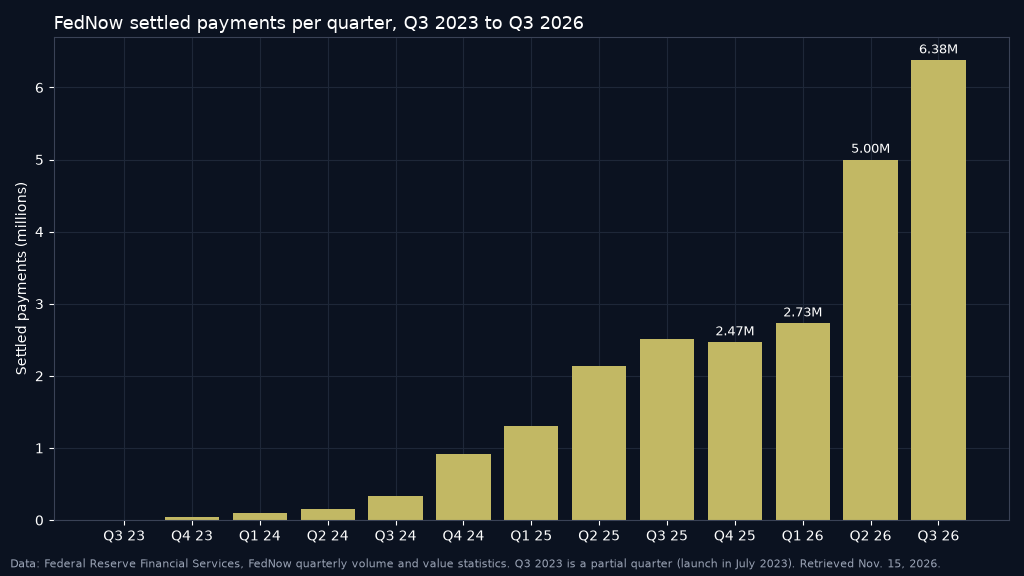
The scale gap is still wide. FedNow averaged 69,309 payments a day in the third quarter, while the Fed handled an average of 11.2 million checks per business day in 2025.
The Fed is open about that. The notice calls 2026 FedNow volume “modest,” compares its adoption to FedACH’s slow build in the 1970s and 1980s, and forecasts $236.1 million in FedNow operating expenses this year. It does not expect the service to recover its costs within the usual 10-year window.
Pricing is changing too. The free tier that covered the first 2,500 FedNow transactions per month ends after 2026, replaced by a new incentive program from Jan. 1, 2027 that rewards banks for enabling both sending and receiving.
Why Crypto Watchers Should Care
The direction is clear even if the pace is slow. Paper is fading, and the Fed is shifting toward payment rails that do not close for the weekend.
We think that trend favors digital assets. Bitcoin has settled transactions 24 hours a day, seven days a week, since 2009, and tokenized money is moving the same way, from Hong Kong’s 24/7 tokenized deposit settlement to central bank tests aimed at cutting FX settlement risk.
The next checkpoints are the fourth-quarter FedNow figures and the May 2027 check schedule change. Together they will show how quickly America’s oldest payment habit is giving ground to always-on money.
DC Forecasts is a leader in many crypto news categories, striving for the highest journalistic standards and abiding by a strict set of editorial policies. If you are interested to offer your expertise or contribute to our news website, feel free to contact us at [email protected]












Discussion about this post