



The digital euro has a test date, a list of participants and a place to start: staff canteens at the European Central Bank. What it still lacks is a law.
ECB Executive Board member Piero Cipollone laid out the timeline to the European Parliament’s economic and monetary affairs committee in Brussels on Nov. 10. His introductory statement pressed lawmakers to finish negotiations on the Single Currency Package so it can be adopted by the end of 2026.
“A delay in adoption could instead postpone the introduction of the digital euro,” Cipollone said, warning that it would also “further entrench Europe’s dependence on foreign providers.”
A Digital Euro Pilot Starting in the Second Half of 2027
The ECB is already preparing a pilot. It will run on a beta version of the digital euro without legal tender status, and its job is to test technical functions, operations and the user experience.
The pilot is scheduled to start in the second half of 2027. It will involve Eurosystem staff, participating payment service providers (PSPs) and selected merchants offering everyday services, such as canteens at the ECB and participating national central banks.
Demand to take part has been strong. In July the ECB picked 36 PSPs from more than 50 applicants, including both banks and non-bank firms of different sizes, business models and locations. A separate call for online and mobile merchants, aimed at testing remote payments, opened in September, and the final selection is due early next year.
A new wave of innovation work, including tests of conditional payments and the use of artificial intelligence in payments, will run from January to June 2027.
The Legal Clock Is the Real Deadline
The technical work can only go so far. Cipollone said the ECB can set a planned date for a possible first issuance only after the regulation is adopted.
Progress so far has been positive. The European Parliament adopted its position on the Single Currency Package in a plenary vote on July 9, which Cipollone said gives the project “a strong democratic backing.” The package covers both the legal tender of euro cash and the legal framework for a possible digital euro. Talks among the EU institutions, known as trilogues, are still under way.

The ECB also wants every main use case available from day one, including person-to-person, online and in-store payments. At the same time, market feedback favors a gradual rollout, and the ECB welcomed lawmakers’ plans to give legal clarity on a phased introduction in shops.
Cash Is Not Going Away
The speech’s title, “Cash and the digital euro: two sides of the same coin,” was a deliberate message. The ECB is designing new banknotes at the same time it builds digital money.
A public survey on ten shortlisted designs, built around the themes “European culture” and “Rivers and birds,” drew almost 10 million responses. The ECB’s Governing Council is expected to choose the final design concept around the end of this year, and the first new notes are expected in the early 2030s.
The data supports that dual approach. Euro banknotes in circulation were worth about €1,632 billion at the end of September, according to the ECB Data Portal, close to the record €1,637 billion set in July 2026. That is up from €1,590 billion a year earlier.
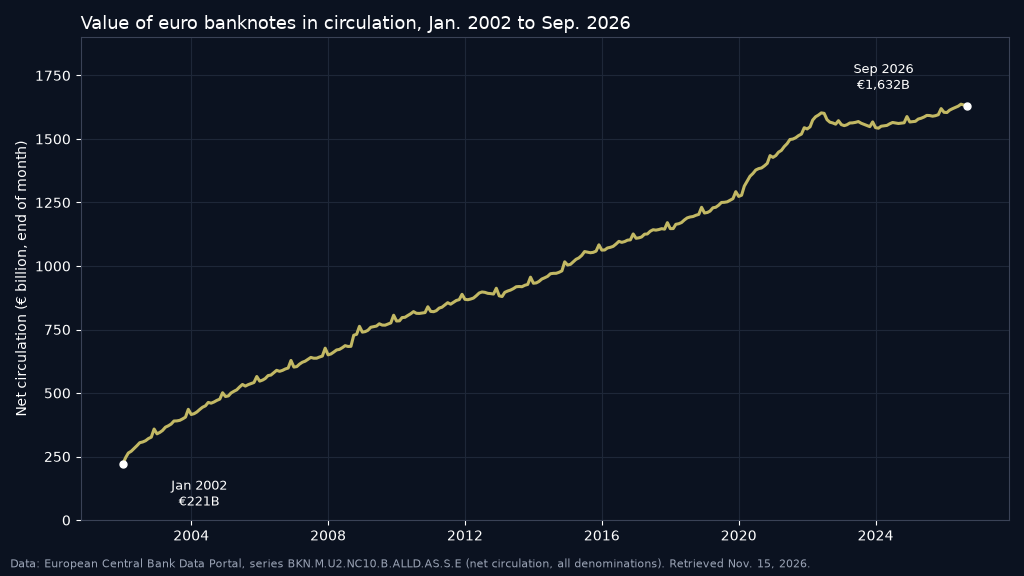
Cipollone backed “strong legislative provisions” on mandatory cash acceptance, access to cash across the euro area and the resilience of cash infrastructure. Jan. 1, 2027 will mark 25 years since euro notes and coins entered circulation.
Tokenized Finance Is Moving Faster
While the retail digital euro waits for lawmakers, the wholesale side is already live. Cipollone highlighted Pontes, which links market distributed ledger technology (DLT) platforms with the Eurosystem’s TARGET Services.
Pontes launched in September with 18 market participants and DLT operators onboarded on day one. On Nov. 2 it settled the European Stability Mechanism’s first digitally native benchmark bond, a €1 billion issue, in central bank money.
That fits a wider push in Europe. Regulators are now recruiting firms to write common standards for tokenized assets, and euro-pegged stablecoins are still trying to close a large gap with dollar tokens.
What It Means for Bitcoin
A digital euro would be a liability of the central bank, built to sit alongside cash and bank money inside the euro system. Bitcoin is a different kind of asset: a fixed-supply network with no issuer that has run around the clock since 2009.
We see Europe’s push as further proof that money is moving onto digital rails, a shift Bitcoin helped start. The ECB’s own reason for hurrying, reducing reliance on foreign payment providers, also shows how much the question of who controls payments now matters.
The next markers are clear: whether trilogue talks wrap up by year-end, the merchant selection early in 2027 and the pilot launch in the second half of next year.
DC Forecasts is a leader in many crypto news categories, striving for the highest journalistic standards and abiding by a strict set of editorial policies. If you are interested to offer your expertise or contribute to our news website, feel free to contact us at [email protected]












Discussion about this post