


The Federal Reserve has quietly redrawn next year’s calendar, and traders who plan around FOMC meeting dates will want to update their diaries. A revised tentative schedule published on Nov. 12 cuts the number of 2027 interest rate announcements from eight to seven.
Two changes do the work. The Oct. 26-27 meeting will no longer end with a policy decision. Instead, the Fed says it “will be dedicated to the discussion of broad monetary policy strategy issues.” And the Dec. 7-8 meeting that appeared on the original calendar is gone, replaced by a meeting on Nov. 16-17.
For anyone who trades around central bank days, including Bitcoin holders, the result is a calendar with longer quiet stretches at the end of the year.
What Changed in the FOMC Meeting Dates
The Federal Open Market Committee first published its 2027 plan on Sept. 5, 2025. That version listed eight two-day meetings, each ending with a policy statement at 2 p.m. Eastern Time and a news conference with the Chair half an hour later.
The first six meetings are unchanged in the new version. They run Jan. 26-27, March 16-17, April 27-28, June 8-9, July 27-28 and Sept. 14-15. The first meeting of 2028 also stays put on Jan. 25-26.
The differences come after September:
- Oct. 26-27: still on the calendar, but as a strategy session with no rate decision.
- Nov. 16-17: a new meeting that will produce a policy decision.
- Dec. 7-8: no longer listed.
The release does not explain the reasoning behind the change. It also describes the full schedule as tentative, so further adjustments remain possible.
Longer Gaps Between Fed Decisions
A typical FOMC year spaces decisions six to seven weeks apart. Under the original 2027 plan, that rhythm held all year: the longest gap between announcements was seven weeks.
The revision stretches the fourth quarter. From the Sept. 15 decision to the Nov. 17 decision is nine weeks. From Nov. 17 to the next scheduled decision on Jan. 26, 2028 is ten weeks.

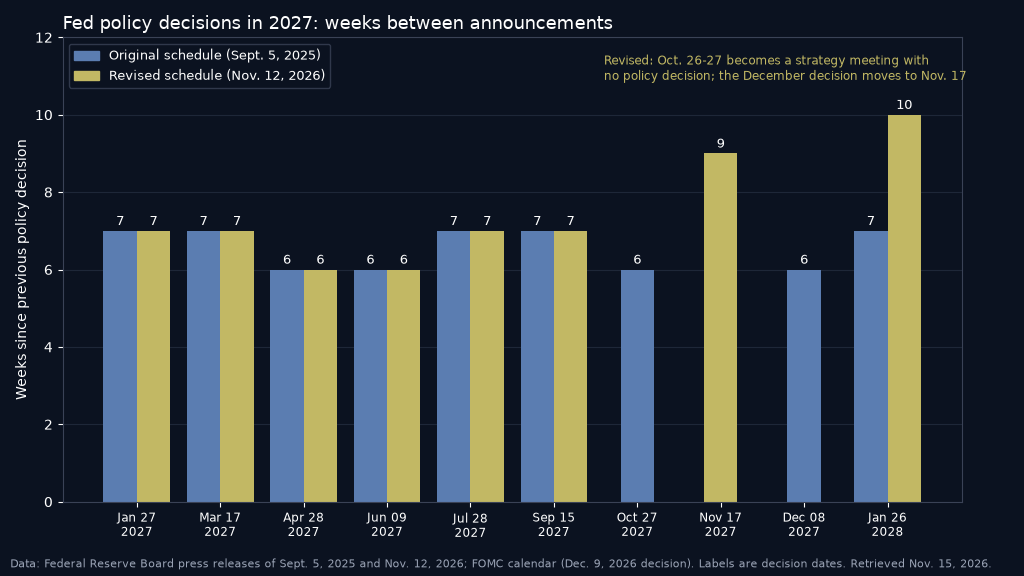
In practice, that means markets will go more than two months without a scheduled rate announcement on two separate occasions late in 2027. The Fed can still act between meetings if conditions require it, but scheduled decisions are what most investors plan around.
We think a strategy-focused meeting is worth watching on its own. When the central bank sets aside a full session to talk about how it conducts policy, the conclusions can shape the rate path for years, not weeks.
What Comes Before 2027
None of this affects the rest of 2026. According to the Fed’s meeting calendar, the final decision of the year is due on Dec. 9, after a two-day meeting that also includes a fresh Summary of Economic Projections.
That meeting arrives at a delicate moment for crypto. Bitcoin touched $61,946 on Sunday, its lowest level since July 13, before rebounding. Rate expectations are one of the forces traders watch most closely, so the December decision will draw plenty of attention.
The Fed’s balance sheet is part of the backdrop too. As we covered recently, the Fed has started growing its balance sheet again after a long run of quantitative tightening, a shift we examined alongside Bitcoin’s 213% gain during the drawdown.
How Bitcoin Has Traded Around FOMC Days
To see how much a single decision day matters, we looked at Bitcoin’s daily moves on each of the seven 2026 decision dates so far, using Coinbase BTC-USD daily closes in UTC. Because the Fed announces at 2 p.m. Eastern, each decision lands inside that UTC trading day.
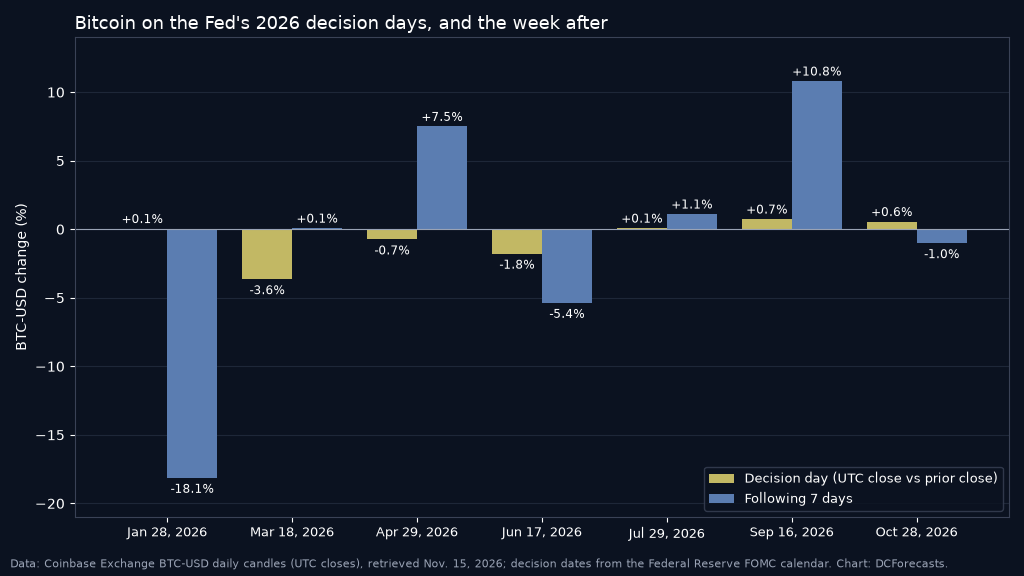
The decision days themselves were mostly calm. The average move, up or down, was about 1.1%. The biggest single-day move was a 3.6% drop on March 18, and five of the seven days finished within 0.8% of the prior close.
The week that followed told a different story. Over the seven days after each decision, Bitcoin’s moves ranged from an 18.1% decline after the Jan. 28 meeting to a 10.8% gain after the Sept. 16 meeting. April’s decision was followed by a 7.5% rise.
The data come with an important caveat. Seven meetings is a small sample, and many other forces moved the price during those weeks, so these numbers show what happened, not what the Fed caused.
Still, the pattern is useful. Bitcoin tends to absorb the headline quickly, while the bigger repricing plays out as investors digest the statement, the press conference and the data that follow.
What to Watch Next
For now, the practical takeaway is simple. Anyone who builds a trading or reporting calendar around FOMC meeting dates should replace the December 2027 entry with Nov. 16-17 and mark Oct. 26-27 as a no-decision meeting.
Fewer scheduled announcements also means fewer event-driven shocks. Bitcoin is a 24/7 market that does not wait for a press conference, and long gaps between decisions leave more room for adoption, flows and on-chain fundamentals to drive the price. We see that as a healthy backdrop for an asset built to operate independently of central bank calendars.
The next scheduled test is close at hand. The Fed’s Dec. 9 decision will be the last of 2026, and the first of the seven 2027 decisions follows on Jan. 27.
DC Forecasts is a leader in many crypto news categories, striving for the highest journalistic standards and abiding by a strict set of editorial policies. If you are interested to offer your expertise or contribute to our news website, feel free to contact us at [email protected]











Discussion about this post