



Measured in Turkish lira, Bitcoin’s slide looks far less severe than the dollar headlines suggest. At Sunday’s close, the coin sat 36.2% below its record in lira terms, against a 47.2% drop when priced in US dollars.
Over a longer window, the gap is even wider. Since the first trading days of 2024, Bitcoin is up about 146% in lira but roughly 45% in dollars.
The difference is not about Bitcoin at all. It is about the currency used to measure it.
We rebuilt Bitcoin’s price in seven major currencies to see how the current sell-off feels for savers around the world, and why the lira stands out.
How We Priced Bitcoin in Seven Currencies
We started with daily Bitcoin closes against the euro from Coinbase, measured at midnight UTC, from Jan. 2, 2024, through Nov. 15, 2026.
We then converted those prices into dollars, pounds, yen, Brazilian reais, Indian rupees and Turkish lira using the European Central Bank’s euro reference rates. For Sunday’s close, we used the latest ECB fixing, from Friday, Nov. 13.
Peaks here are daily closes, not intraday highs, so the dollar figures differ slightly from direct quotes. The method keeps every currency on the same footing.
Bitcoin’s Drawdown Is Smallest in Turkish Lira
In six of the seven currencies, Bitcoin’s record close came on Oct. 6, 2025. In yen it came two days later, and in reais it came on July 14, 2025.
From those peaks, the declines are strikingly similar for most of the group. Bitcoin is down 43.9% in rupees, 44.2% in euros, 44.3% in yen and 44.4% in reais.

The pound and the dollar show the deepest falls, at 46.4% and 47.2%. The lira is the clear outlier, with a drawdown of 36.2%.
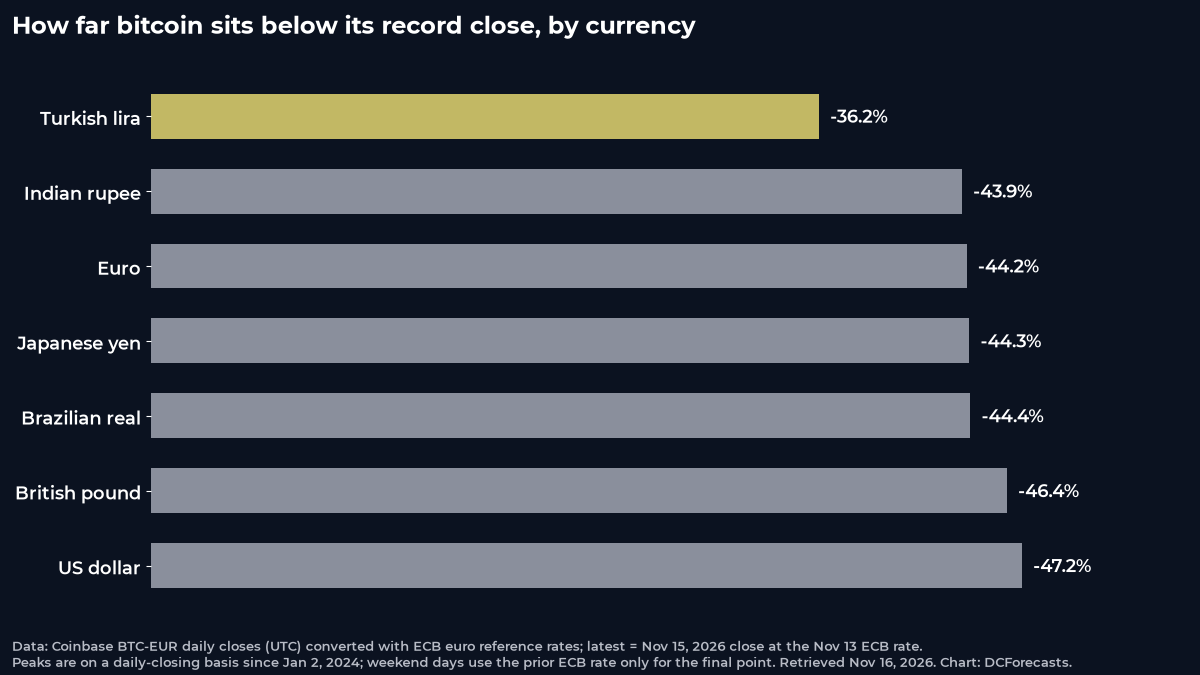
The one-year picture tells the same story. From Nov. 14, 2025, to Nov. 15, 2026, Bitcoin fell 17.7% in lira, compared with 30.9% in dollars.
Why the Turkish Lira Changes the Picture
The explanation is the lira itself. On Jan. 2, 2024, one euro cost 32.57 lira at the ECB’s reference rate. By Nov. 13, 2026, it cost 55.67 lira, a 71% increase.
Against the dollar, the implied rate moved from about 29.7 lira to roughly 50.4 over the same period. In other words, the lira has lost about 41% of its value against the dollar since the start of 2024.
When a local currency weakens, assets priced globally become more expensive in that currency. That cushions any fall in the dollar price and amplifies any rise.
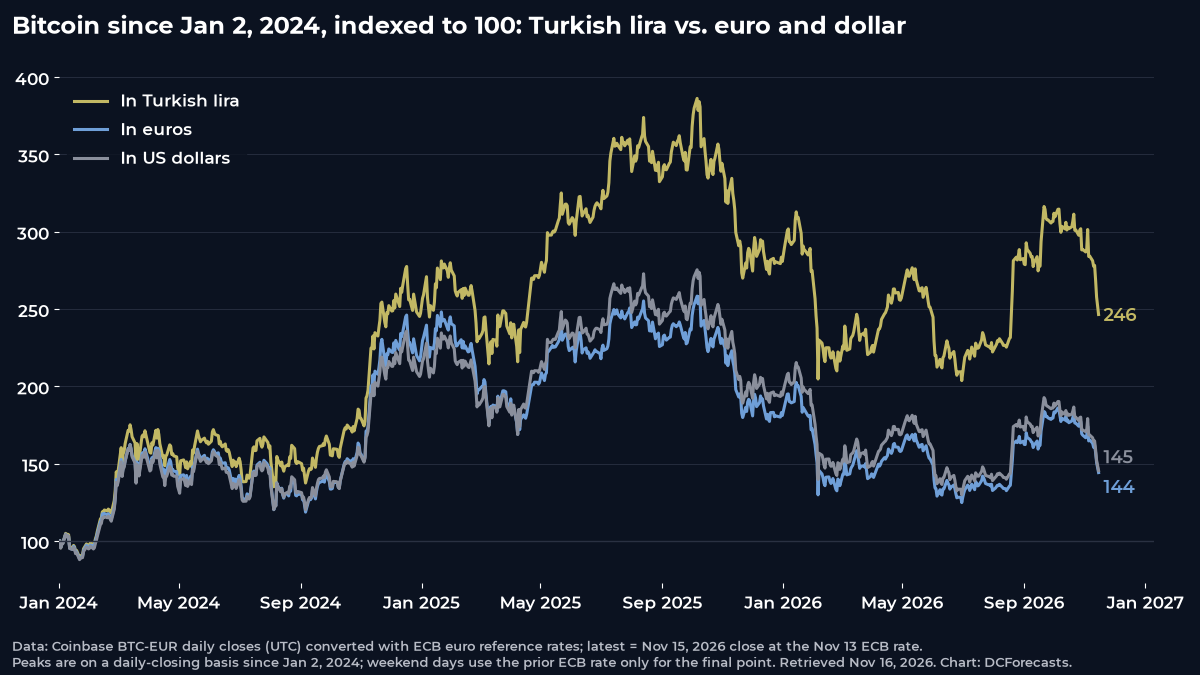
The chart shows the lines moving together through most of 2024, then separating as the lira weakened. By Sunday, the index stood at 246 in lira, 145 in dollars and 144 in euros.
One BTC closed Sunday at about 3.30 million lira. That is still well above where it began 2024, even after the recent sell-off.
A Ranking That Mirrors Currency Strength
The longer-term gains follow a clear pattern. Ranked from largest to smallest, Bitcoin’s gains since January 2024 line up exactly with how much each currency weakened against the euro over the same period, based on the ECB reference rates.
The pound actually strengthened against the euro over that span, and the dollar was roughly flat. Bitcoin’s gains since 2024 are smallest in those two currencies and the euro, at about 39%, 45% and 44%.
The yen, rupee and real each weakened by roughly 14% to 17% against the euro. Bitcoin’s gains in those currencies are correspondingly larger, at 64% to 69%.
The lira sits at the far end of the scale, which explains its outsized result.
What This Means for Bitcoin Savers Outside the Dollar
The data highlights a point that dollar-based charts can hide. For people whose savings are held in a weakening currency, Bitcoin’s long-run performance looks very different.
In lira, Bitcoin has more than doubled since the start of 2024, even after giving back a large part of its gains this autumn.
We believe this is a core reason Bitcoin keeps drawing interest in countries with unstable money. A fixed supply of 21 million coins cannot be diluted by any single central bank.
That does not make Bitcoin immune to losses. Even in lira, it has fallen sharply since early October, and short-term price swings remain large in every currency.
It also is not a precise inflation hedge on a month-by-month basis. Its 2026 high in lira, set on Sept. 21 at about 4.24 million, still fell short of the October 2025 record.
What the data does show is resilience over a multi-year horizon. Across every currency we checked, Bitcoin is worth more today than at the start of 2024.
How This Fits the Wider Market Picture
Viewed in dollars, the market mood is grim. Bitcoin is trading below several widely watched trend lines, including its 200-week moving average.
Yet price is always a ratio between two assets. We saw the same effect when we looked at Bitcoin priced in gold, where the ratio moved in Bitcoin’s favor even as the dollar price fell.
For long-term holders, the takeaway is simple. The currency you measure in shapes how a drawdown feels, and for many savers outside the dollar, Bitcoin’s record over the past three years still looks like a store of value at work.
DC Forecasts is a leader in many crypto news categories, striving for the highest journalistic standards and abiding by a strict set of editorial policies. If you are interested to offer your expertise or contribute to our news website, feel free to contact us at [email protected]












Discussion about this post