



The Czech National Bank has issued its first koruna bonds on a blockchain ledger, and it settled them with a domestic bank almost instantly. The pilot comes about a year after the same central bank put a small amount of money into bitcoin to learn how digital assets work from the inside.
The bank announced the pilot on November 10. Governor Aleš Michl used it to describe a bigger goal: a deep, fast market for koruna assets settled in central bank money.
What the Czech National Bank Actually Issued
According to the Czech National Bank (CNB), the bonds were created on distributed ledger technology (DLT) infrastructure run by the Central Securities Depository Prague. These are the first tokenized koruna bonds the central bank has issued.
The pilot covered the main jobs a bond market has to handle. The CNB tested transfers, purchases and sales against payment, and repo transactions. The trades ran in October and November with a domestic commercial bank, which Michl named as Česká spořitelna in a speech at the CzechCrunch Money Maker event in Prague.
The bank put the test volume at tens of thousands of koruna, and Michl said each bond had a nominal value of CZK 10,000. Settlement was almost instantaneous. In his speech, Michl compared this with traditional transfers that “could take up to two days.”
The CNB also said it had recently invested in a euro-denominated government bond that exists only on DLT. That means the bank is now both issuing and holding tokenized debt.
Michl Wants a Koruna Market Easier to Trade Than Bunds
“We are conservative in monetary policy and innovative in everything else,” he said in the bank’s statement.
He then set an ambitious target: “The goal is clear: to create a large market for koruna-denominated assets that are easier to buy and sell than German Bunds. The central bank must be involved from the outset, so that settlement has central bank money at its core, not private money such as stablecoins.”
Other central banks also want the cash leg of tokenization to stay with them. Hong Kong now settles tokenized deposits around the clock in central bank money. Kazakhstan’s central bank has priced its first tokenized notes, and government bonds could follow. With this pilot, the tokenization of securities in Prague has moved from talk to live trades.

Michl was also open about where the idea came from. “This form of DLT takes what is useful from bitcoin and discards what regulated finance cannot use. No miners,” he said.
The Bitcoin Test Portfolio That Came First
The bond pilot builds on an earlier step that drew more attention. In autumn 2025, the CNB set up a USD 1 million test portfolio of digital assets that includes bitcoin, a stablecoin and tokenized deposits. The portfolio is held outside the bank’s foreign exchange reserves, and the bank says its purpose is to gain hands-on experience.
For anyone following Czech bitcoin news, the order of events matters. The bank started by holding bitcoin and other digital assets. Now it is building ledger-based bonds that borrow bitcoin’s settlement model.
What the CNB’s Own Research Says About Bitcoin
The clearest view of how the bank’s leadership sees bitcoin is in its Research and Policy Note 1/2026. Board members Jan Adam and Aleš Michl wrote it with Jakub Škoda, and the CNB published it in March 2026. The note models what bitcoin would add to the bank’s reserves, and the results are striking.
Over the October 2020 to September 2025 sample, raising bitcoin from 0% to 4% of the portfolio produced about the same gain in expected return as raising equities by 15 percentage points. Measured in koruna, it was close to the gain from lifting gold holdings to 400 tons, about 30% of reserves. On September 30, 2025, the bank held 67.2 tons of gold, or 5.0% of reserves.
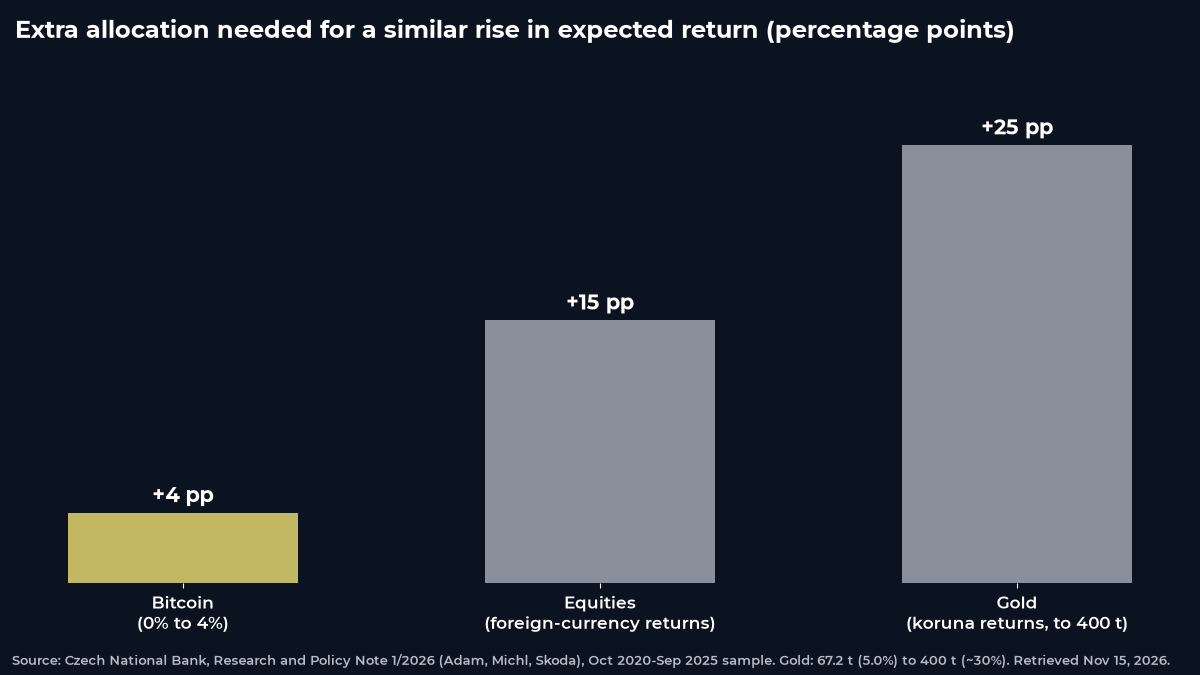
The longer sample was even more favorable. From 2010 to 2025, a 2% bitcoin allocation matched the return gain from adding more than 15 percentage points of equities, with lower portfolio volatility. In the koruna-based case, a 1% bitcoin weight slightly reduced the portfolio’s overall volatility. Bitcoin’s correlation with bonds was often negative.
The note does not hide the trade-offs. Bitcoin’s annualized volatility over five years from January 2020 was around 60%, against about 20% for equities, 16% for gold and 6% for bonds. After the pandemic, its correlation with equities rose as high as 0.6.
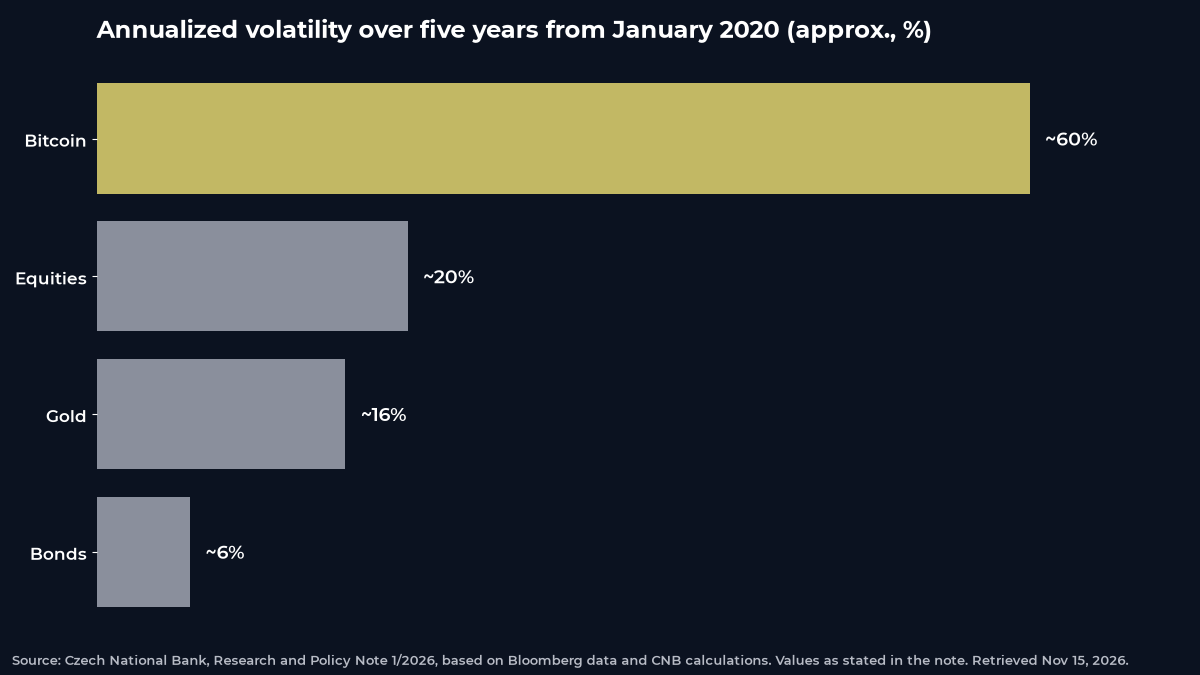
That bitcoin volatility, and the fact that the relationships change over time, is why the Bank Board decided not to put bitcoin into the reserves yet. The word “yet” is the bank’s own.
Why This Pilot Matters Beyond Prague
The next questions are about scale. The pilot ran in tens of thousands of koruna. Michl’s goal of a koruna market more liquid than German Bunds would need issuance many times larger, more participating banks and a legal framework for settlement in central bank money on a shared ledger.
For bitcoin, the signal is constructive. A conservative, inflation-targeting central bank says openly that its newest market plumbing learns from bitcoin. Its own research shows that small bitcoin allocations improved risk-adjusted returns in past samples. The bank has stopped short of a reserve allocation for now, but it is building the tools and the knowledge it would need if that decision changes.
DC Forecasts is a leader in many crypto news categories, striving for the highest journalistic standards and abiding by a strict set of editorial policies. If you are interested to offer your expertise or contribute to our news website, feel free to contact us at [email protected]












Discussion about this post