



German customs will soon have a new way to hold crypto assets worth more than €100,000 when their origin looks doubtful, even before any criminal case is opened. The federal government’s own numbers show the tool is aimed at a few hundred cases a year, not at the millions of Germans who simply own bitcoin.
The Bundestag passed the bill on November 12. Its formal name is the Act for More Justice by Strengthening the Customs Administration and Combating Financial Crime. The Bundesrat still has to approve it, and the finance ministry plans for it to take effect on January 1, 2027.
What German Customs Can Do Under the New Law
The law creates an administrative asset-review procedure run by the customs administration. Under the new Section 54 of the Customs Administration Act, the assets covered include claims and other property rights. The text says these “also include crypto-assets” as defined in Article 3 of the EU’s MiCA regulation, along with comparable digital representations of value. The government’s explanatory notes say the reference also covers asset-referenced tokens, e-money tokens and utility tokens.
Only “significant” assets fall under the procedure. That means a value above €100,000, or above €50,000 for items that must be entered in a public register, such as cars, land, ships and aircraft. Crypto is not held in such a register, so the €100,000 threshold should apply to it. Officials are allowed to estimate the value.
If there are factual indications that such an asset does not have a lawful origin, customs can secure it for up to 30 days to investigate. A finance court can extend the hold once, by up to 150 more days, so the maximum is 180 days. For crypto and other property rights, the hold works through attachment under the Fiscal Code and acts as a ban on selling.
How “Reasonable Doubt” Is Judged
The bill defines reasonable doubt as a case where, looking at all the circumstances, a lawful acquisition does not seem plausible. Officials can consider whether the owner’s income and wealth fit the asset’s value. They can also consider whether the claimed source of funds can be traced. The owner’s own explanation must be included in that assessment.
The Bundestag’s finance committee changed the government draft on November 11 in three ways that matter to crypto holders:
- A panel of finance-court judges, rather than a single judge, will decide whether assets are finally confiscated.
- False statements by the person concerned now count explicitly as a reason for doubt.
- A hold can continue if the matter turns into a criminal case.
The committee’s printed report records that CDU/CSU, SPD and AfD voted in favor, Die Linke voted against and the Greens abstained. The plenary vote followed the same pattern.
Berlin’s Own Estimate: 319 Cases a Year
The most useful detail is in the cost section of the government bill. Berlin expects the new procedure to bring in about €308 million a year from 2028. To reach that figure, officials estimated 319 procedures a year across the eight planned customs directorates. They assumed two suspect assets per case and a success rate of about 50%.

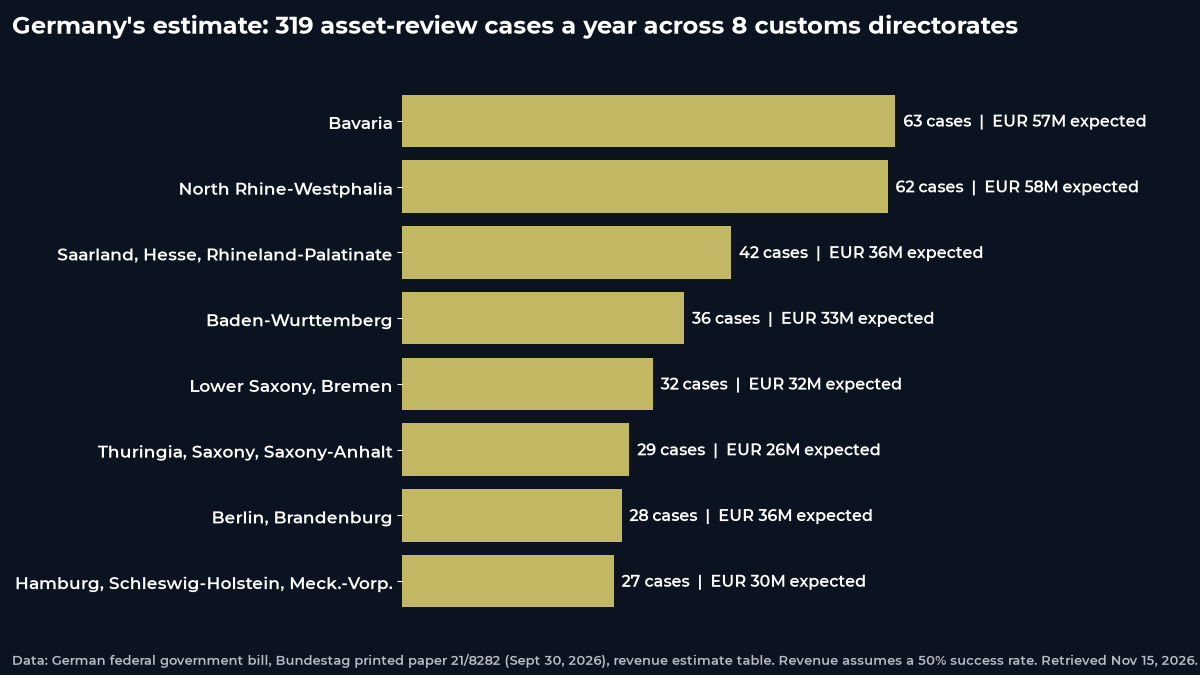
For valuables such as art and crypto, as well as vehicles, the model assumes an average value of €250,000 per asset. Property was modeled at about €1.02 million and €2.85 million per object. The officials called these conservative assumptions because no statistics exist yet on assets of unlawful origin.
For perspective, 319 cases a year in a country of more than 80 million people is a narrow tool. It is designed for large, unexplained fortunes, such as a cash-bought apartment block or a luxury car fleet. A long-term saver who bought bitcoin through a regulated exchange is not its target.
Police Are Budgeting for Crypto Analysis Tools
The bill also gives Germany’s Federal Criminal Police Office about €28.4 million in extra funding for 2027 to 2030. The bill says the money is mainly for IT infrastructure and crypto-asset analysis tools. On top of that, the office gets about €26.9 million a year for 206.5 new posts.
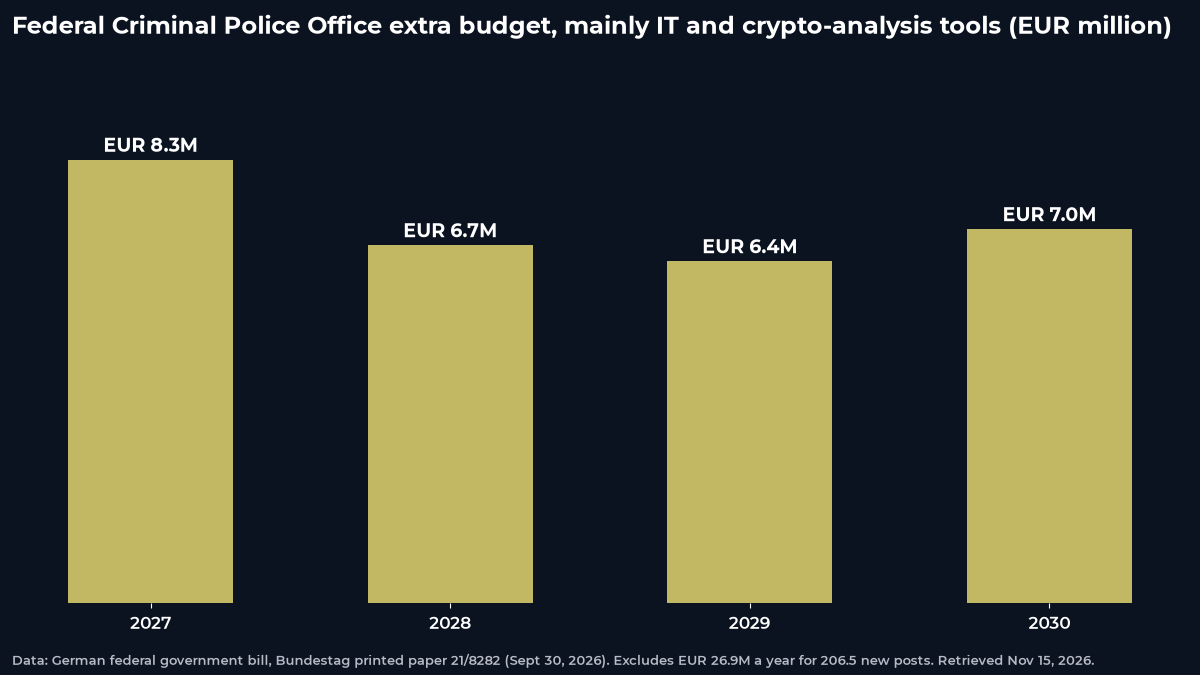
That spending reflects one of bitcoin’s strengths. Every transaction sits on a public ledger, so investigators can follow illicit money in a way they cannot with cash in a suitcase. We saw the same thing this month, when US authorities froze about half of the funds stolen in the Binance hack within two weeks.
What German Bitcoin Holders Should Keep on File
For law-abiding investors, the practical message is to keep good records. The test centers on whether the source of funds is plausible and can be traced. Bitcoin makes that easier than most assets do. Exchange statements, bank transfers, on-chain transaction IDs and wallet records can show where every coin came from.
Holders with significant amounts should keep:
- purchase confirmations and bank records from exchanges;
- a list of wallet addresses and transaction IDs;
- notes on coins bought years ago, before current reporting standards.
Germany is not the only government moving on this. Many regulators are now writing crypto into their rulebooks, from Thailand’s stablecoin draft to Kenya’s new licensing regime.
The German law treats crypto as ordinary property, as it does a car or a house. That is a sign of how far bitcoin has come. It also comes with court oversight, a high threshold and an estimate of only a few hundred cases a year. For most bitcoin holders in Germany, the new customs powers should change little beyond the value of keeping clear records.
DC Forecasts is a leader in many crypto news categories, striving for the highest journalistic standards and abiding by a strict set of editorial policies. If you are interested to offer your expertise or contribute to our news website, feel free to contact us at [email protected]












Discussion about this post