



Kenya’s crypto firms can now apply for a VASP license, and the rules they face are lighter than the ones regulators first put on the table.
In a joint public notice dated Nov. 13, the Central Bank of Kenya and the Capital Markets Authority said anyone providing, or planning to provide, virtual asset services must apply to the relevant regulator for a licence.
The notice confirms that the Virtual Asset Service Providers Regulations, 2026 were gazetted on July 22 as Legal Notice No. 134. That step brought the country’s VASP Act, in force since Nov. 4, 2025, fully into operation.
For Bitcoin users in Kenya, the bigger story sits inside the final text. A licensed exchange now needs KSh 100 million in paid-up capital, a third less than the KSh 150 million in the March draft.
The question now is how quickly the first licences arrive, and which platforms make the list.
Who Needs a VASP License in Kenya?
The short answer is almost every business that touches crypto for Kenyan customers.
The regulations apply to anyone operating “in or from Kenya.” That includes firms with no office in the country if they actively target local consumers or earn income from Kenya.
That clause matters, because many of the platforms Kenyans use today are registered abroad. The National Treasury’s impact statement on the rules flagged exactly that gap.
Supervision is split by activity. The central bank covers wallet providers, payment processors and stablecoin issuers.

The Capital Markets Authority covers exchanges, brokers, investment advisers, asset managers and offering platforms for initial coin offerings and tokenization.
Both regulators said licensing checklists are on their websites. Each will publish a list of licensed providers once approvals are issued.
When the Act took effect in November 2025, the two regulators said they had not licensed a single provider under it.
A Lower Capital Bar Than the Draft
We compared the capital schedule in the March draft with the gazetted version. The minimum paid-up capital went down in nine of the ten licence categories.
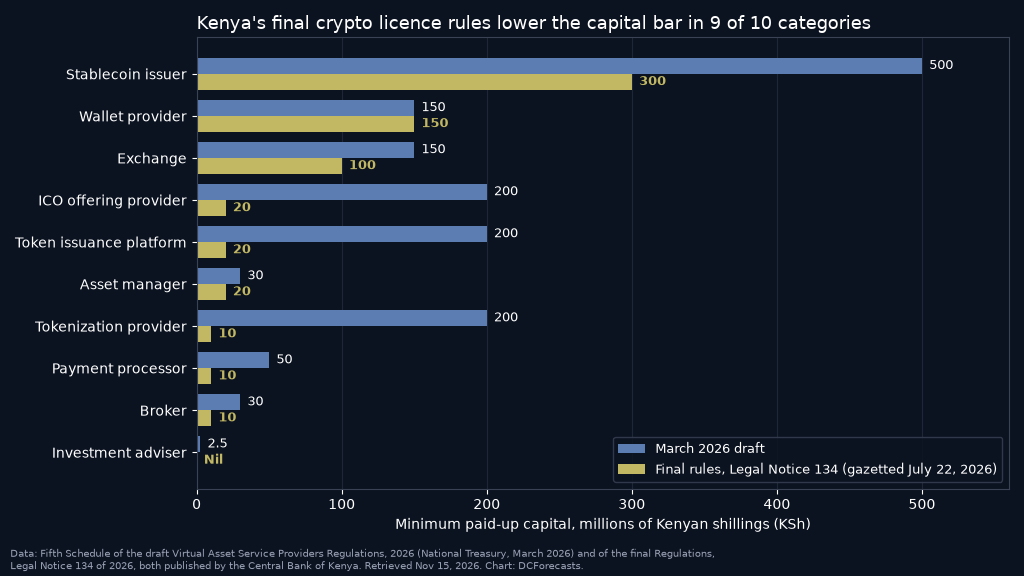
Stablecoin issuers face the highest bar at KSh 300 million, down from KSh 500 million. That is roughly $2.3 million at the central bank’s latest rate of about KSh 130 to the dollar.
Wallet providers are the only category left unchanged, at KSh 150 million. Exchanges fell to KSh 100 million, or about $770,000.
The steepest cuts hit smaller businesses. Brokers and payment processors now need KSh 10 million, against KSh 30 million and KSh 50 million in the draft. Investment advisers need no minimum capital at all.
The bar still rises for firms that do more than one thing. A licensee must hold the capital for its highest category plus 50% of the amount for each extra activity, and regulators can demand more for riskier firms.
Fees Came Down Too
The fee schedule moved in the same direction. An exchange licence costs KSh 1 million, half the draft figure.
The yearly renewal for exchanges dropped from the higher of KSh 2 million or 2% of gross income to the higher of KSh 500,000 or 0.5% of gross revenue.
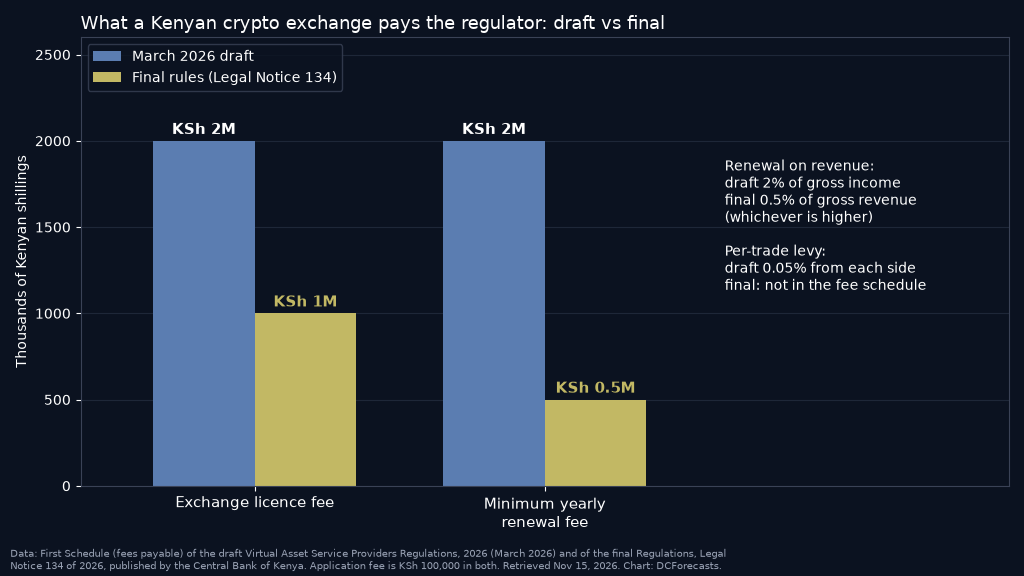
The draft also proposed a 0.05% fee on the value of every exchange trade, paid by each counterparty. That levy does not appear in the final fee schedule.
We believe that is the most important change for ordinary traders. A charge on every trade would have flowed straight through to users and pushed activity toward unlicensed offshore venues.
What the Rules Demand in Return
Lighter capital does not mean light supervision. Every licensee needs a board of at least three members, one-third of them independent.
Wallet providers must keep customer coins at separate on-chain addresses from their own holdings and run separate internal ledger accounts.
Stablecoin issuers face strict reserve rules. Each token must be fully backed by cash, central bank deposits, government securities maturing within 90 days or very short repurchase agreements.
Those reserves must sit with a custodian approved by the Central Bank of Kenya, and issuers cannot pay holders interest. That mirrors the direction of travel elsewhere, as we saw with Thailand’s draft stablecoin rules this week.
Advertising is regulated as well, with a full section of the rules on how virtual assets may be promoted.
Why We See This as a Win for Bitcoin Adoption
Kenya did not choose a ban. The Treasury’s impact statement weighed prohibition and rejected it, warning that a ban would suppress innovation and leave Kenyans at a disadvantage in the global digital economy.
The same document said Kenyans are increasingly using virtual assets to invest and move value, citing speed, cost and cross-border reach. A 2023 national risk assessment found the strongest interest among younger people.
For us, the signal is clear. Regulators listened during public consultation and lowered the cost of doing business before the licensing window opened.
A clear licence gives local exchanges and wallet providers a path to bank partnerships and mainstream trust. It also gives users an official register to check a platform against, which is the best defence against scams.
We expect stablecoin issuers to draw close attention under the new framework. We have noted how stablecoins now equal 21% of Bitcoin’s market value, a sign of how central dollar tokens have become to the trading that surrounds Bitcoin.
Plenty can still slow things down. The notice sets no deadline for existing firms to apply, and no licensed provider has been named.
But the country that made mobile money mainstream now has a working crypto rulebook. We believe that clarity will bring more Kenyans into Bitcoin through regulated, accountable doors.
DC Forecasts is a leader in many crypto news categories, striving for the highest journalistic standards and abiding by a strict set of editorial policies. If you are interested to offer your expertise or contribute to our news website, feel free to contact us at [email protected]











Discussion about this post