



Big companies can now send U.S. dollars between the United States and Singapore at any hour, including Saturdays and Sundays. DBS Bank and Kinexys, the blockchain unit of J.P. Morgan that grew out of its JPM Coin project, announced on November 16 that they have connected their tokenized deposit networks, and that the link is commercially live.
The first client is Ant International, the payments group that runs across many time zones. It will use the link to move dollars between its entities in both countries whenever its treasury team needs to, rather than waiting for banks to open.
What DBS and Kinexys actually switched on
The solution connects DBS Token Services with the Kinexys Blockchain Deposit Account network. Both are permissioned systems, meaning only approved bank clients can use them. The money moving across them is a tokenized deposit: an ordinary bank deposit recorded on a blockchain ledger, still a claim on the bank that issued it.
According to the banks, institutional clients of Southeast Asia’s largest bank and the largest U.S. bank can now deploy on-chain dollar liquidity “on demand, 24/7.” Settlement between the two networks is coordinated by Partior, a market infrastructure firm in which DBS and J.P. Morgan are both founding shareholders. Partior has appeared before in our coverage of efforts to cut settlement risk in foreign exchange.
The launch puts into practice an interoperability framework the two banks first announced in November 2025. A year later, it is handling live client money.
The fine print on “24/7”
The round-the-clock claim holds for transfers between blockchain accounts. Payments inside the Kinexys network settle on a 24/7/365, same-day basis, and the new link extends that to DBS.
There is one gap. Moving money between a traditional demand deposit account and a Kinexys blockchain account still has a three-hour weekly downtime, from 3 p.m. to 6 p.m. Eastern Time every Saturday. While the U.S. is on standard time, that is 4 a.m. to 7 a.m. Sunday in Singapore. The announcement says an enhancement to remove this window is under development.
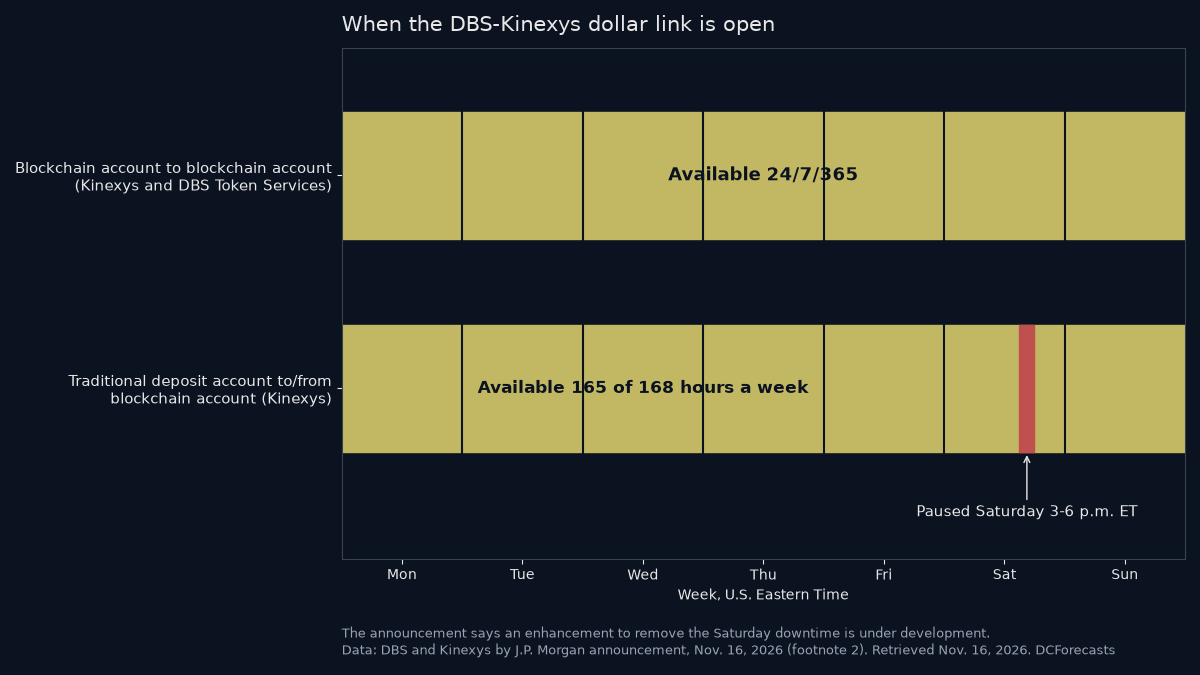
In practice, that means a treasurer who keeps dollars on-chain can move them at any time, while one who needs to bring cash in from a legacy account should plan around the Saturday afternoon pause.
Why Ant International wanted weekend dollars
For businesses in e-commerce and digital services, sales don’t stop at 5 p.m. on Friday. Suppliers and customers still need paying, and cash can get stuck between entities over the weekend or across a public holiday in one market. The banks say the new link gives these firms more payment certainty and faster access to cash.

Ant International has worked with both banks before. In 2024 it took part in the launch of DBS’s Treasury Tokens solution, and it was one of the first companies in Asia to plug into the Kinexys Blockchain Deposit Account network for real-time treasury management.
“Operating across fast-moving global markets means that we require treasury solutions with round-the-clock agility, speed and efficiency to meet our customers’ needs,” said Kelvin Li, General Manager of Platform Tech at Ant International.
Rachel Chew, Chief Operating Officer and Co-Head of Digital Assets for Global Transaction Services at DBS, said tokenized money “is moving rapidly from experimentation to delivering live tangible value for clients.” Zack Chestnut, Global Head of Commercial at Kinexys, called the launch “a tangible step towards bringing true interconnectivity to global money movement on permissioned blockchain rails.”
A US$24 trillion payments market in Asia
The banks are aiming at a fast-growing pool of money. Citing an April 2026 study by Money20/20 and FXC Intelligence, they say outbound cross-border payments from Asia are projected to reach US$24 trillion by 2033, nearly double the US$13.5 trillion recorded in 2025.
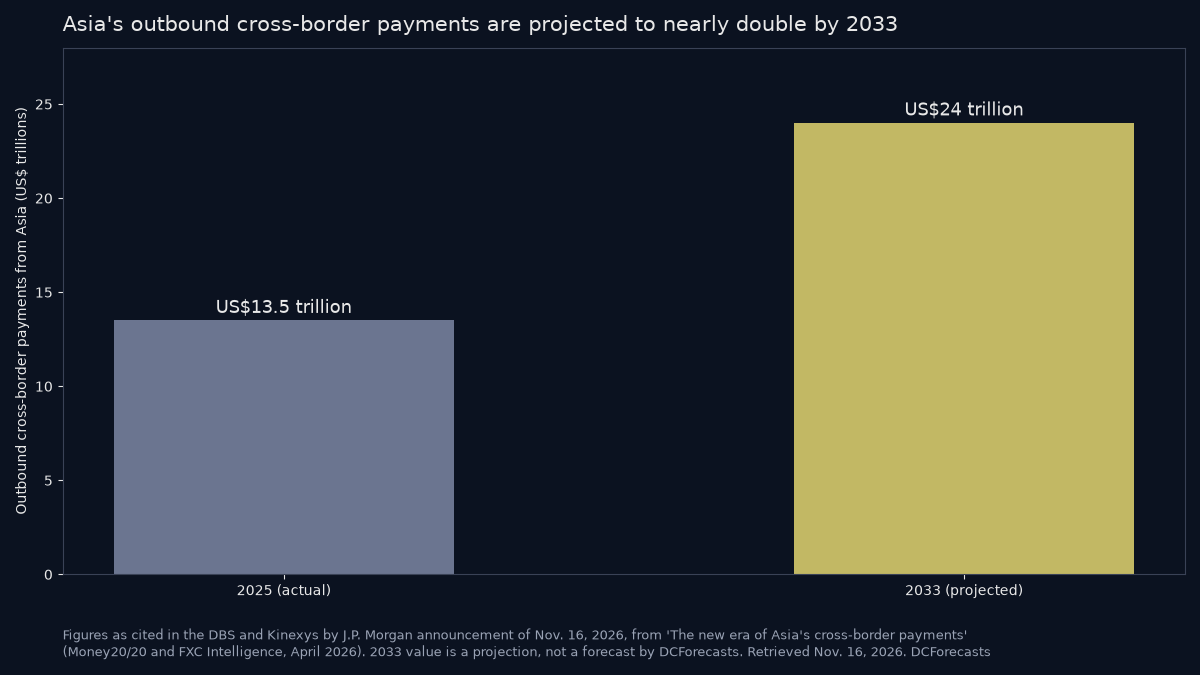
Corporate demand appears to be there. A DBS report, “The Great Rewiring: Money in a new order,” found that 88% of corporations are already deploying or piloting tokenized money use cases, and more than half have adopted or plan to adopt tokenized deposits.
Singapore’s regulator is pushing the same direction
The link also advances BLOOM, the Monetary Authority of Singapore’s initiative for settling payments in tokenized bank money and well-regulated stablecoins. DBS and Kinexys co-lead BLOOM’s token interoperability workgroup, which develops frameworks for moving different forms of digital money across networks.
BLOOM has been growing. In October, MAS said Bank Negara Malaysia and the Bank of Thailand had joined as policymaker members, alongside new participants such as Mastercard, Visa, Ripple and the World Bank Group. Hong Kong is moving on a similar track, as we reported when it began settling tokenized deposits 24/7 in central bank money.
What always-on bank money says about Bitcoin
Kinexys dollars and Bitcoin are very different things. A tokenized deposit is a bank liability on a private ledger, open only to approved clients. Bitcoin is a scarce asset on an open network that anyone can use without asking permission.
Still, the direction of travel is telling. Bitcoin has settled transactions around the clock, every day of the year, since its network went live in 2009. Weekends, holidays and cut-off times have never applied. Now two of the world’s biggest banks are spending years of engineering, and still working on a Saturday gap, to give corporate clients a version of that same always-on experience for dollars.
We see that as a quiet endorsement of the model Bitcoin pioneered. As banks, regulators and companies get used to money that moves at any hour, a 24/7 global network like Bitcoin looks less like an outlier and more like the standard that traditional finance is now working to meet.
DC Forecasts is a leader in many crypto news categories, striving for the highest journalistic standards and abiding by a strict set of editorial policies. If you are interested to offer your expertise or contribute to our news website, feel free to contact us at [email protected]












Discussion about this post