



OpenSats, the nonprofit that pays developers to work on free and open-source Bitcoin software, has announced its biggest Bitcoin grant wave in at least three years.
The group said on Nov. 17 that its General Fund is backing 21 projects at once: eight new grants and 13 renewals. The money goes to work on privacy, wallets, independent node software, home mining hardware, ecash and network security.
For Bitcoin users, it is a sign that the people building the network’s tools are getting more support, not less.
What OpenSats Announced
The eight new grants go to Bdk-cli, Cashu-TS and Cashu.me, Code Orange Dev School, Dana, Libbitcoin, OrangeCheck, the Stratum V2 Reference Implementation, and a Tor Network project focused on fighting malicious relays.
The 13 renewals cover Dana Wallet, Braidpool, Orchard, Bitcoin Research Kit, Rust-bitcoin, two developers on Floresta, BitShoka, Krux-installer, Krux, Fully Noded, BitaxeBonanza, and Tollgate and FIPS.
OpenSats said the grants are paid for by donations to its General Fund, and that the software stays freely available to everyone.
The Largest Wave in Three Years
OpenSats publishes each grant round on its blog with the number of projects funded. Across the last 16 Bitcoin General Fund waves, going back to December 2023, none was larger than this one.
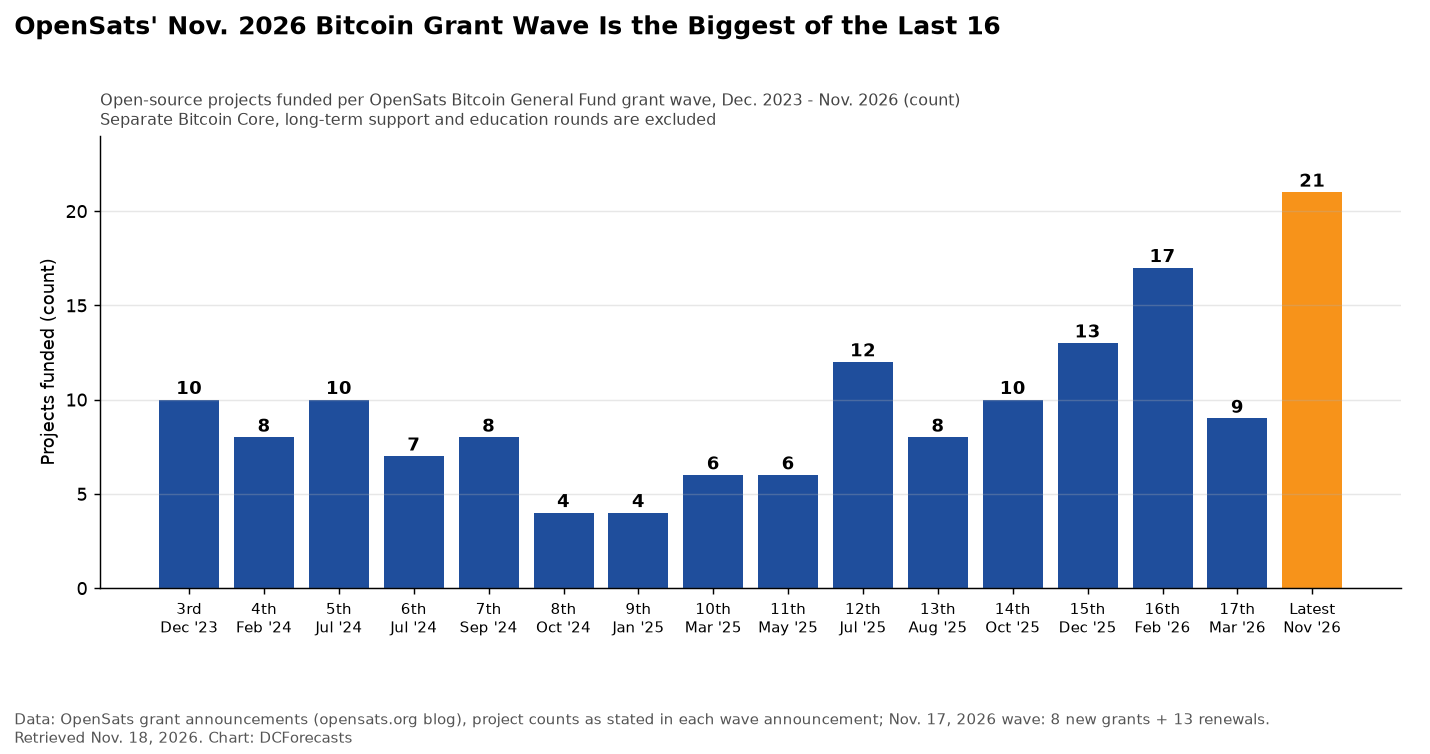
The previous high was 17 projects in February 2026. Before that, waves ranged from four to 13 projects.
The count does not include OpenSats’ separate support for Bitcoin Core. In October, the group announced four new grants and one renewal for Bitcoin Core’s foundational development, and it named developer l0rinc as a long-term support grantee.

Mining Gets Real Attention
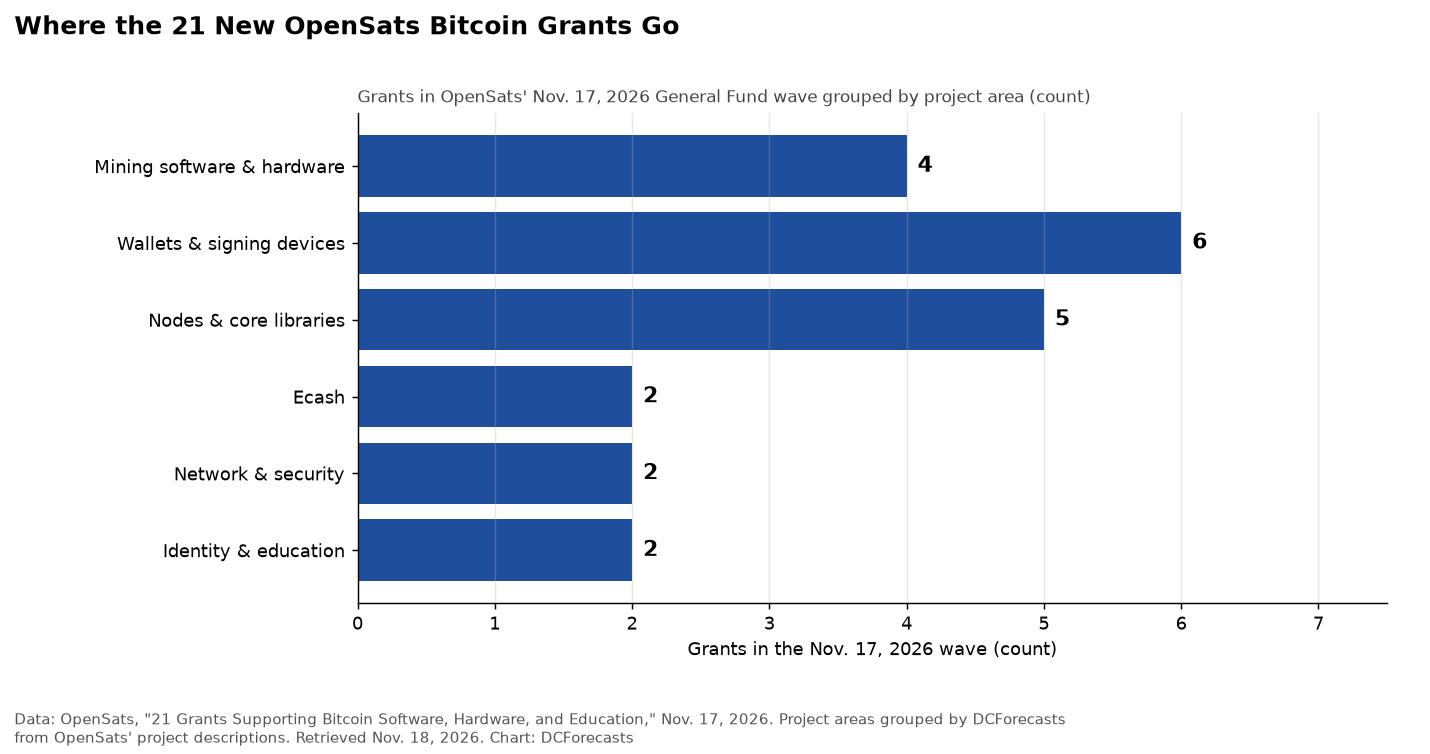
Four grants in this round focus on mining, an area where decentralization matters for Bitcoin’s long-term health.
The Stratum V2 grant supports developer bit-aloo’s work on the reference implementation. Stratum V2 encrypts and authenticates the connection between miners and pools, and its job negotiation feature lets miners build their own block templates instead of leaving transaction selection to pool operators.
That kind of protection matters. Earlier this month, mining pool operator Luxor said attackers hijacked hashrate on its platform.
Braidpool, a peer-to-peer mining pool project, is getting a second grant to add fuzzing, stress tests and benchmarking on the way to a production-ready release.
On the hardware side, BitaxeBonanza will develop a new open-source miner based on Intel’s BZM2 chips. BitShoka, a made-in-Africa fork of Bitaxe, aims to give people a cheap, local way to learn about mining and take part in it.
Privacy and Self-Custody Tools
Wallets make up the largest group, with six grants.
Dana is an experimental mobile wallet built around Silent Payments, which let users receive bitcoin through a reusable payment code without reusing an on-chain address. The grant will help move Dana toward a production-ready Android release.
Fully Noded, an iOS wallet that connects directly to a user’s own Bitcoin Core node, will use its second grant to add Silent Payments support. The Krux-installer desktop app, which already ships packages for Debian, Ubuntu, Fedora, macOS and Windows in twelve languages, was also renewed, with work now aimed at code quality, documentation and testing across the Krux ecosystem.
Bdk-cli, a command-line wallet tool built on the Bitcoin Dev Kit, will focus on reviewing contributions from newer developers, including features for wallet labels, Payjoin and Silent Payments.
More Ways to Run Bitcoin
Several grants support independent node software, giving users more than one way to verify the chain for themselves.
Libbitcoin is a modular C++ toolkit and full node implementation that has been in development since 2011. Its design focuses on parallel processing and making efficient use of hardware during sync and validation.
Floresta, an independent node project OpenSats has funded since September 2024, got two renewals in this round. Developer Jaoleal has been improving its RPC server, fixing inconsistencies with Bitcoin Core and adding functional tests.
Rust-bitcoin, the low-level library that most Rust-based Bitcoin projects rely on, also got a renewal. So did the Bitcoin Research Kit, an on-chain data generator and visualizer that is adding a light block explorer.
Ecash and Bitcoin-Paid Internet
Two grants back Cashu, an ecash protocol that uses blind signatures so mints can verify tokens without tracing them back to where they were issued. Cashu-TS is a TypeScript library for building Cashu wallets, while Orchard is a web app that helps operators manage their mints and the Lightning node behind them.
Another renewal funds TollGate, which turns WiFi routers into internet access points paid for in bitcoin, and FIPS, a networking project that uses Nostr public keys in place of IP addresses.
Defending the Network Layer
One of the most practical grants targets Tor, which many node operators use to hide their network addresses.
OpenSats noted that in 2020 the Tor Project removed groups of exit relays that intercepted connections to cryptocurrency exchanges. The new grant funds a team working specifically on detecting and investigating malicious relays.
Attacks around crypto users keep coming. Just this week, Etherscan and LOBSTR reported intrusions at their support desks. Better privacy tools reduce how much attackers can learn in the first place.
Training the Next Developers
Code Orange Dev School, based in Bali, Indonesia, will run a year-long Bitcoin Privacy Developer Track with 24 biweekly sessions. Its goal is to train more than 40 developers and open at least 30 pull requests on privacy-related projects over the next year.
That is the quieter side of Bitcoin’s strength. Prices move every day, but open-source code, written and reviewed by a growing pool of funded developers, keeps the network secure, private and in the hands of its users.
DC Forecasts is a leader in many crypto news categories, striving for the highest journalistic standards and abiding by a strict set of editorial policies. If you are interested to offer your expertise or contribute to our news website, feel free to contact us at [email protected]












Discussion about this post