



Bitcoin whales are increasing their holdings while long-term investors continue moving coins at a loss, according to new on-chain research published on November 19. The divergence comes as Bitcoin trades near $62,000–$64,000, with investors searching for signs that the latest correction could be approaching a turning point.
Data discussed in CryptoQuant’s latest on-chain research shows that tracked whale balances, excluding exchanges and mining pools, increased approximately 2.5% over the past 30 days, reaching 3.02 million BTC.
At the same time, Bitcoin’s long-term holder Spent Output Profit Ratio (SOPR) has remained below 1 since November 2.
The combination suggests that Bitcoin’s ownership structure is changing during the decline, although rising whale balances do not necessarily prove fresh buying.
Bitcoin Whale Balances Reach 3.02 Million BTC
One of the most interesting developments in the latest market data is the increase in Bitcoin held by large wallets.
According to CryptoQuant’s November 18 analysis, tracked whale balances reached approximately 3.02 million BTC following a 2.5% increase over 30 days.
That implies an earlier balance of approximately 2.95 million BTC, representing an increase of roughly 73,700 BTC.
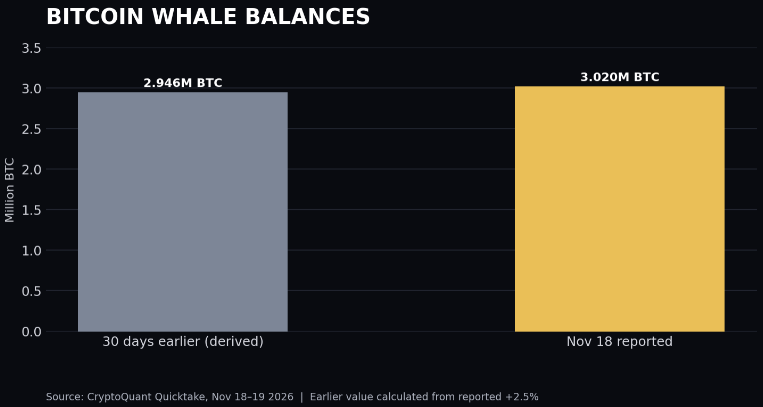
The increase is significant because it occurred during a period of weakening prices and reduced market confidence.

Large holders may be positioning for a longer-term recovery, although wallet consolidation, internal transfers, and changes in address classification can also influence the metric.
For that reason, the figures should be interpreted as a change in tracked holdings rather than definitive evidence that whales purchased every additional coin.
Nevertheless, the increase provides a useful contrast to Bitcoin’s recent price performance.
Long-Term Bitcoin Holders Are Realizing Losses
While whale balances have increased, another important on-chain indicator shows that long-term holders remain under pressure.
Bitcoin’s long-term holder SOPR seven-day average stood at approximately 0.94 on November 17.
The indicator has remained below 1 since November 2, according to CryptoQuant.
SOPR measures the value of spent coins relative to their value when previously moved on-chain.
A reading above 1 indicates that coins are being spent at a profit, while a reading below 1 suggests that they are being spent at a loss.
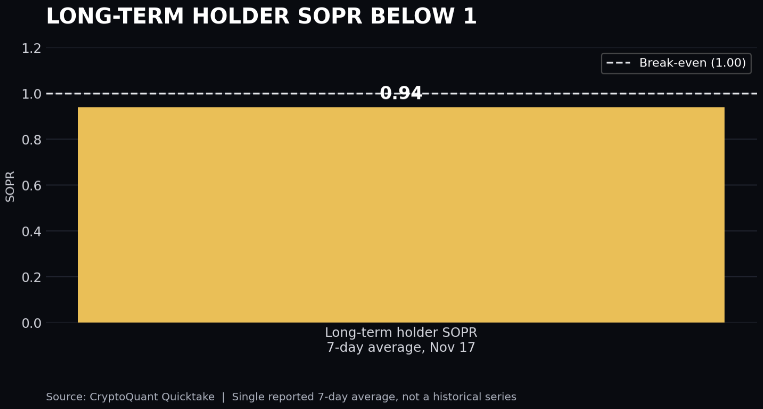
At 0.94, the seven-day average indicates that spent outputs in this cohort were valued approximately 6% below their previous on-chain movement value.
However, this does not mean every long-term Bitcoin investor has experienced a 6% loss, and not every on-chain transfer represents a sale.
The distinction matters when evaluating whether investors are capitulating or simply reorganizing their holdings.
Our earlier Bitcoin correction analysis examined how short-term holders respond when Bitcoin falls below their average acquisition price.
The latest data adds another dimension by showing that pressure has also reached older coins.
Why the Divergence Matters for Bitcoin
The simultaneous increase in whale balances and below-one long-term holder SOPR suggests that different groups of Bitcoin investors may be responding differently to the correction.
Some older coins are moving at losses, while the total balance attributed to large non-exchange wallets has increased.
However, these datasets do not establish that whales directly purchased the coins moved by long-term holders.
That distinction is important because Bitcoin’s market structure involves exchange transactions, institutional custody, private transfers, and other activities that cannot always be identified from wallet balances alone.
The development also comes as Bitcoin continues trading below important longer-term trend indicators.
As we explained in our Bitcoin Mayer Multiple analysis, BTC recently moved below its 200-day moving average, placing additional attention on the strength of any recovery.
Can Whale Accumulation Support Bitcoin’s Next Recovery?
The latest on-chain figures offer a mixed but potentially constructive picture.
Growing whale balances suggest that large-wallet holdings have remained resilient during the decline.
At the same time, continued losses among long-term holders show that selling pressure has not disappeared.
A stronger recovery signal would require evidence of sustained spot demand, improving profitability among spending holders, and a stabilization in Bitcoin’s price.
Our recent Bitcoin cycle analysis also highlighted how the current correction compares with earlier market downturns.
For now, the most important question is whether the increase in large-wallet balances continues while long-term holder selling pressure begins to ease.
We believe the divergence deserves close attention because it shows that Bitcoin’s current correction is not producing identical behavior across investor groups.
If whale balances remain elevated and realized losses begin declining, Bitcoin could develop a stronger foundation for its next recovery.
However, the current data does not confirm that a market bottom has formed. Investors will need further evidence before treating the latest accumulation signals as the beginning of a sustained reversal.
DC Forecasts is a leader in many crypto news categories, striving for the highest journalistic standards and abiding by a strict set of editorial policies. If you are interested to offer your expertise or contribute to our news website, feel free to contact us at [email protected]












Discussion about this post