


The USDT INR price on India’s biggest crypto exchanges has pulled sharply away from the official exchange rate this month, just as banks slowed or stopped rupee payouts to exchange customers.
On CoinDCX, one Tether (USDT) closed Nov. 19 at ₹104.34. The US dollar itself was worth ₹93.30, based on European Central Bank reference rates.
That gap is a premium of 11.8%, the widest daily reading since Jan. 20, 2025 in our dataset, and roughly three times this year’s 3.9% average.
For Bitcoin investors, the striking part is what kept working. Rupee withdrawals stalled, yet trading and on-chain transfers carried on.
The bigger question is whether the premium fades once the bank rails are fixed, or whether Indian demand for dollar tokens and BTC is simply running ahead of local supply.
Which Exchanges Hit Banking Trouble?
Coinbase India has been the hardest hit. In a Nov. 14 post on X, it said INR withdrawals were “temporarily unavailable due to an outage at our banking partner,” adding that the outage affected “the bank’s payouts for all of its clients, not just Coinbase.”
Deposits, including UPI transfers, kept working, the company said.
On Nov. 17 it began processing withdrawals that had failed since Nov. 9, in batches, through an alternative banking route. Customers can still request INR through support, with funds promised within 48 to 72 hours.
Its Nov. 20 update said another batch had gone out, but the banking partner’s outage was “still ongoing” and the in-app withdraw option remained unavailable.

CoinDCX reported a milder problem on Nov. 19. It said INR withdrawals were “taking longer than usual due to processing changes being implemented at our banking partners’ end,” with most completed within four to six hours.
ZebPay said on Nov. 11 that INR withdrawals were slower because of a technical disruption at its banking partner. It also paused crypto withdrawals during platform upgrades and targeted Nov. 17 for their return.
None of the three exchanges has named its bank, and none has said whether the disruptions are linked.
How Big Is the USDT INR Premium Now?
A premium over the official rate is normal in India. Crypto transfers carry 1% tax deducted at source and gains are taxed at 30%, which adds friction to every round trip.
What changed is the size.
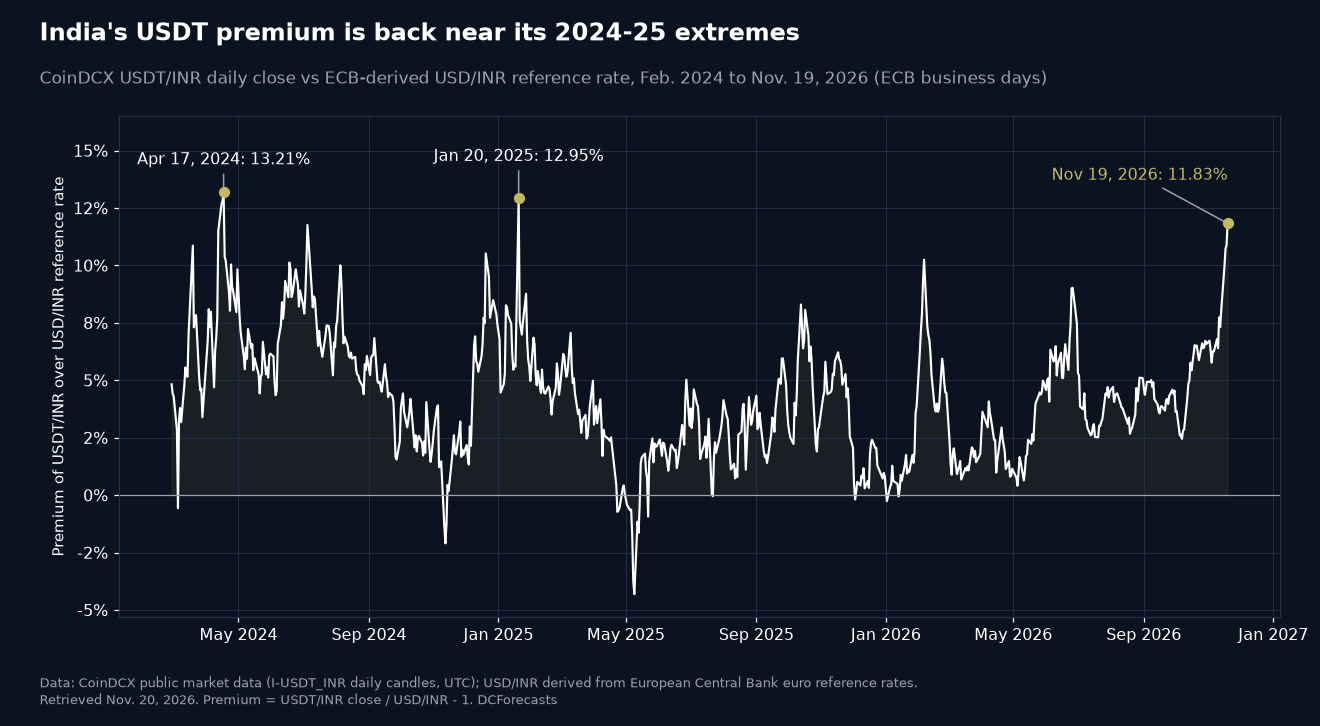
The premium stood at 6.7% on Nov. 2 and 6.8% on Nov. 9, the day Coinbase’s failed payouts began. By Nov. 13 it had reached 8.1%. After the weekend it printed 9.9%, then 10.7%, 10.9% and 11.8% on Nov. 19.
That is still below the 12.95% of January 2025 and the 13.2% peak of April 2024, so this is not uncharted territory.
The move is not a single-venue quirk either. On WazirX, USDT closed Nov. 19 at ₹103.20, a 10.6% premium, after touching 11.2% on Nov. 17.
Why the Gap Opened From Both Sides
Two forces pushed in opposite directions at once.
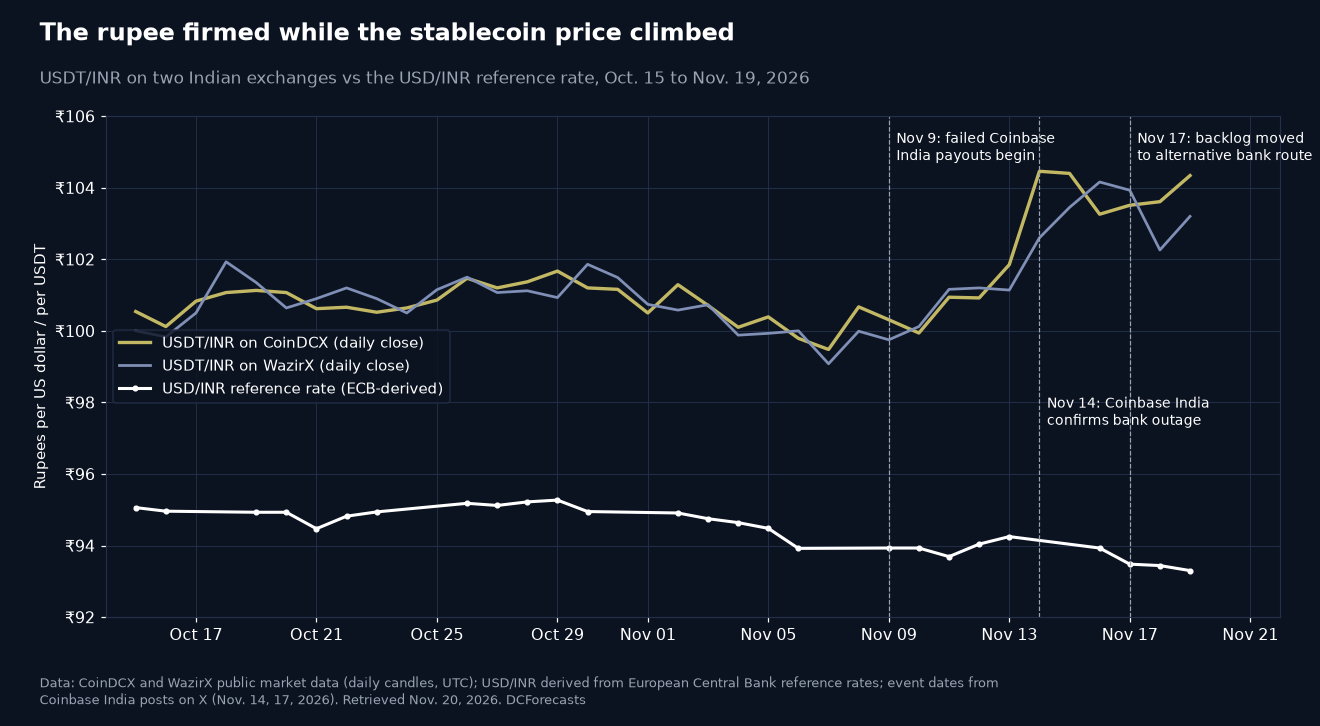
USDT on CoinDCX climbed about 4% from Nov. 9 to Nov. 19. Meanwhile the rupee firmed, with the reference rate easing from ₹95.27 per dollar on Oct. 29 to ₹93.30 on Nov. 19.
Normally a stronger rupee would make dollar tokens cheaper in India. This time the local price went the other way.
We think the likeliest explanation is simple plumbing. When rupees are slow to leave an exchange through the bank, customers who want out can still buy USDT or BTC and withdraw on-chain. That extra buying lands on the local order book.
That reading is our interpretation, not something the exchanges have stated. Other factors may play a part, including the Enforcement Directorate searches at CoinDCX that we covered on Nov. 8.
What It Means for Bitcoin Buyers in India
Bitcoin carries a similar markup. CoinDCX’s BTC/INR market closed Nov. 19 at about ₹64.8 lakh, against a global price of $61,913 on Coinbase’s US exchange, or about ₹57.8 lakh at the reference rate.
That works out to a premium of roughly 12.2%, up from 5.9% on Nov. 4.
In plain terms, Indian buyers are paying well above the world price to own BTC, even after a month in which the global price fell sharply. We read that as a sign of demand, not retreat.
It also shows why self-custody matters. Bank payouts can freeze, and India has already seen Unocoin suspend all services after a security breach this month. Coins held in a personal wallet do not wait on a banking partner.
The flip side is real: buying at a 12% premium means a buyer starts behind the global price, and that gap can close quickly once rupee withdrawals normalise.
What to Watch as Banks Reopen the Rails
The first signal is Coinbase India restoring its in-app withdraw button. The company says it is “strengthening our banking setup in India.”
The second is the premium itself. A slide back toward October’s 5% average would suggest the squeeze was about plumbing.
The third is whether CoinDCX’s four-to-six-hour delays shorten, and whether ZebPay confirms crypto withdrawals are fully back.
We believe the bigger picture is encouraging. Even with bank rails strained, Indians kept buying dollar tokens and Bitcoin, and paid extra for the privilege.
Bitcoin’s fixed supply and borderless settlement are exactly what make it attractive when local payment systems falter. The coming days will show whether that premium is a temporary toll or a lasting sign of demand.
DC Forecasts is a leader in many crypto news categories, striving for the highest journalistic standards and abiding by a strict set of editorial policies. If you are interested to offer your expertise or contribute to our news website, feel free to contact us at [email protected]












Discussion about this post