



A Bitcoin loan through Coinbase is now available in every US state. On Nov. 16, Coinbase updated its crypto-backed lending announcement to say New York customers can now borrow USDC against Bitcoin, Ethereum and Solana.
New York was the last gap in the US map. The product first went live on Jan. 16, 2025, with Bitcoin as the only collateral and New York left out.
The timing is what stands out. Bitcoin trades near $64,185, according to CoinGecko data, yet onchain records show borrowers have pledged more Bitcoin to this lending rail than ever before.
The bigger question is what that tells us about how long-term holders are behaving in a weak market.
How a Coinbase Bitcoin loan works
A user picks an amount, and the pledged BTC is converted one-for-one into Coinbase Wrapped BTC, or cbBTC, then moved into a smart contract on Morpho, a lending protocol running on Base.
USDC lands in the customer’s Coinbase account within seconds. Coinbase’s loans page says there is no repayment schedule and no deadline, and that the company will not treat the borrow transaction as a taxable event.
Limits have grown sharply since launch. Coinbase now lists up to $5 million in USDC against Bitcoin, $1 million against Ether and $100,000 against Solana and several other coins.
If the loan, including interest, reaches 86% of the collateral’s market value, the position is liquidated and a penalty fee applies. A one-time fee is also added to the principal each time a customer borrows.
Coinbase advertises variable-rate loans “from 5.1%,” with the rate set by supply and demand in Morpho’s open market.

Bitcoin collateral hits a record 40,871 BTC
The clearest public window into this business is the main cbBTC/USDC market on Morpho’s Base deployment. It uses the same 86% liquidation threshold Coinbase quotes, though any wallet can use it, so not every position belongs to a Coinbase customer.
According to the Morpho API, that market held 40,871 cbBTC as collateral on Nov. 17. That is the highest level in its history.
A year earlier, on Nov. 6, 2025, the figure was 16,198 BTC. In the launch week of January 2025 it was just 428 BTC.
That is a 152% rise in about a year, and we believe it is one of the more telling adoption numbers in the market right now.
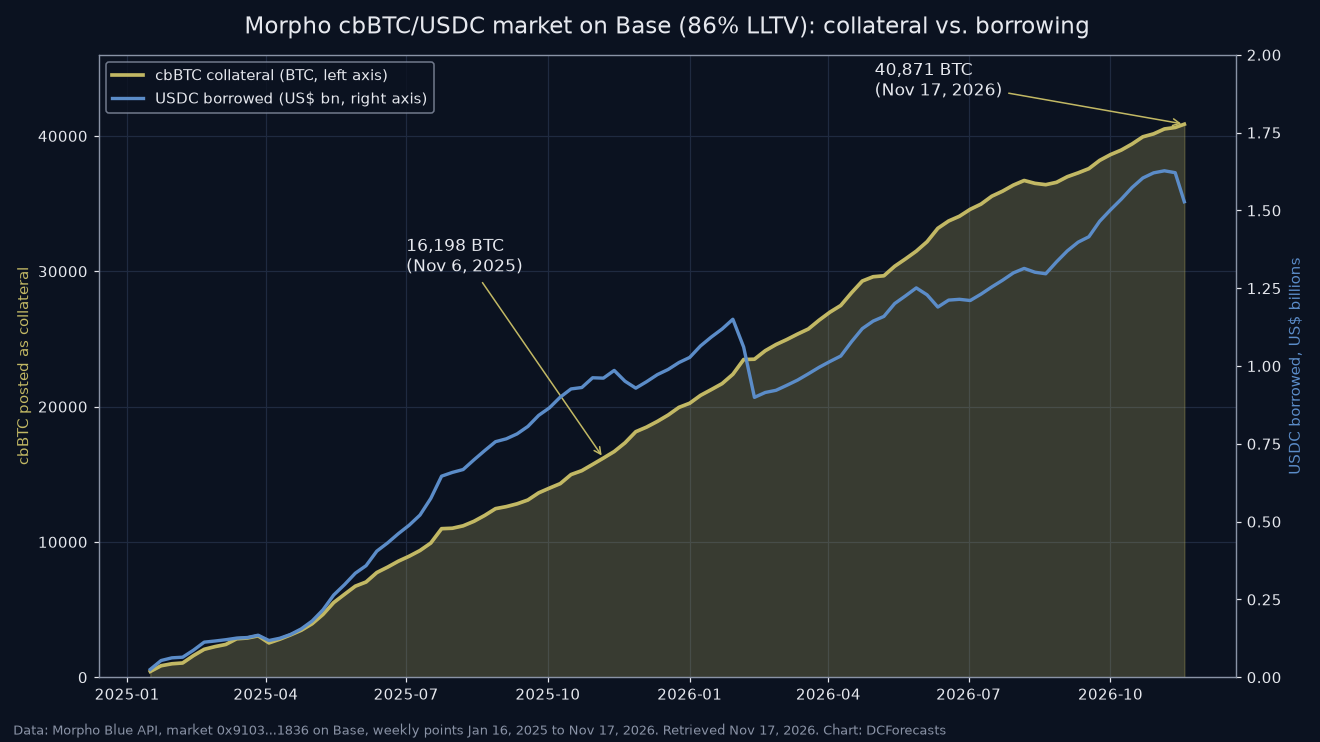
In dollar terms the picture is softer. The collateral was worth about $2.63 billion on Nov. 17, down from roughly $3.36 billion on Oct. 22, because the Bitcoin price fell.
Borrowers are trimming debt, not selling Bitcoin
Outstanding USDC debt in the market peaked at about $1.63 billion on Nov. 5. By Nov. 17 it had fallen to about $1.53 billion, a drop of roughly $99.5 million, or 6.1%.
In other words, holders are paying down part of their loans while leaving more Bitcoin locked as collateral.
That has kept the market’s balance sheet comfortable. Across the whole market, debt equals about 58% of collateral value, well below the 86% liquidation line. Individual loans vary, and some positions will sit much closer to that limit.
We have seen this pattern before. Between Jan. 29 and Feb. 12, 2026, borrowing fell from $1.15 billion to $899 million, a 21.8% cut, while collateral rose from 22,390 BTC to 23,504 BTC.
That fits the broader picture we described when Bitcoin slipped below its 200-week average: price is under pressure, but long-term conviction looks intact.
What borrowing costs say about demand
The variable borrow rate in the same market stood at 5.23% on Nov. 17, according to Morpho data. That lines up with the “from 5.1%” pricing Coinbase advertises.
Rates have been calm for most of 2026. The weekly low was 4.08% on Feb. 12, and the rate spent much of the year near 5%.
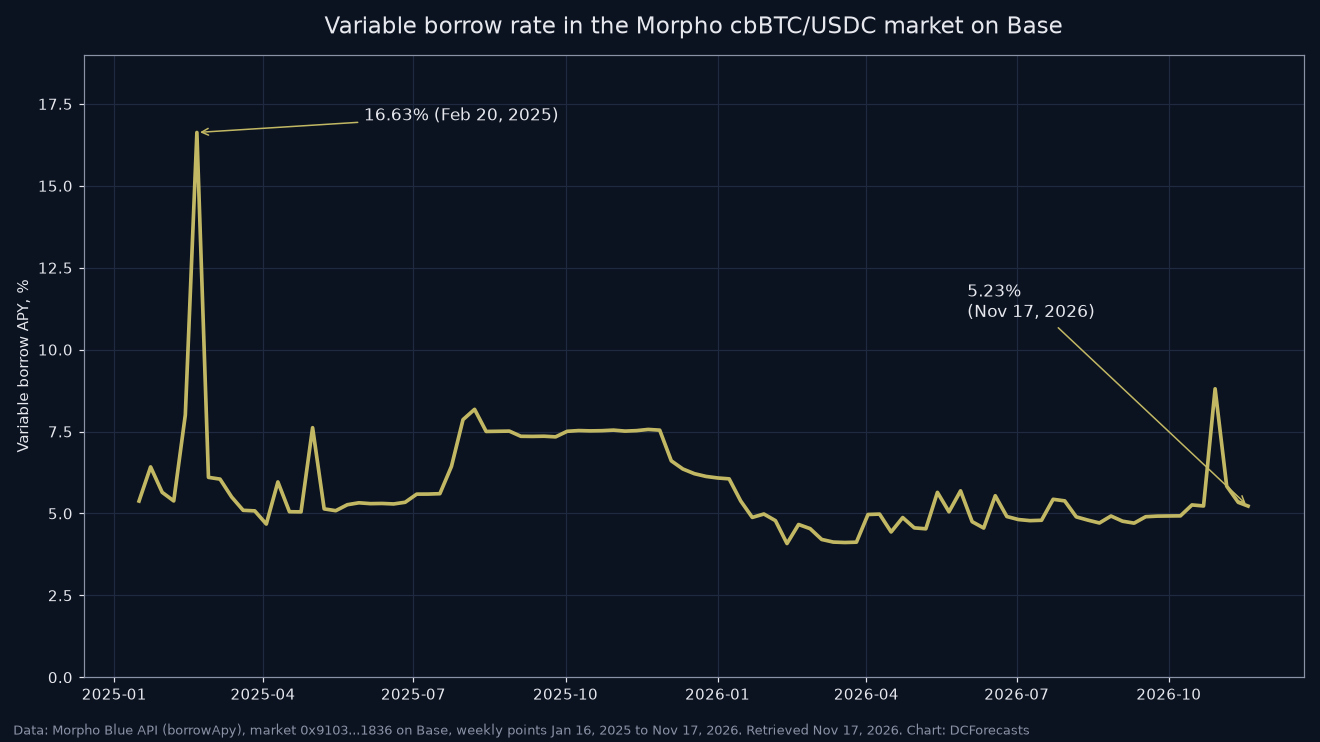
There was one brief spike. The weekly reading jumped to 8.80% on Oct. 29, then eased back to 5.84% a week later and 5.34% on Nov. 12.
Utilization explains the swings. About 86.7% of the USDC supplied to the market was lent out on Nov. 17, and the protocol raises rates when that share gets too high, pulling in more lenders.
Why New York matters for Bitcoin credit
New York is one of the most demanding places in the US to launch a crypto product, and it is home to a large pool of wealthy investors. Opening the market there completes a national rollout that took about 22 months.
It also fits Coinbase’s wider push to bring onchain tools into its main app, from lending to the AI trading plugin it put inside ChatGPT.
Bitcoin remains the anchor of the product. Its $5 million limit is five times the cap for Ether and 50 times the cap for most other coins.
Can a Bitcoin loan market keep growing in a bear phase?
The honest answer is that a deeper price drop would test it. Lower prices push loan-to-value ratios up, and liquidations remain a real risk for anyone who borrows too close to the limit.
But the data so far points the other way. Collateral has climbed for most of the past year, borrowers have cut debt during sell-offs, and rates have stayed close to 5%.
We believe that is what maturing Bitcoin credit looks like. Holders can raise dollars without selling a fixed-supply asset, and they are using that option with growing discipline.
The coming weeks will show whether New York adds a new wave of collateral. If the 40,871 BTC record keeps rising while the price is weak, it will be hard to argue that long-term holders are losing faith.
DC Forecasts is a leader in many crypto news categories, striving for the highest journalistic standards and abiding by a strict set of editorial policies. If you are interested to offer your expertise or contribute to our news website, feel free to contact us at [email protected]












Discussion about this post