


Tokenized deposits are getting a formal test bed from the European Central Bank, and no bank is allowed to walk in alone.
On November 20, the Eurosystem invited market groups to join practical work under Appia, its plan for a tokenized European financial system.
Applications for the first round close on December 11 at 12:00 CET. Selected groups are expected to work through 2027, feeding into an Appia blueprint due by 2028.
For Bitcoin investors, the interesting part is not a new token. It is how carefully Europe’s central bankers are fencing the networks they are willing to touch.
The bigger question is whether a consortium-only, permissioned model can move at the speed markets now expect.
What Did the ECB Open Up on November 20?
The ECB published the call as a market innovation news item with two annexes: the full invitation and an offline application form.
It names three priority “design streams” that came out of this year’s public consultation.
- Tokenized deposits and related payments: netting, clearing and settling tokenized bank money against mock tokenized central bank money.
- Tokenized securities: repo, collateral mobility, liquidity efficiency in clearing and settlement, and tools such as tokenized money market funds for treasurers.
- Shared network governance: rulebooks for DLT networks that would run as shared utilities.
Standard-setting is explicitly out of scope and will get a separate call. That fits with the European Tokenisation Standards Group, which we covered when EU regulators began recruiting its members.
The full notice is on the ECB website.

Why Can’t a Bank Test Tokenized Deposits on Its Own?
Annex A is blunt: individual market participants cannot apply. They must join a “collective initiative” working under a documented arrangement.
For the deposit and governance streams, that group needs at least five independent legal entities, and companies in the same corporate group count as one.
Members must come from at least two euro area countries. A majority must be authorized or supervised under EU frameworks such as CRD, MiFID II, CSDR or MiCAR.
At least two members must be participants in TARGET, the Eurosystem’s settlement system, or be eligible to join it.
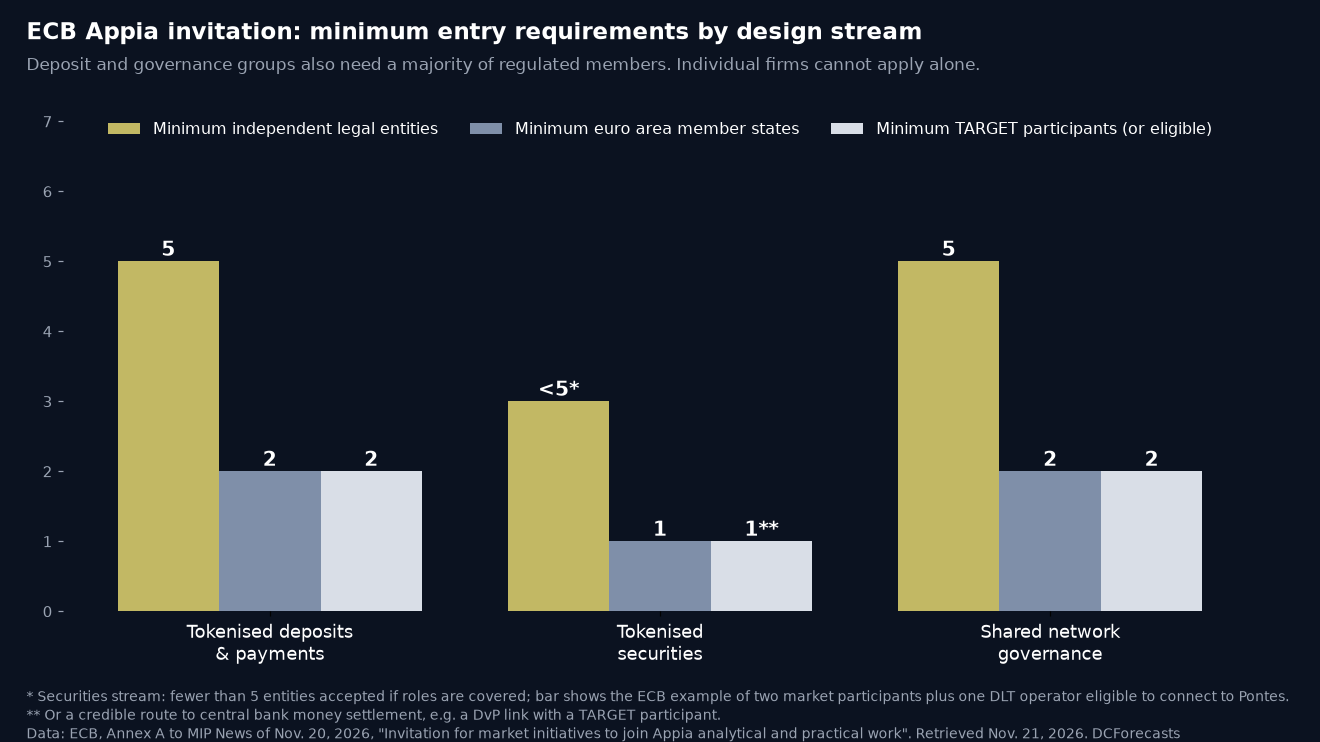
The securities stream is looser. The ECB will consider smaller groups, citing two market participants plus one DLT operator eligible to connect to Pontes, its bridge to central bank money settlement.
One euro area country is enough there, and a credible route to central bank money, such as a delivery-versus-payment link with a TARGET participant, can stand in for direct access.
We read the five-member rule as a deliberate filter. The ECB wants shared plumbing, not dozens of single-bank pilots that never talk to each other.
Who Pays, and Who Controls the Network?
Participation is voluntary and unpaid. Each group bears its own costs, and the Eurosystem will not provide hosting, infrastructure or technical support for test environments.
Groups also may not publicize their involvement until the ECB names participants, unless it approves in writing.
The control clauses stand out most. The deposit application asks which permissioned DLT network a group will use and which EU- or EEA-based entity runs it.
Where mock tokenized central bank money is used, operators must accept Eurosystem smart contracts and nodes. The Eurosystem keeps “exclusive control over issuance, redemption, access and transaction validation.”
That is a sound design for a central bank. It is also the opposite of how Bitcoin works.
On Bitcoin, anyone can run a node and validate every transaction, and no operator controls issuance. That difference is why we believe both models can grow side by side rather than compete for the same role.
Does the Market Actually Want This?
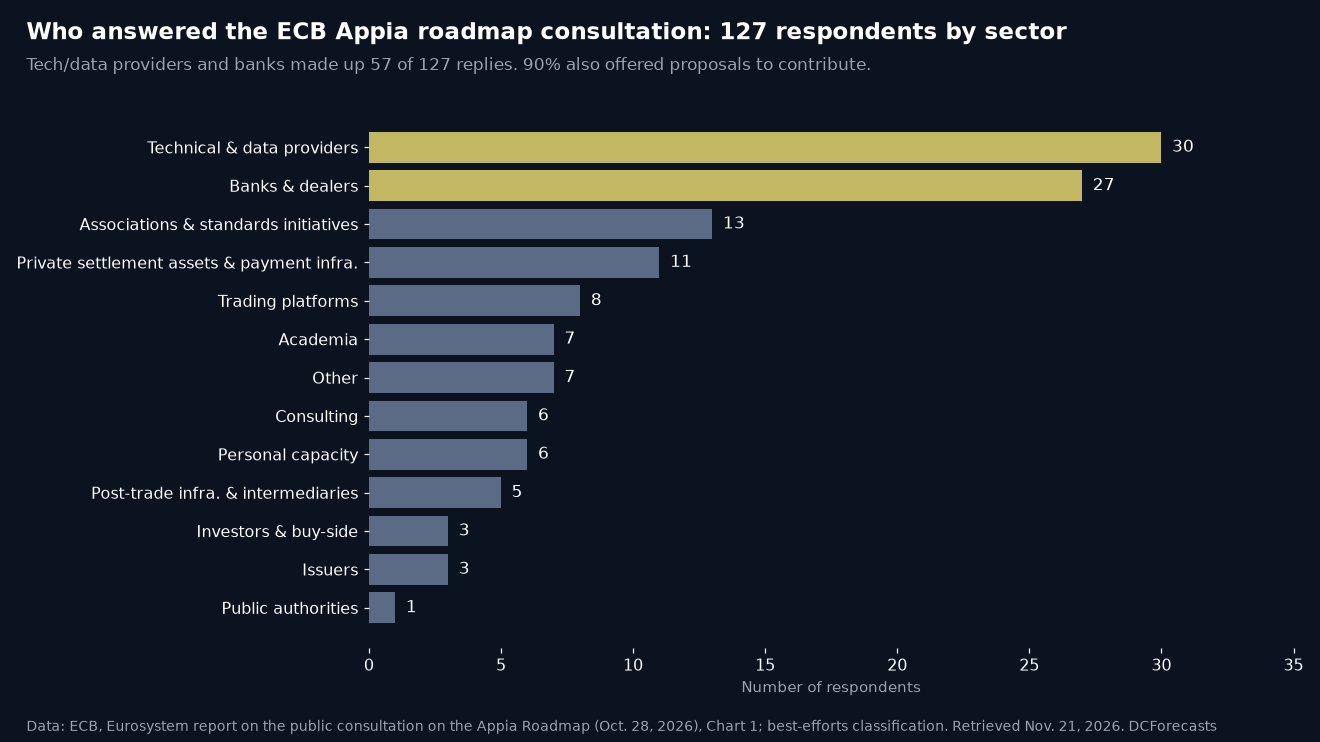
The consultation suggests yes. The ECB’s October 28 report counted 127 respondents to the Appia roadmap published in March.
Technical and data providers led with 30 replies, followed by 27 banks and dealers. Associations and standards bodies sent 13, and private settlement and payment infrastructure firms sent 11.
About two-thirds, 85 of 127, came from the European Union, with the largest shares from Germany, Spain, France, Italy and the Netherlands.
Interest in doing the work was high. The report says 90% of respondents submitted at least one proposal, and 103 submitted several.
The new invitation turns that interest into a gate, judged on technical readiness, committed resources, expected outputs and diversity of countries and participant types.
How Does Appia Fit Europe’s Wider Tokenization Push?
The call landed the same day Christine Lagarde warned that Europe has a short window to build a single tokenized market, as we reported on Friday.
Appia is the practical follow-through. The securities stream even points at collateral for Eurosystem credit operations, which would bring tokenized assets close to the core of monetary plumbing.
We believe the timeline deserves attention. The ECB wants groups that can test “between December 2026 and 2027,” yet the blueprint is not due until 2028.
That is careful by design. It also leaves room for open networks to keep building in the meantime.
What Should Investors Watch After December 11?
First, how many groups apply, and whether large banks lead the deposit stream or leave it to infrastructure firms.
Second, whether the governance stream produces rules that open networks could ever meet, or only permissioned ones.
Third, interoperability. The ECB wants deposit groups to explore common business rules and technical links across networks, a sign that fragmentation is the problem it most wants to solve.
For us, the key takeaway is simple. Europe’s banks are slowly moving money onto ledgers, under tight central bank control.
Bitcoin was built on the opposite premise: fixed supply, open validation and no gatekeeper. As tokenized deposits spread, we believe more savers will notice that difference, and the coming months will show how fast Appia turns paperwork into working rails.
DC Forecasts is a leader in many crypto news categories, striving for the highest journalistic standards and abiding by a strict set of editorial policies. If you are interested to offer your expertise or contribute to our news website, feel free to contact us at [email protected]











Discussion about this post