



Sports event contracts are now the center of a 44-attorney-general challenge to the Commodity Futures Trading Commission, and the paper trail shows how crowded that fight has become.
A bipartisan coalition of 43 states and the District of Columbia told the CFTC in a Nov. 18 comment letter to withdraw its proposal to define event contracts on sports, politics, culture and weather as “swaps.”
A multistate group filing through Maryland’s attorney general, for itself, 43 other states and the District of Columbia, also commented on the agency’s companion interim rule, which is already in force.
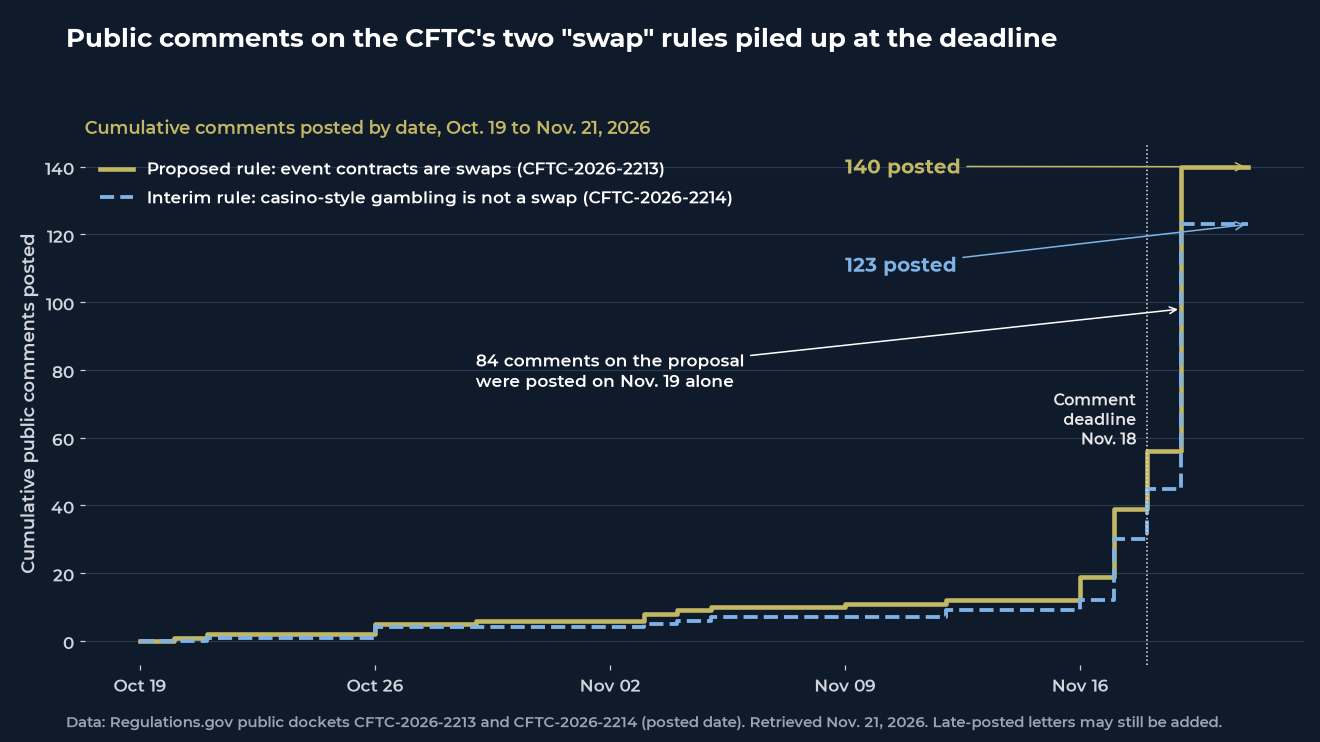
Regulations.gov records show 140 public comments posted on the proposal and 123 on the interim rule as of Nov. 21, with 84 of the proposal’s comments posted on Nov. 19 alone.
The bigger question is whether one rulemaking can settle a jurisdiction fight that courts have so far split on.
What the CFTC Proposed in October
The CFTC published both measures in the Federal Register on Oct. 19. The proposed rule would add “event contracts, including those based on sports-, politics-, cultural, and weather-related events” to the regulatory definition of a swap.
The interim final rule took effect the same day. It treats house-backed, casino-style gambling, including sportsbook wagers, as outside that definition.
Read together, the two rules draw a line. Peer-to-peer contracts on an exchange would fall under federal oversight, while bets against a house would stay with state gaming regulators.
The voting summary attached to both documents lists only Chairman Michael Selig voting in favor, with no commissioner voting against.

Why 44 Attorneys General Say Sports Event Contracts Are Not Swaps
The comment letter is co-led by Ohio, Kentucky, Maryland, Nevada, New Jersey, New York, Tennessee and Utah. By our count of its signature pages, the only states missing are Florida, Georgia, Indiana, Montana, New Hampshire, North Dakota and Texas.
“A sports bet isn’t a derivative just because the CFTC says so,” Ohio Attorney General Andy Wilson said in a Nov. 18 release.
The letter makes four main arguments. It says the Commodity Exchange Act does not give the CFTC power to call sports wagers swaps, that the rule has procedural defects, that it is arbitrary and capricious, and that it would clash with constitutional doctrine.
The procedural point stands out. The states argue the CFTC “has only one commissioner” and therefore lacks a quorum to issue any rule until more commissioners are confirmed.
They also cite consumer protection. The letter notes that state law sets age limits, licensing and self-exclusion programs, and says the proposal includes none of these for prediction-market gambling.
New Jersey Attorney General Jennifer Davenport, a co-lead, said on Nov. 20 that the CFTC “continues to stray far outside of its lane.” Her office added that New Jersey has asked the U.S. Supreme Court to hear its case against Kalshi, backed by 39 states, the District of Columbia and 146 tribal nations and organizations.
A Docket That Filled Up at the Deadline
For most of the comment window, the docket was nearly silent. Only 12 comments had been posted on the proposal by Nov. 12.
Then the deadline arrived, and the letters followed.
Who wrote in matters as much as how many. Grouping the 140 proposal comments by filer name, 51 came from individuals and 46 from tribal nations and tribal gaming groups.
Another 32 came from companies, including Coinbase, Gemini, Kalshi, Polymarket US, Cboe Global Markets, Cantor Fitzgerald, Andreessen Horowitz, Paradigm and The Digital Chamber.
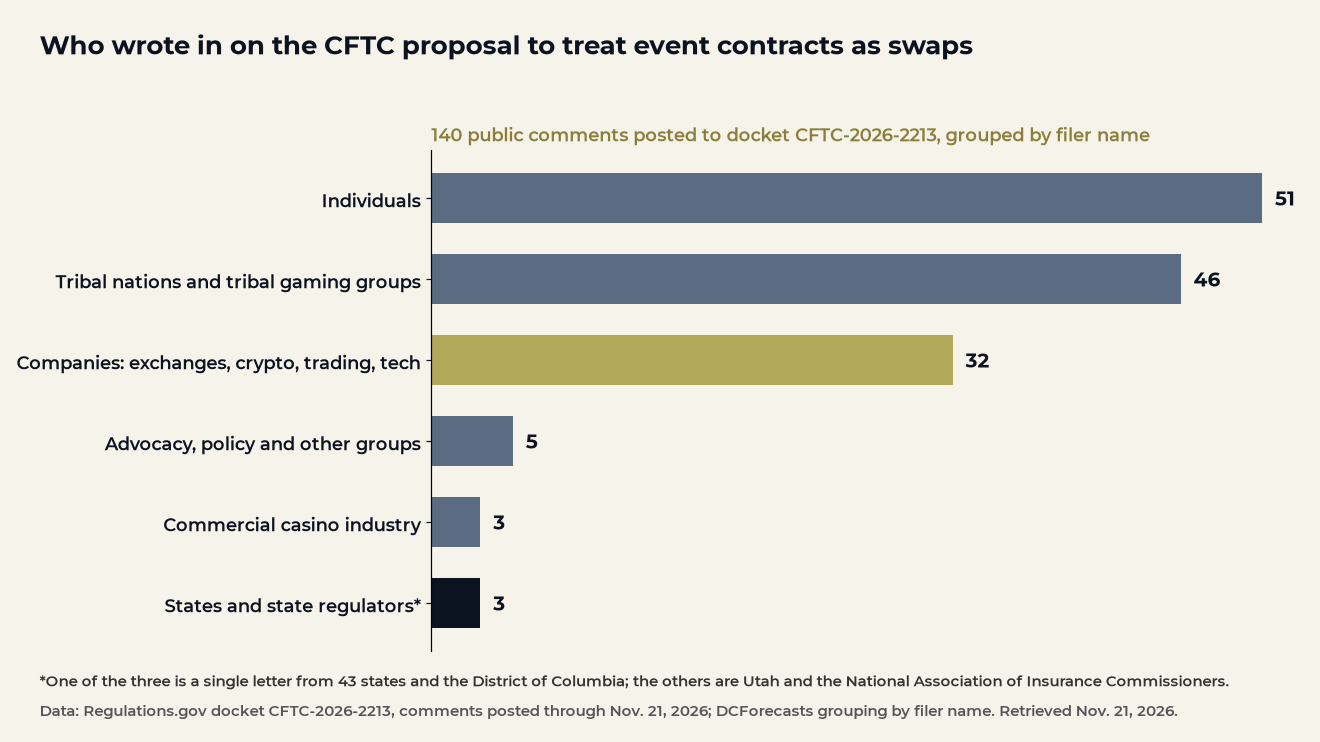
The commercial casino industry also filed, through the American Gaming Association, Boyd Gaming and the Nevada Resort Association.
Not every filer opposes the plan. As we reported, the Hyperliquid Policy Center backed both rules in its Nov. 16 letters, with a drafting fix as its main request.
Courts, Not Comment Letters, May Have the Final Word
The states lean heavily on recent rulings. Their letter cites Sixth and Ninth Circuit decisions against Kalshi and argues the rule cannot take effect in those circuits.
It also points to the Fourth Circuit’s Nov. 18 decision, which, as we covered, still lets Maryland police Kalshi.
That leaves the CFTC with a heavy record to answer. A final rule would need to respond to the main arguments raised in the comments, and any version adopted without a fuller commission would likely face the quorum challenge in court.
We believe that makes a quick resolution unlikely. The more realistic path is a long contest between the agency, the states and possibly the Supreme Court.
What the Fight Leaves Untouched for Crypto Markets
It is worth being precise about the target. The states’ objections center on sports and election wagers, and the letter itself faults the CFTC for not considering the option of regulating some event contracts while leaving sports and casino-style products out.
Contracts tied to commodities and financial benchmarks remain core CFTC territory. That includes the regulated futures and options markets where Bitcoin already trades.
For us, that is the constructive takeaway. The dispute is over gambling-style products, not over whether crypto belongs inside federal derivatives oversight.
The heavy participation of Coinbase, Gemini and other crypto firms shows how central regulated event trading has become to their plans. Whatever the CFTC decides, clearer lines between investing and wagering should help serious market infrastructure, including Bitcoin’s, keep maturing.
The next signal to watch is whether the CFTC moves to finalize the proposal while it still has only one commissioner.
DC Forecasts is a leader in many crypto news categories, striving for the highest journalistic standards and abiding by a strict set of editorial policies. If you are interested to offer your expertise or contribute to our news website, feel free to contact us at [email protected]












Discussion about this post