



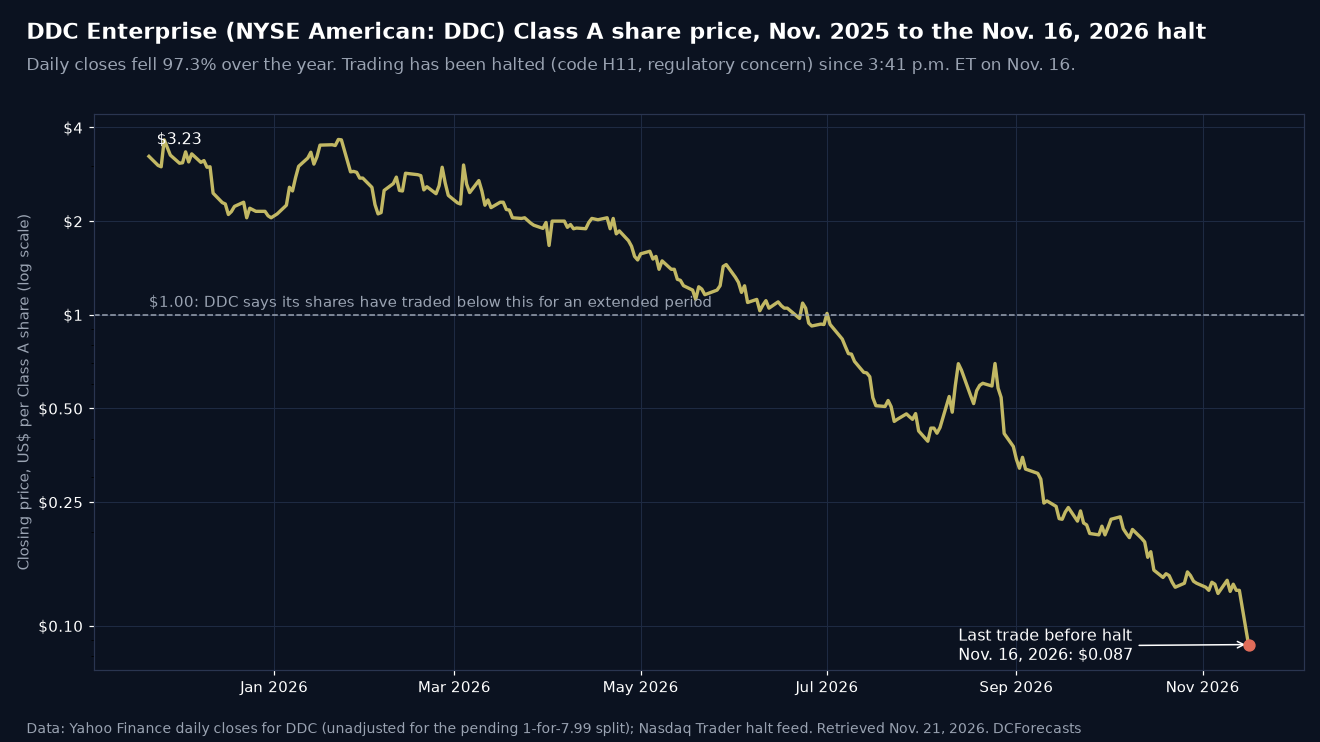
DDC Enterprise shares have not traded since 3:41 p.m. Eastern time on November 16, when NYSE American halted the stock for a regulatory concern.
Four days later, the Asian food group turned Bitcoin treasury company announced a 1-for-7.99 reverse share split that takes effect on November 30.
The last trade before the halt printed at $0.087, a 33% drop on the day and down 97.3% from $3.23 a year earlier.
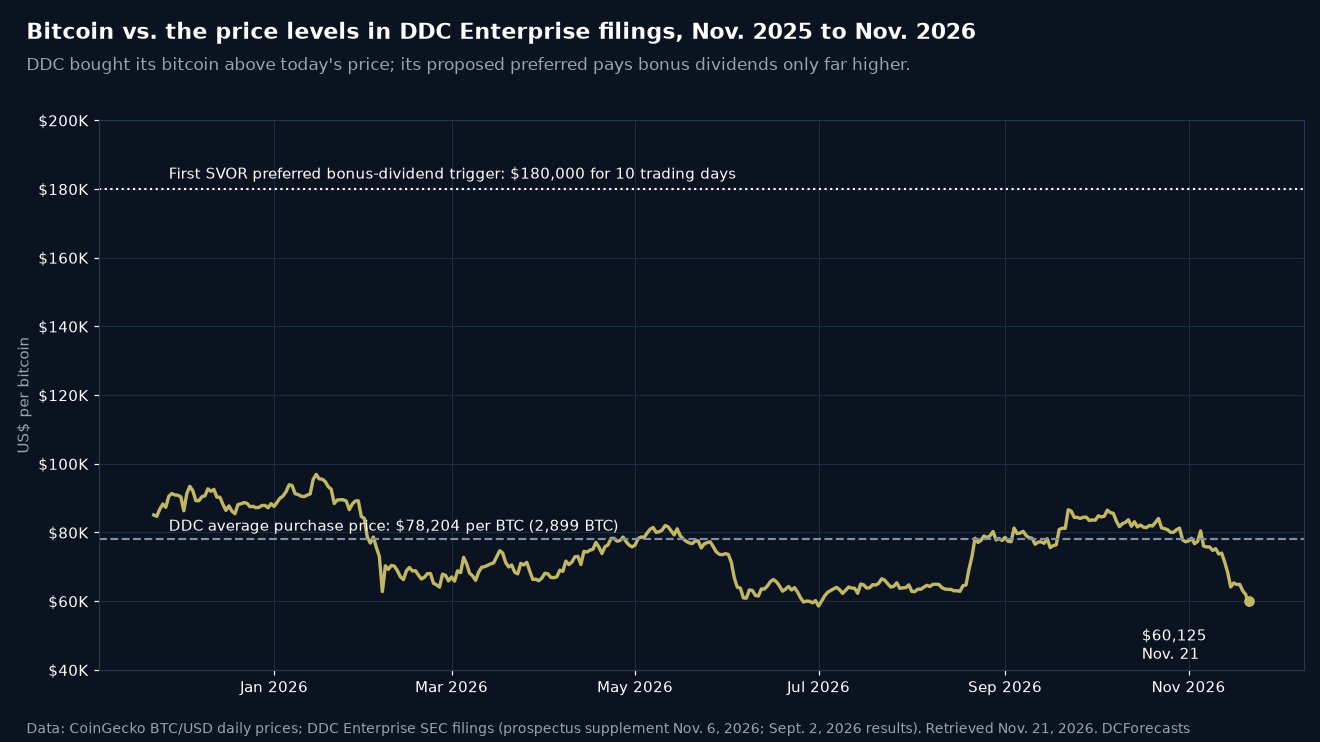
Meanwhile, the 2,899 BTC that DDC reported holding kept trading around the clock and were worth roughly $174 million at Saturday’s price near $60,100.
The bigger question is whether a smaller share count can fix a problem that the coins themselves did not create.
What DDC Enterprise Filed on November 20
According to the Form 6-K filed with the SEC, DDC’s board approved the reverse split on November 17, using authority shareholders granted on June 29 for a ratio of up to 1-for-10.
Every 7.99 Class A shares will become one. Outstanding Class A shares will drop from about 68.17 million to about 8.53 million, and par value will rise from $0.40 to $3.196.
Split-adjusted trading is expected to begin at the open on November 30 under the same DDC ticker and a new CUSIP. Class B shares are not affected.
The company said the split is meant to lift the per-share price and support compliance with NYSE American continued listing standards.

The filing does not mention the halt. The exchange halt feed lists code H11, a regulatory concern, with no resumption date published as of November 21.
Why the Split Math Still Falls Short of $1
A reverse split changes the number of shares, not the value of the company.
Multiplying the last pre-halt price by 7.99 gives about $0.70 per new share. That is still below $1.
In its November 6 preliminary prospectus supplement, DDC warned that its shares “have traded below $1.00 per share for an extended period” and that NYSE American may consider delisting stocks that sell at a low price for a substantial time.
DDC’s interim financial statements already restate older share data for an earlier 1-for-25 reverse split. So this would be at least the second consolidation in the company’s listed history.
We believe that is the real signal for investors. Share-count engineering cannot replace demand for the stock.
A Bitcoin Treasury Company Diluted Faster Than It Stacked
DDC began its Bitcoin treasury on May 15, 2025, and calls Bitcoin its primary treasury reserve asset. Its September 2 results release said holdings rose from 1,181 BTC at the end of 2025 to 2,899 BTC, a 145% increase.
The share count grew faster. Class A shares outstanding went from 23.28 million at December 31 to 45.63 million at June 30, and to roughly 68.17 million by the November 20 filing.
That works out to about 50.7 BTC per million Class A shares at the end of 2025 and about 42.5 BTC per million using the latest disclosed holdings and share count.
In other words, each share now carries less Bitcoin than it did at the start of the year, even though the company owns more than twice as many coins.
For a Bitcoin treasury company, that per-share figure matters more than the headline coin count. We covered the same tension when ZOOZ Strategy’s stock traded below its Bitcoin earlier today.
The Bitcoin Is Intact; the Wrapper Is Under Strain
Counting only listed Class A shares at $0.087, DDC’s equity was valued at about $6 million when trading stopped.
That is a tiny fraction of the coins’ market value. It does not mean the stock was simply cheap. At June 30, DDC reported $71.3 million of total liabilities and net debt of $10.2 million, and the halt adds uncertainty that the market cannot price until trading resumes.
DDC’s filings show an average purchase price of about $78,204 per coin. With Bitcoin near $60,100, the stack sits roughly 23% below cost on paper.
That gap is real, and we will not dress it up. Bitcoin itself is down about 29% over the past 12 months by CoinGecko data, while DDC shares lost 97.3% over the same period.
For us, the difference is the lesson. Bitcoin kept settling every block. The pain sits in the corporate layer: dilution, listing rules and a halted ticker. Holding coins directly avoids every one of those risks.
Where the Proposed SVOR Preferred Fits In
DDC has also filed preliminary terms for a 13.5% perpetual cumulative preferred share, proposed to list as SVOR, with a $25 stated value and daily dividends of $3.375 a year.
The filings promise one-time bonus dividends if Bitcoin holds at or above $180,000, $250,000 and $350,000 for 10 consecutive trading days. The first trigger sits about three times above the current price.
As of November 21, EDGAR shows only preliminary prospectus supplements with blank pricing fields, and no final pricing filing.
What We Are Watching Before November 30
First, any NYSE American notice or company statement explaining the H11 halt and a resumption time.
Second, whether DDC updates its Bitcoin holdings. The last count of 2,899 BTC dates from September 2.
Third, whether the split-adjusted stock can hold above $1 once trading restarts.
Bitcoin, for its part, has already rebounded to $60,000 after a two-year low, and its fixed 21 million supply does not depend on any exchange’s listing standards.
We believe the coming weeks will separate Bitcoin treasury companies that grow Bitcoin per share from those that only grow share counts. The asset at the center of both models keeps working either way.
DC Forecasts is a leader in many crypto news categories, striving for the highest journalistic standards and abiding by a strict set of editorial policies. If you are interested to offer your expertise or contribute to our news website, feel free to contact us at [email protected]












Discussion about this post