



The Texas Bitcoin reserve turned one this week, and the state’s latest federal filings show it still holds exactly what it bought: 197,844 shares of BlackRock’s iShares Bitcoin Trust (IBIT).
That figure appears in every quarterly Form 13F filed by the Texas Treasury Safekeeping Trust Company since the end of 2025. The most recent one, covering Sept. 30, was filed with the SEC on Nov. 13.
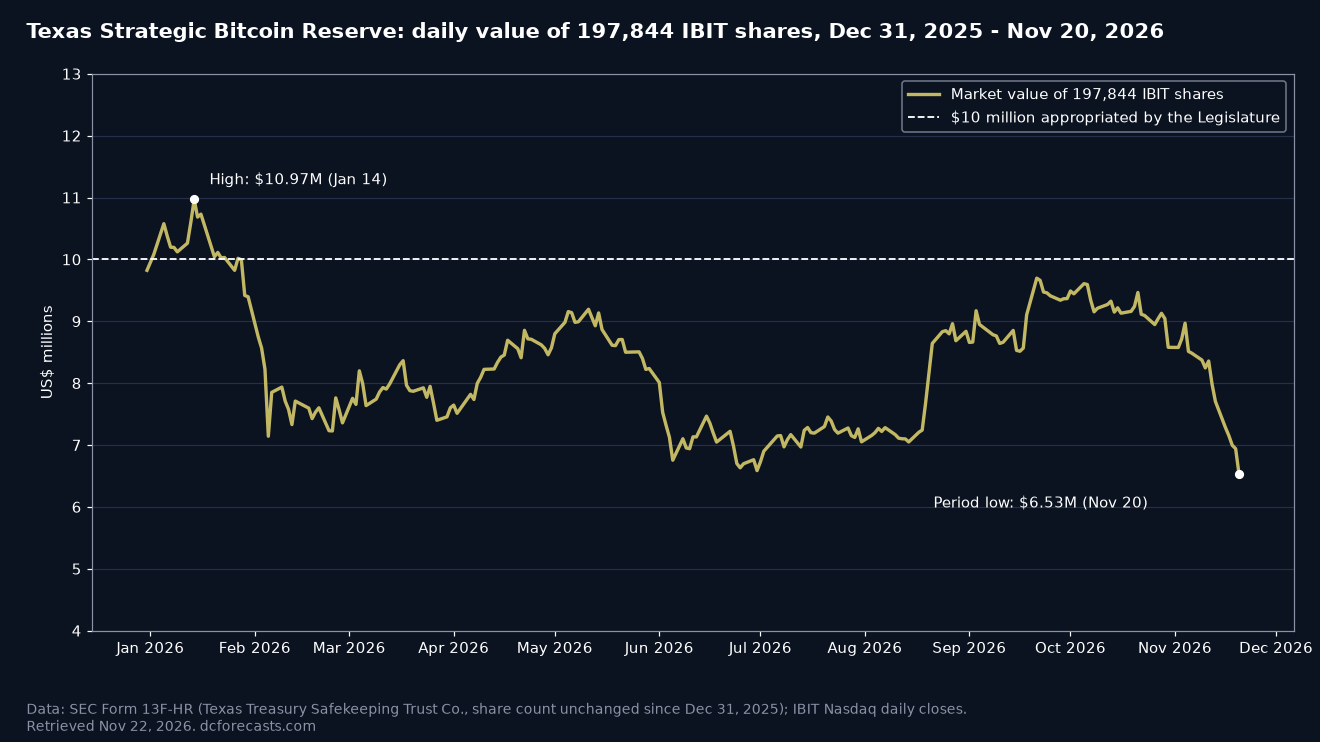
Not one share was sold through a drawdown that took IBIT from $49.65 at the end of 2025 to $33.02 at Friday’s close.
For Bitcoin investors, the bigger story is what has not happened yet. The ETF position was always meant to be a stand-in, and the state still has not named the custodian that would let it hold Bitcoin directly.
The question now is whether Texas finishes that step before its first report to lawmakers comes due on Dec. 31.
What the Texas Bitcoin Reserve Holds a Year In
Senate Bill 21, signed in June 2025, created the Texas Strategic Bitcoin Reserve as a special fund outside the state treasury, with the comptroller as custodian.
Lawmakers set aside $10 million for it in the 2026-27 budget. The comptroller’s office made its first purchase in November 2025, choosing IBIT as a placeholder while it looked for a way to hold coins directly.
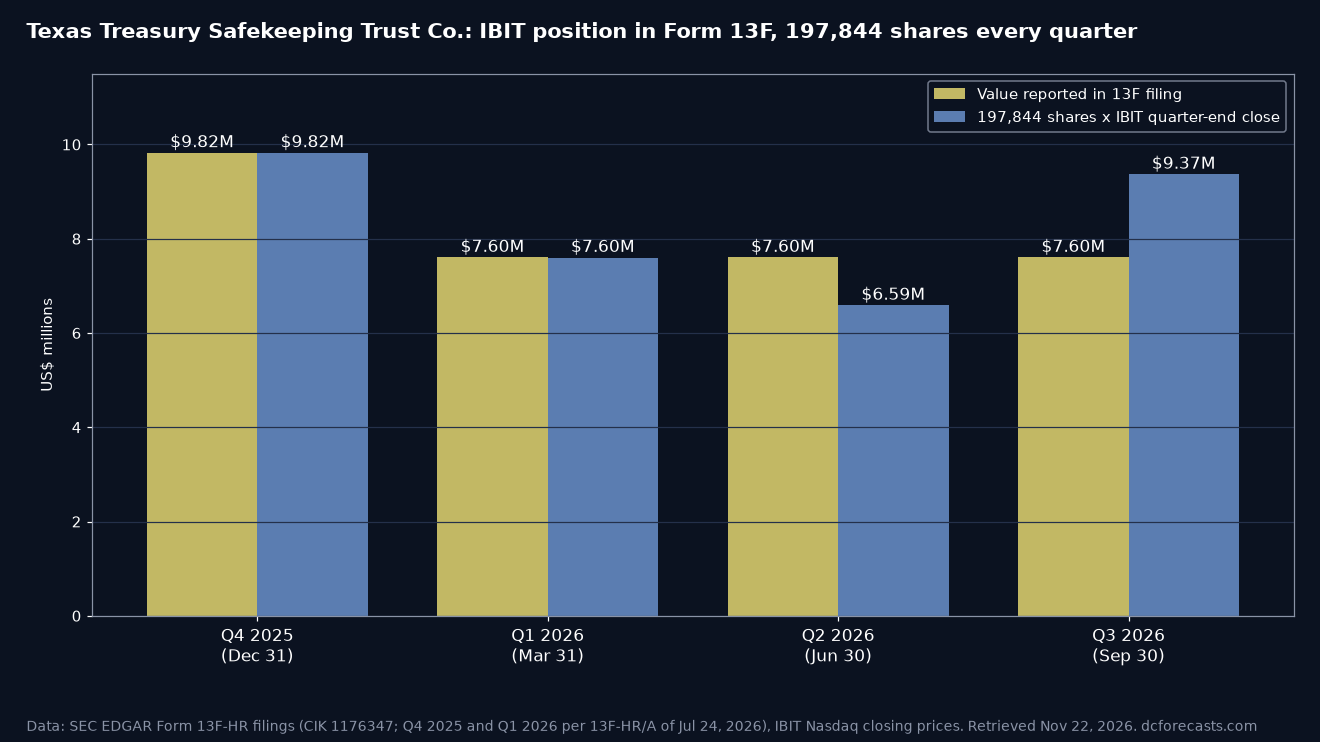
The 13F record confirms the timing. The trust company reported no IBIT at Sept. 30, 2025, and 197,844 shares worth $9.82 million at Dec. 31, 2025.
The holding has not changed since. At Friday’s close, those shares were worth about $6.53 million, roughly 35% below the $10 million appropriation.

That gap reflects timing. On the day of the first buy, Bitcoin traded above $86,000; CoinGecko data now puts it around $60,600.
Why the 13F Filings Tell an Unusual Story
The trust company’s original 13Fs for the fourth quarter of 2025 and the first quarter of 2026 did not list IBIT at all. The position first appeared when both reports were amended on July 24, 2026.
The value column is also worth a look. The first-quarter filing reports $7.60 million, which matches 197,844 shares at IBIT’s March 31 close of $38.42.
The second- and third-quarter filings repeat that same $7.60 million figure. At IBIT’s June 30 and Sept. 30 closes, the position would have been worth about $6.59 million and $9.37 million.
We read this as a reporting detail rather than a change in strategy. The share count, which is the number that matters, has not moved in four filings.
The Custodian Is Still the Missing Piece
On May 28, 2026, the comptroller’s office named the reserve’s advisory committee and announced a request for proposals for a firm to provide custody and liquidity services.
The winning firm is to hold and report the state’s Bitcoin and build a public website showing the reserve’s holdings.
The four outside committee members bring real Bitcoin depth. They include Cormint founder Jamie McAvity, CleanSpark president and CFO Gary Vecchiarelli, SMU law professor Carla Reyes and investment veteran Laurie Dotter.
As of Nov. 22, the comptroller’s news page lists no custodian award. Its latest Bitcoin-related release is still the May 28 announcement.
Comptroller Don Huffines, sworn in on Aug. 1, has issued dozens of releases since. None has addressed the reserve.
What the Dec. 31 Report Must Disclose
Section 403.708 of the law requires the comptroller, by Dec. 31 of each even-numbered year, to publish a report on its website and send it to the Legislature.
It must list the Bitcoin and other crypto held on the last day of the prior state fiscal biennium, an estimate of their value, changes in amount and value over the holding period, and the steps taken to manage the reserve.
It will be the first time Texas explains the reserve in one public document. We believe that is a healthy test for any public Bitcoin program.
The law also sets a high bar for what the reserve can buy. Any coin must have averaged at least $500 billion in market value over the past 24 months, a test only Bitcoin passes today.
Money in the fund cannot be moved back to the state treasury without legislative approval.
Why a $10 Million Position Still Matters for Bitcoin
By the standards of the trust company’s own 13F, the stake is small. The Sept. 30 filing lists about $799 million in reported positions, and IBIT accounts for under 1% of that total.
Size was never the point. The share count has held through a 33% drop in IBIT since the end of 2025.
We see that patience as the most bullish detail in the filings. Slow public money that does not panic is exactly the holder a scarce asset needs.
The idea is also spreading inside Texas. As we covered, a new Texas Bitcoin bill would let each city and county invest up to $10 million of its own.
It fits a wider pattern, too. Our look at Bitcoin ETF cost basis found that the funds kept 94% of their coins through this slide.
Can Texas Move From ETF Shares to Real Bitcoin?
We would watch three things over the next five weeks: a custody contract award, the content of the Dec. 31 report, and the next 13F, due in mid-February.
A custodian would let the state swap fund shares for coins it controls, which is what the law was built to allow, and remove the ETF layer between Texas and its Bitcoin.
At today’s prices, each dollar buys at least 40% more Bitcoin than it did on the day Texas first bought.
The coming weeks will show whether Texas turns its placeholder into the real thing.
DC Forecasts is a leader in many crypto news categories, striving for the highest journalistic standards and abiding by a strict set of editorial policies. If you are interested to offer your expertise or contribute to our news website, feel free to contact us at [email protected]












Discussion about this post