



Twenty One Capital buys bitcoin when prices fall, and this week it did so twice in four days.
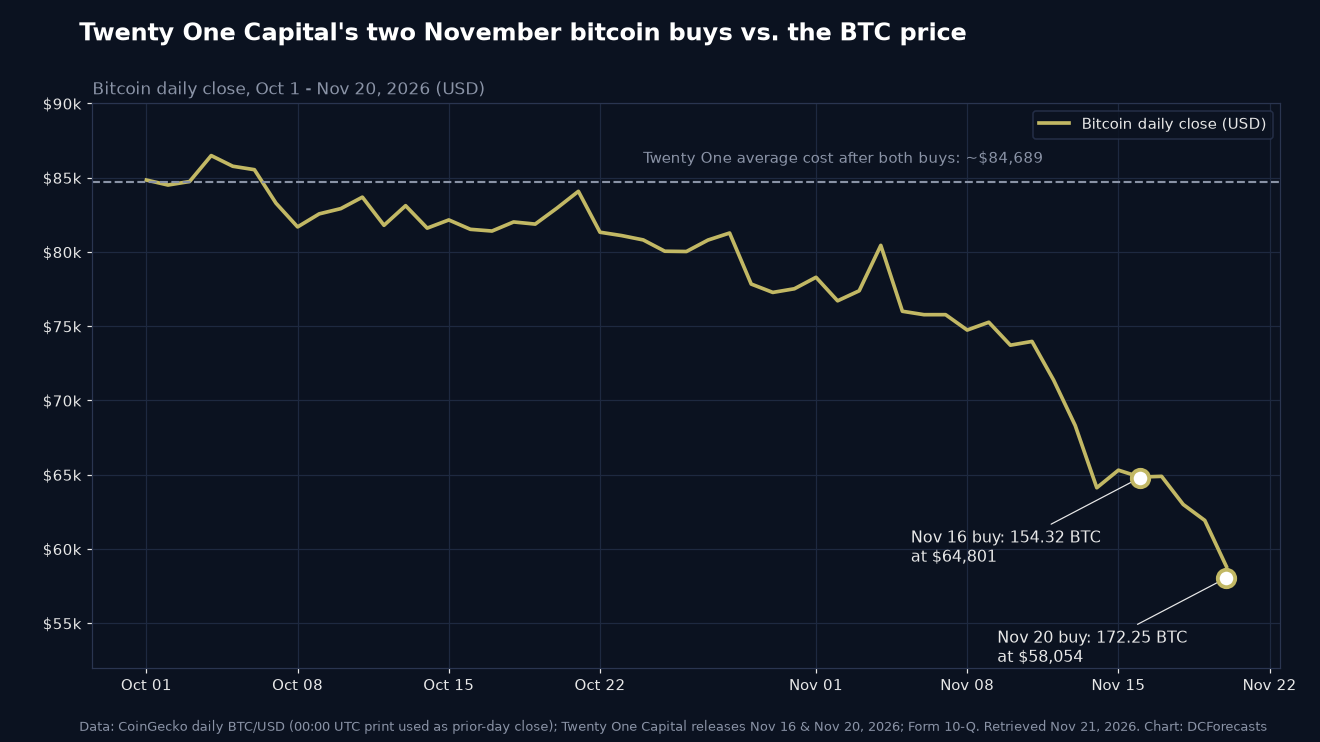
The NYSE-listed company said on Nov. 20 that it bought 172.25 BTC for $10 million in cash, at an average price of about $58,054 per coin.
That came on top of the 154.32 BTC it announced on Nov. 16 at roughly $64,801. Together, the two orders add 326.57 BTC and lift the treasury to about 43,841 BTC.
The second purchase was about 10.4% cheaper than the first, which is exactly the kind of averaging a long-term holder wants.
The puzzle is on the other side of the ledger. At Friday’s close, XXI shares valued each of those coins at well under half of what the company just paid for them.
Two Cash Purchases in Four Days
Chief executive Rapha Zagury put the second order in plain terms. “We purchased another $10 million of Bitcoin today, bringing our purchases this week to $20 million,” he said in the company’s release.
“Market downturns are part of Bitcoin’s history, and they create opportunities for investors with a long-term perspective,” he added, saying the recent decline gave the company “an attractive opportunity to put some cash to work.”
The timing looks deliberate. CoinGecko daily data shows bitcoin closing Nov. 20 near $58,818, after a slide from roughly $85,000 at the start of October.
The price then fell below $56,000 early on Saturday, according to CoinGecko data, before recovering. As we reported, bitcoin reclaimed $60,000 within hours, and it was trading near $60,020 at 17:45 UTC on Nov. 21.

Why Twenty One Capital Buys Bitcoin With Cash, Not Shares
Both orders were paid from the balance sheet. No new stock was sold to fund them.
That matters because Twenty One tracks its progress in bitcoin per share. Its Form 10-Q put that figure at 12,553 satoshis on Sept. 30, based on 43,514 BTC and 346.65 million Class A shares.
Using the 346.66 million Class A shares reported on Nov. 9 and the new total of 43,841 BTC, we estimate the figure at roughly 12,647 satoshis, a gain of about 0.75% since Sept. 30, almost all of it from this week’s two orders.
That is small, but it is clean. Every coin added this way raises each holder’s share of the treasury without dilution.
The cash cushion is finite. The company reported $102.8 million in cash and cash equivalents at the end of September, so this week’s $20 million used roughly a fifth of that balance, before any other fourth-quarter spending.
What XXI Stock Says About Each Coin
Here is the tension that makes this purchase interesting. XXI closed at $4.03 on Nov. 20, down from $4.56 on Nov. 16 and $4.95 a week earlier.
Multiply that price by the 346.66 million Class A shares and the company’s equity was worth about $1.40 billion. Its 43,841 BTC were worth about $2.58 billion at the same day’s close.
Divide one by the other and the stock market was valuing each Twenty One bitcoin at roughly $31,900, or about 54% of bitcoin’s price.
Class B shares are excluded because the 10-Q says they carry no economic rights. A fuller enterprise-value view, adding the $486.5 million of convertible notes and subtracting an estimated $83 million of remaining cash, still lands near $41,000 per coin.
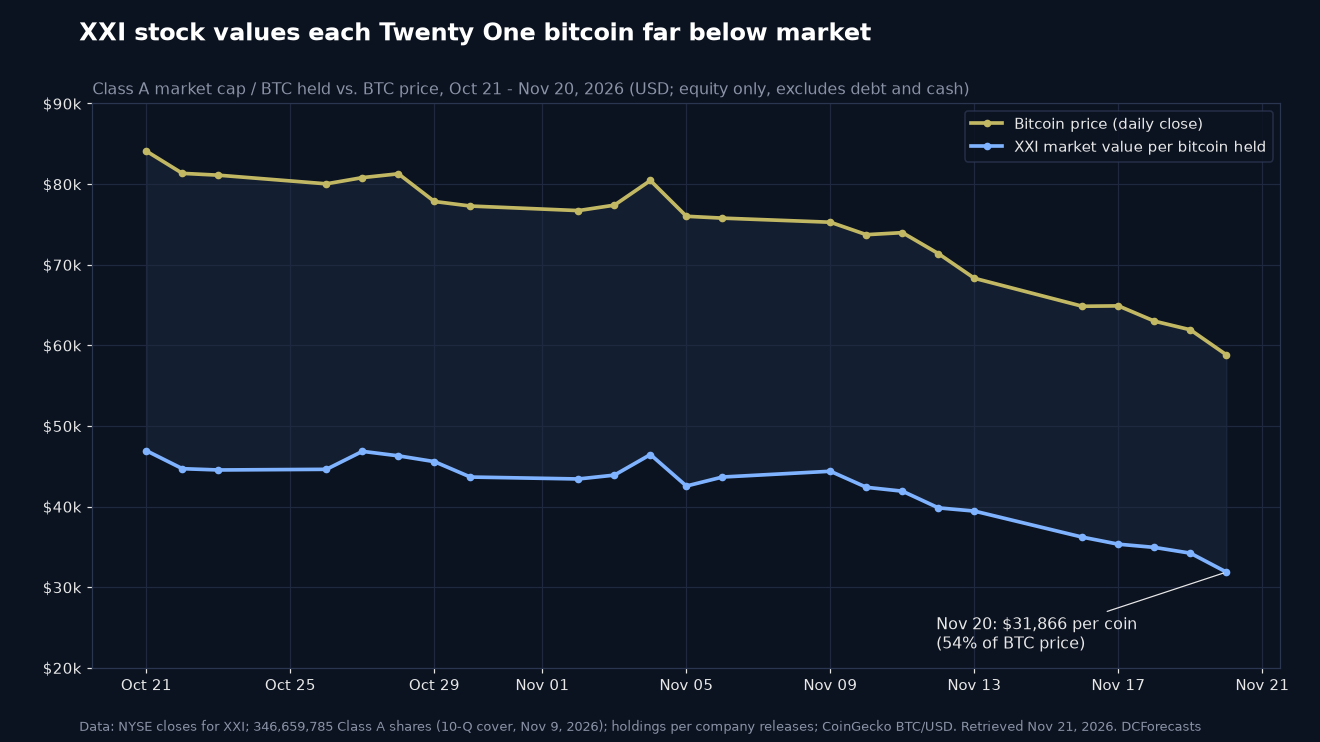
The discount is not new. Our calculation shows the ratio held between about 54% and 59% on every trading day of the past month, so the stock has largely moved in step with bitcoin rather than breaking away from it.
Bitcoin, Buybacks or Businesses?
A gap like this raises an obvious question for any treasury company: is it better to buy more bitcoin or to buy back stock that trades below its holdings?
Zagury has addressed that trade-off directly. In the Nov. 16 release, he said every dollar spent “whether on Bitcoin, acquisitions, or buybacks, is weighed against maintaining flexibility to run our business well.”
He also called bitcoin “our benchmark for every investment decision we make,” adding that any business the company acquires “has to beat simply buying more Bitcoin.”
We believe this week’s choice says a lot about how management sees the asset. Buying back shares would have raised bitcoin per share faster on paper, but it would not have added a single coin to the treasury.
Twenty One instead chose to grow the stack well below its own average cost. The 10-Q puts the cost basis of its earlier 43,514 coins at $3.69 billion, or about $84,865 each, so the two orders came in roughly 24% and 32% cheaper. We estimate the blended average after both buys at about $84,700 per coin.
The treasury also carries a commitment worth noting. About 16,116 BTC are pledged as collateral for the 1% convertible notes due 2030, and those coins are not available for general corporate purposes.
What We Are Watching at Twenty One Capital
The company has said it plans additional purchases, with size and timing set by “market conditions, available liquidity, and competing investment opportunities.”
For us, three signals matter most. First, whether purchases continue if bitcoin holds near $60,000. Second, how quickly the cash balance shrinks. Third, whether XXI’s discount to its holdings narrows as the market steadies.
Our earlier report on Twenty One’s first bitcoin buy of 2026 covered how long its holdings had sat unchanged before this month.
Two orders totaling $20 million will not move the bitcoin market on their own. What they show is a holder of nearly 44,000 coins choosing to add while bitcoin traded near its lowest levels in two years, using cash it already had.
Bitcoin’s fixed supply rewards that kind of patience over full cycles. If prices recover from here, the coins bought at $58,054 could prove to be among the best-timed in Twenty One’s treasury.
DC Forecasts is a leader in many crypto news categories, striving for the highest journalistic standards and abiding by a strict set of editorial policies. If you are interested to offer your expertise or contribute to our news website, feel free to contact us at [email protected]












Discussion about this post