



The kimchi premium is back: South Korean traders on Upbit paid as much as 3.64% more for Bitcoin than buyers on Coinbase during last week’s slide, the widest gap since January.
That reading came on Saturday, Nov. 14, when Upbit’s daily close of 88.86 million won worked out to about $66,450 at the European Central Bank’s reference rate. Coinbase closed the same day at $64,119.
The gap has not closed since. On our daily calculation, the premium has stayed above zero for 54 straight closes, from Sept. 28 through Nov. 20.
For Bitcoin investors, the interesting part is the timing. Korean buyers were paying up while the dollar price was falling.
The bigger question is whether that local appetite is an early sign of dip demand, or simply a market that cannot easily arbitrage itself.
How Wide Did the Kimchi Premium Get?
We compared Upbit’s KRW-BTC daily close with Coinbase’s BTC-USD close at the same 00:00 UTC cutoff, converting won into dollars with the ECB’s USD/KRW reference rate for each day.
On that basis, the premium hit 3.64% on Nov. 14. The last time it was higher was Jan. 31, 2026, at 3.66%.
It eased to 1.59% on Nov. 19, then widened again to 2.99% on Nov. 20 as Coinbase closed at $58,815.
By Saturday evening, Nov. 21, the gap was about 2.3%. Upbit traded at 82.44 million won at 21:12 Jerusalem time, against $60,170 on Coinbase.

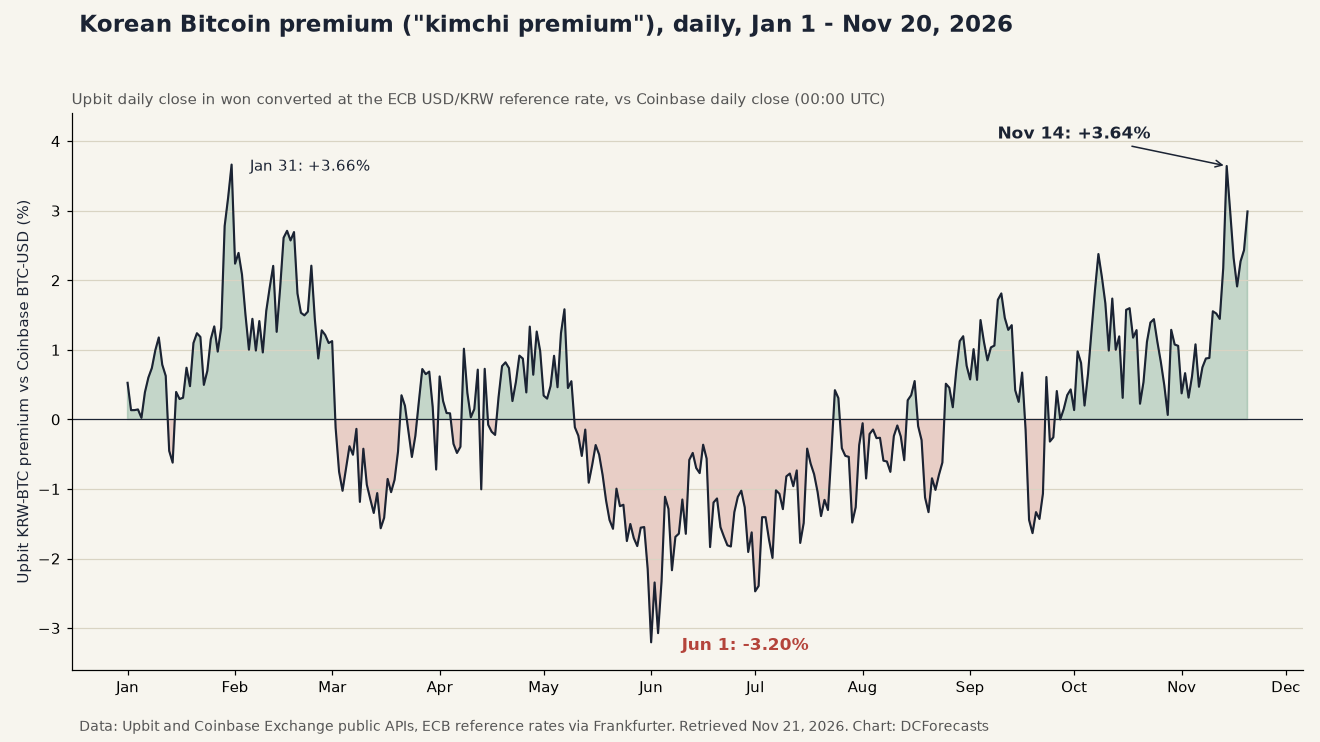
That recovery deserves attention. On June 1, the same measure showed a 3.20% discount, the deepest in our data going back to September 2024.
In other words, Korean buyers have moved from selling at a markdown to paying extra in under six months.
Why Korean Prices Can Drift From the Global Market
A premium like this should not survive for long in an open market. Traders would buy abroad, sell in Seoul and pocket the difference.
In practice, Korea’s foreign-exchange rules and real-name banking requirements make that loop slow and costly. So when local demand outpaces supply on won exchanges, the price can sit above the global level for weeks.
That is why the premium works as a rough gauge of retail sentiment in a closely watched retail crypto market.
A discount suggests locals are keener to sell than overseas traders. A premium suggests the opposite.
We believe that makes the November reading more useful than a single price print. It shows Korean traders were not dumping into the decline.
Upbit Volume Doubled as Bitcoin Fell
The premium did not widen on thin trading. Upbit’s KRW-BTC turnover jumped as the price dropped.
Converted at the ECB rate, the pair averaged about $64 million a day in October. From Nov. 12 to Nov. 20 it averaged about $125 million, roughly double.
Nov. 14, the day of the widest premium, was also the busiest session of the month at about $178 million. That was the heaviest day since Sept. 21.
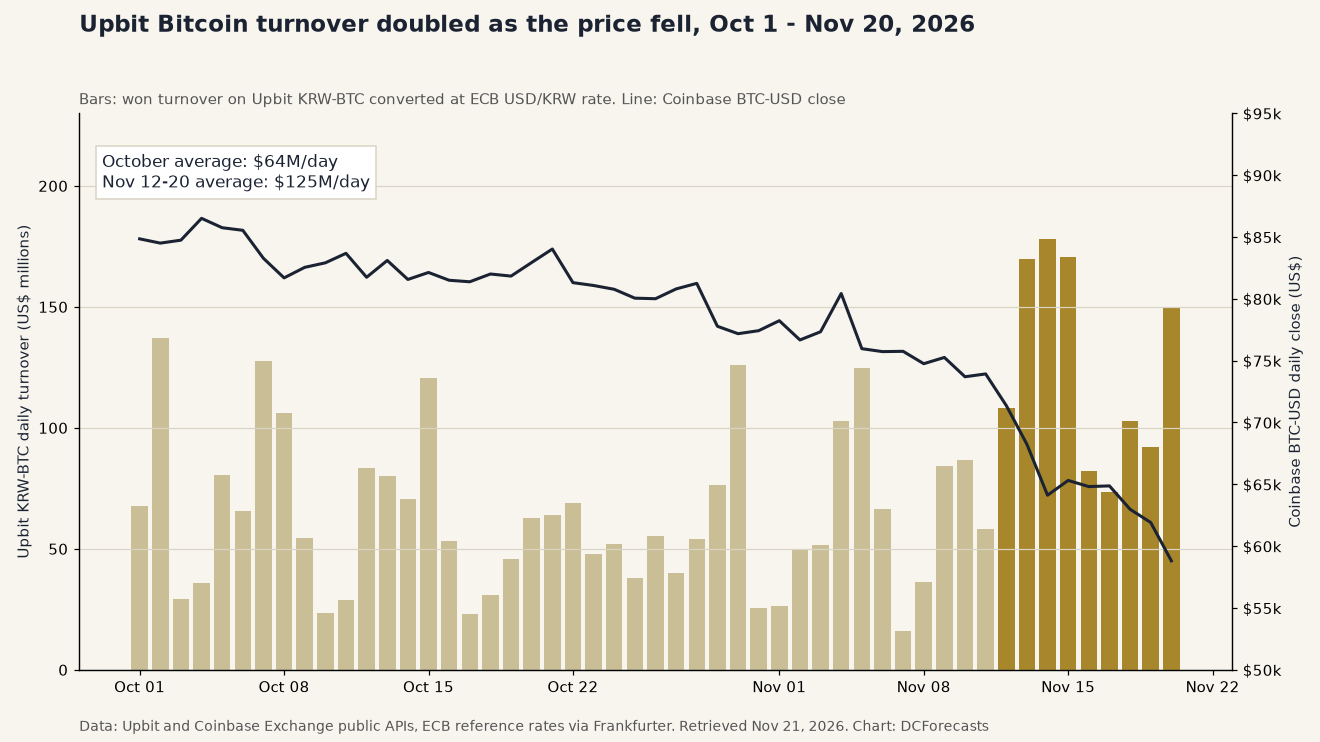
Meanwhile, Coinbase’s close fell from $73,698 on Nov. 10 to $58,815 on Nov. 20, a drop of about 20%.
Higher volume plus a higher premium during that stretch points to net buying pressure on the Korean side. We would not read it as panic.
That fits a pattern we flagged when we looked at how much Bitcoin Upbit customers added in 2026: Korean retail has been accumulating through a weaker year for trading revenue.
What the Korean Bitcoin Premium Does Not Tell Us
There are limits to this signal, and we want to be clear about them.
First, the premium is small next to past episodes. On Feb. 2, 2025, our same calculation showed 8.76%, more than double today’s level.
Second, it reflects one venue. Upbit’s roughly $125 million a day is meaningful, but it is still a small slice of global spot and futures volume.
Third, a weaker won can lift the premium mechanically. The ECB rate was steady, between about 1,328 and 1,339 won per dollar from Nov. 12 to Nov. 20, so currency moves do not explain this jump.
Finally, intraday gaps can be wider than daily closes suggest. On Saturday, Coinbase’s low was $55,106, while Upbit’s low of 76.43 million won equals about $57,063 at Friday’s ECB rate. Those lows may not have printed at the same minute.
Can Korean Dip Buying Help Bitcoin Steady Above $60,000?
Bitcoin is trying to hold the level it reclaimed this weekend. As we noted when the rebound took BTC back above $60,000, the speed of the recovery mattered.
A persistent Korean premium adds a second layer to that story. It shows a large retail base willing to pay above market while global prices were under pressure.
For us, the key indicators now are simple. We would watch whether the premium stays above 2%, whether Upbit turnover remains near the November pace, and whether US spot ETF flows stop bleeding.
If those three line up, the Korean bid could help turn a sharp drawdown into a base.
Bitcoin’s fixed supply does not change with sentiment in any one country. But when buyers in a major market keep paying extra during a 20% slide, it tells us that demand is waiting below, not disappearing.
The coming days will show whether the rest of the market follows Seoul’s lead.
DC Forecasts is a leader in many crypto news categories, striving for the highest journalistic standards and abiding by a strict set of editorial policies. If you are interested to offer your expertise or contribute to our news website, feel free to contact us at [email protected]











Discussion about this post